Two distinct numbers are selected at random from the set {1, 2, 3, . . ....
Two distinct numbers are selected at random from the set {1, 2,
3, . . . , 100}.
(a) What is the probability that the sum is even?
(b) What is the probability that the sum is a multiple of 10?
Homework Answers

Add Answer to:
Two distinct numbers are selected at random from the set {1, 2,
3, . . ....
A box contains 9 balls numbered from 3 to 11. If 4 random balls are selected...
A box contains 9 balls numbered from 3 to 11. If 4 random balls are selected (without replacement), what is the probability that the sum of the numbers is even? (explain please) Thanks for the help
#3 and 5 only 3. Prove that if six natural numbers are chosen at random, then...
 #3 and 5 only
3. Prove that if six natural numbers are chosen at random, then the sum or difference of two of them is divisible by 9. 4. Consider a square whose side-length is one unit. Select any five points from inside this square. Prove that at least two of these points are within 2 units of each other. 5. Prove that any set of seven distinct natural numbers contains a pair of numbers whose sum or difference is...
#3 and 5 only
3. Prove that if six natural numbers are chosen at random, then the sum or difference of two of them is divisible by 9. 4. Consider a square whose side-length is one unit. Select any five points from inside this square. Prove that at least two of these points are within 2 units of each other. 5. Prove that any set of seven distinct natural numbers contains a pair of numbers whose sum or difference is...
4.60 The sum of two uniform random numbers. Generate two random numbers between 0 and 1...
 4.60 The sum of two uniform random numbers. Generate two random numbers between 0 and 1 and take Y to be their sum. Then Y is a continuous random variable that can take any value between 0 and 2. The density curve of Y is the triangle shown in Figure 4.12. (a) Verify by geometry that the area under this curve is 1. (b) What is the probability that Y is less than 1? [Sketch the density curve, shade the...
Two independent random numbers between 0 and 1 are selected (say by a random number generator...
Two independent random numbers between 0 and 1 are selected (say by a random number generator on a calculator). What is the probability the first is no greater than 0.33 and the other is at least 0.57?
Two independent random numbers between 0 and 1 are selected (say by a random number generator...
Two independent random numbers between 0 and 1 are selected (say by a random number generator on a calculator). What is the probability the first is no greater than 0.33 and the other is at least 0.57?
3. A computer chooses 100 independent random numbers, each uniformly from the set of integers between...
 3. A computer chooses 100 independent random numbers, each uniformly from the set of integers between 1 and 200. What is the expected value of: (a) The number of the chosen numbers which are multiples of 10
Problem 1 (35 points): Two numbers are chosen at random and simultaneously from among the numbers...
 Problem 1 (35 points): Two numbers are chosen at random and simultaneously from among the numbers 1 to 4 without replacement. Let A,产(1,2,3,41, be the event that the first number is . 1. Find the probability of the event B that the second number chosen is 3. 2. What is the probability that the first number is 1 given that the second number is 3?
(Print distinct numbers) C++ Write a program that reads in 10 numbers and displays distinct numbers...
(Print distinct numbers) C++ Write a program that reads in 10 numbers and displays distinct numbers (i.e., if a number appears multiple times, it is displayed only once). The numbers are displayed in the order of their input and separated by exactly one space. (Hint: Read a number and store it to an array if it is new. If the number is already in the array, discard it. After the input, the array contains the distinct numbers.) Sample Run Enter...
Suppose that X is uniformly selected from the numbers 1, 2, 3 (that is, P(X =...
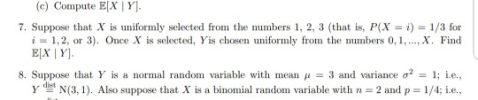 Suppose that X is uniformly selected from the numbers
1, 2, 3 (that is, P(X = i) = 1/3 for
i = 1, 2, or 3). Once X is selected, Y is chosen uniformly from the
numbers 0, 1, ..., X. Find
E[X | Y ].
(c) Compute EX Y 7. Suppose that X is uniformly selected from the numbers 1, 2, 3 (that is, P(X- i) 1/3 for ,X. Find i = 1,2, or 3). Once X is selected,...
Suppose that X is uniformly selected from the numbers
1, 2, 3 (that is, P(X = i) = 1/3 for
i = 1, 2, or 3). Once X is selected, Y is chosen uniformly from the
numbers 0, 1, ..., X. Find
E[X | Y ].
(c) Compute EX Y 7. Suppose that X is uniformly selected from the numbers 1, 2, 3 (that is, P(X- i) 1/3 for ,X. Find i = 1,2, or 3). Once X is selected,...
10. (6 pts) Slips of paper marked with numbers 1, 2, 3, 4, and 5 are...
10. (6 pts) Slips of paper marked with numbers 1, 2, 3, 4, and 5 are placed in a box. After being mixed, two slips are drawn simultaneously. a) Find the probability that both slips are marked with even numbers. b) Find the probability that one slip is marked with an odd number and the other is marked with an even number. c) Find the probability that the sum is 10.
 #3 and 5 only
3. Prove that if six natural numbers are chosen at random, then the sum or difference of two of them is divisible by 9. 4. Consider a square whose side-length is one unit. Select any five points from inside this square. Prove that at least two of these points are within 2 units of each other. 5. Prove that any set of seven distinct natural numbers contains a pair of numbers whose sum or difference is...
#3 and 5 only
3. Prove that if six natural numbers are chosen at random, then the sum or difference of two of them is divisible by 9. 4. Consider a square whose side-length is one unit. Select any five points from inside this square. Prove that at least two of these points are within 2 units of each other. 5. Prove that any set of seven distinct natural numbers contains a pair of numbers whose sum or difference is...
 4.60 The sum of two uniform random numbers. Generate two random numbers between 0 and 1 and take Y to be their sum. Then Y is a continuous random variable that can take any value between 0 and 2. The density curve of Y is the triangle shown in Figure 4.12. (a) Verify by geometry that the area under this curve is 1. (b) What is the probability that Y is less than 1? [Sketch the density curve, shade the...
 3. A computer chooses 100 independent random numbers, each uniformly from the set of integers between 1 and 200. What is the expected value of: (a) The number of the chosen numbers which are multiples of 10
 Problem 1 (35 points): Two numbers are chosen at random and simultaneously from among the numbers 1 to 4 without replacement. Let A,产(1,2,3,41, be the event that the first number is . 1. Find the probability of the event B that the second number chosen is 3. 2. What is the probability that the first number is 1 given that the second number is 3?
 Suppose that X is uniformly selected from the numbers
1, 2, 3 (that is, P(X = i) = 1/3 for
i = 1, 2, or 3). Once X is selected, Y is chosen uniformly from the
numbers 0, 1, ..., X. Find
E[X | Y ].
(c) Compute EX Y 7. Suppose that X is uniformly selected from the numbers 1, 2, 3 (that is, P(X- i) 1/3 for ,X. Find i = 1,2, or 3). Once X is selected,...
Suppose that X is uniformly selected from the numbers
1, 2, 3 (that is, P(X = i) = 1/3 for
i = 1, 2, or 3). Once X is selected, Y is chosen uniformly from the
numbers 0, 1, ..., X. Find
E[X | Y ].
(c) Compute EX Y 7. Suppose that X is uniformly selected from the numbers 1, 2, 3 (that is, P(X- i) 1/3 for ,X. Find i = 1,2, or 3). Once X is selected,...
Most questions answered within 3 hours.
-
Where is the error in this code sequence?
String s1 = "Hello";
String s2 = "ello";...
asked 10 months ago -
Financial data for Joel de Paris, Inc., for last year
follow:
Joel de Paris, Inc.
Balance...
asked 10 months ago -
Consider this reaction:
Al2(SO4)3 (aq)+ BaCl3
(aq) Al2Cl6 (aq)- +
3BaSO4(s) . What is the...
asked 10 months ago -
Suppose that Savneet is considering increasing her
recent random sample from 20 car rentals to 40...
asked 10 months ago -
Trucks arrive at an unloading terminal at an average rate of 120
per hour.
Trucks arrive...
asked 10 months ago -
Why are methanol and ethanol completely soluble in water while
octanol is not very little soluble....
asked 10 months ago -
A facilities manager at a university reads in a research report
that the mean amount of...
asked 10 months ago -
When the CuSO4 is rehydrated by adding water to the anhydrous
compound, is this an endothermic...
asked 10 months ago -
A ray of sunlight is passing from diamond into crown glass; the
angle of incidence is...
asked 10 months ago -
A block of mass 0.249 kg is placed on top of a light, vertical
spring of...
asked 10 months ago -
how do the kidneys compensate in the presences of acidosis
a) trigger hyperventilate
b) reserve acid...
asked 10 months ago -
Question 501 pts
The rental rate of capital to the firm increases. Which of the
following...
asked 10 months ago