when a star runs out of protons in its core, why does it becomes more luminous?...
when a star runs out of protons in its core, why does it becomes more luminous? why does the surface temperature of the star cool down?
Homework Answers
Dear Student,
When the hydrogen fuel of a star runs out,i.e. when stars run out of protons in its core, then fusion of hydrogen into helium stops, thus shutting off the outward radiation pressure. The helium core begins to contract due to gravitational attraction. This contraction results in the conversion of gravitational potential energy into thermal energy. Even though the fusion is not occuring, still the thermal heat generated heats up the shell of hydrogen surrounding the core until it is hot enough to start hydrogen fusion again, producing more energy than its previous state.
The new increased radiation causes the external layer of the star to expand in order to maintain the pressure gradient. As the gas expands it cools, this leads to drop in temperature in the outer layer. Convection transfers huge amount of heat from the core to the outer surface. This increases the luminosity of the star by a factor of 1000 or so. Thus, we observe that when a star runs out of proton, it becomes more luminous while its surface temperature cools down.
Thank you!
Please leave a thumbs up.
Add Answer to:
when a star runs out of protons in its core, why does
it becomes more luminous?...
C. i. As a star runs out of hydrogen to fuel nuclear fusion in its core,...
 C. i. As a star runs out of hydrogen to fuel nuclear fusion in its core, changes within the star usually cause it to leave the main sequence, expanding and cooling as it does so. Would a star with a radius 100 times that of the Sun, but a surface temperature 0.4 times that of the Sun, be more, or less luminous than the Sun? Show and explain your reasoning. You may assume the surface area of a sphere is...
Suppose that a 15 star finally runs out of nuclear fuel in its core and undergoes...
 Suppose that a 15
star finally runs out of nuclear fuel in its core and undergoes a
Type II supernova explosion. You are going to analyse the energy
budget, calculating all the quantities in Joules.
a) Estimate the amount of gravitational energy that would be
liberated by the collapse of the core (say) 1.4 M
to the size of neutron star.
b) How much of this energy would be required to disintegrate the
iron nuclei in the core?
c) How...
Suppose that a 15
star finally runs out of nuclear fuel in its core and undergoes a
Type II supernova explosion. You are going to analyse the energy
budget, calculating all the quantities in Joules.
a) Estimate the amount of gravitational energy that would be
liberated by the collapse of the core (say) 1.4 M
to the size of neutron star.
b) How much of this energy would be required to disintegrate the
iron nuclei in the core?
c) How...
Which of the following statements about red giant stars are true? (Select all that apply.) Red...
Which of the following statements about red giant stars are true? (Select all that apply.) Red giant stars are less luminous than main sequence stars of the same temperature. Red giant stars tend to be more luminous than main sequence stars of the same temperatures because they are larger in size. Red giant stars are less luminous than main sequence stars because fusion happens more rapidly in main sequence stars. A red giant star of a given temperature is more...
5. A star reaches 'breakup' when the centrifugal acceleration at its equator becomes equal to the...
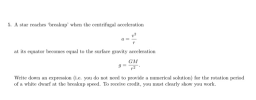 5. A star reaches 'breakup' when the centrifugal acceleration at its equator becomes equal to the surface gravity acceleration GM g= 12 Write down an expression (i.e. you do not need to provide a numerical solution) for the rotation period of a white dwarf at the breakup speed. To receive credit, you must clearly show you work.
Question 1) When does a protostar become a true star? Select one: a. when the star...
Question 1) When does a protostar become a true star? Select one: a. when the star is 1 million years old b. when the central temperature reaches 1 million Kelvin c. when nuclear fusion begins in the core d. when the thermal energy becomes trapped in the center Question 2: On average, what is the greatest mass a newborn star can have? Select one: a. 10 solar masses b. 50 solar masses c. 150 solar masses d. 300 solar masses...
5) A star (no matter what its mass) spends most of its life Select one: a....
5) A star (no matter what its mass) spends most of its life Select one: a. as a protostar. b. as a main-sequence star. c. as a planetary nebula. d. as a red giant or supergiant. 6) What is the ultimate fate of an isolated white dwarf? Select one: a. It will cool down and become a cold black dwarf. b. As gravity overwhelms the electron degeneracy pressure, it will explode as a nova. c. As gravity overwhelms the electron...
ity of the 20 Mo star Sirius predicted by the mass-luminosity equation (Unit 58). Its observed...
 ity of the 20 Mo star Sirius predicted by the mass-luminosity equation (Unit 58). Its observed luminosity is about 20 LO How can you explain the difference? The mass-luminosity relationship predicts that Sirius is about Sirius's higher luminosity is a result of its higher Sun's. Themassluninosit reSisis a times more luminous than the Sun. surface temperature and lrger surface area compared to the
choose A B C D QUESTION 1 Star formation in giant gas clouds is a result...
choose A B C D QUESTION 1 Star formation in giant gas clouds is a result of competition between which forces? Light and rotation Light and dark Rotation and gas pressure Gravity and gas pressure 10 points QUESTION 2 What effect sets the largest size a star can have? The forming star is shining so strongly that it blows the collapsing gas cloud apart. If the star was any larger it would instantly form a Black Hole. If the...
1.What process is pushing back against gravity in the very center (the core) of sun-like stars?...
1.What process is pushing back against gravity in the very center (the core) of sun-like stars? 2."... the length of time a star spends on the main sequence is determined almost entirely by its mass with the counterintuitive result that less massive stars live longer." What is the fundamental reason why massive stars live a much shorter time than the Sun, even though they might have 30 times as much mass – and thus more fuel – available? 3.The text...
When a furnace runs, it needs to get to temperature, hold at that # temperature, then...
When a furnace runs, it needs to get to temperature, hold at that # temperature, then cool down. # # Build a function that determines when a furnace will finish its run # given heating_rate (K/s), hold_time (s), hold_temp (K), and # cooling_rate (K/s). You can assume 300 K for your start and end # temperature. # # hold time / time # ________________ # / \ # heating / \ coolilng # / \ # / \ # #...
 C. i. As a star runs out of hydrogen to fuel nuclear fusion in its core, changes within the star usually cause it to leave the main sequence, expanding and cooling as it does so. Would a star with a radius 100 times that of the Sun, but a surface temperature 0.4 times that of the Sun, be more, or less luminous than the Sun? Show and explain your reasoning. You may assume the surface area of a sphere is...
 Suppose that a 15
star finally runs out of nuclear fuel in its core and undergoes a
Type II supernova explosion. You are going to analyse the energy
budget, calculating all the quantities in Joules.
a) Estimate the amount of gravitational energy that would be
liberated by the collapse of the core (say) 1.4 M
to the size of neutron star.
b) How much of this energy would be required to disintegrate the
iron nuclei in the core?
c) How...
Suppose that a 15
star finally runs out of nuclear fuel in its core and undergoes a
Type II supernova explosion. You are going to analyse the energy
budget, calculating all the quantities in Joules.
a) Estimate the amount of gravitational energy that would be
liberated by the collapse of the core (say) 1.4 M
to the size of neutron star.
b) How much of this energy would be required to disintegrate the
iron nuclei in the core?
c) How...
 5. A star reaches 'breakup' when the centrifugal acceleration at its equator becomes equal to the surface gravity acceleration GM g= 12 Write down an expression (i.e. you do not need to provide a numerical solution) for the rotation period of a white dwarf at the breakup speed. To receive credit, you must clearly show you work.
 ity of the 20 Mo star Sirius predicted by the mass-luminosity equation (Unit 58). Its observed luminosity is about 20 LO How can you explain the difference? The mass-luminosity relationship predicts that Sirius is about Sirius's higher luminosity is a result of its higher Sun's. Themassluninosit reSisis a times more luminous than the Sun. surface temperature and lrger surface area compared to the
Most questions answered within 3 hours.
-
Where is the error in this code sequence?
String s1 = "Hello";
String s2 = "ello";...
asked 11 months ago -
Financial data for Joel de Paris, Inc., for last year
follow:
Joel de Paris, Inc.
Balance...
asked 11 months ago -
Consider this reaction:
Al2(SO4)3 (aq)+ BaCl3
(aq) Al2Cl6 (aq)- +
3BaSO4(s) . What is the...
asked 11 months ago -
Suppose that Savneet is considering increasing her
recent random sample from 20 car rentals to 40...
asked 11 months ago -
Trucks arrive at an unloading terminal at an average rate of 120
per hour.
Trucks arrive...
asked 11 months ago -
Why are methanol and ethanol completely soluble in water while
octanol is not very little soluble....
asked 11 months ago -
A facilities manager at a university reads in a research report
that the mean amount of...
asked 11 months ago -
When the CuSO4 is rehydrated by adding water to the anhydrous
compound, is this an endothermic...
asked 11 months ago -
A ray of sunlight is passing from diamond into crown glass; the
angle of incidence is...
asked 11 months ago -
A block of mass 0.249 kg is placed on top of a light, vertical
spring of...
asked 11 months ago -
how do the kidneys compensate in the presences of acidosis
a) trigger hyperventilate
b) reserve acid...
asked 11 months ago -
Question 501 pts
The rental rate of capital to the firm increases. Which of the
following...
asked 11 months ago