1) You are working to design an inhibitor of a viral enzyme that is key for...
1) You are working to design an inhibitor of a viral enzyme that is key for the viral genome replication, as a potential antiviral drug. The laboratory characterization of the enzyme renders the following MM kinetic parameters: KM=0.5 mM, and kcat=105 s-1. The concentration of this enzyme inside infected cells is about 10-5 And, you know that to be effective in stopping infection the inhibitor needs to decrease the catalytic efficiency of this enzyme by 100 fold.
(a) what would be the best type of inhibition to achieve this result using a single inhibitor (rationalize the answer)?
(b) if the inhibitor has a KI=KI’=1 microM, what concentration of inhibitor will you need to achieve this result?
Homework Answers
a) In this mixed inhibition will be achieved by using a single inhibitor. It is a type of inhibition of enzyme in which the inhibitor will bind to the enzyme whether or not enzyme has already bound to the substrate has a greater affinity for one state or other.As it can be seen as a mixture of both competitive and uncompetitive inhibition in which the inhibitor can only bind the enzyme if substrate has not already bound and in which inhibitor can only bind the enzyme if substrate has already bound called uncompetitive. In this, the inhibitor binds to the allosteric site that is different than active site where substrate binds. It can result in two type: i) decrease in apparant affinity of enzyme for the substrate, it closely mimics competitive binding (Kappm> Km) and ii) increase in apparant affinity of enzyme for substrate that closely mimics uncompetitive binding (Kappm < Km).
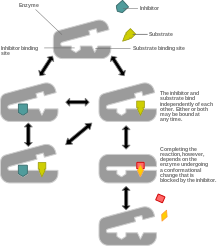
b) If the Inhibitors has KI=KI'=1 microM, non-competitive inhibition occurs. In this enzyme inhibition where inhibitor reduces activity of enzyme and binds equally to the enzyme whether or not it has already bound the substrate. It can occur when equal amount of inhibitors and substrate are at equal amount.
Add Answer to:
1) You are working to design an inhibitor of a viral enzyme that
is key for...
You have an inhibitor for an enzyme that you are studying. The concentration of inhibitor used is...
You have an inhibitor for an enzyme that you are studying. The concentration of inhibitor used is 5.50 µM. The following data was collected for the non-inhibited reaction as well as the reaction that was inhibited. mmol/(mL min) mmol/(mL min) mM Substrate Vo Substrate Vo + Inhibitor 0.200 5.000 3.751 0.400 7.500 4.998 0.800 10.000 5.995 1.000 10.700 6.173 2.000 12.500 6.807 4.000 13.600 7.143 a. Plot this data using Excel or a graphing program. Make sure you give your graph has a...
You are still interested in the enzyme happyase, which catalyzes the following reaction: HAPPY = SAD...
 You are still interested in the enzyme happyase, which catalyzes the following reaction: HAPPY = SAD Previously, you determined that kcat = 400 s and Km = 10 M for your sample of happyase. Further research shows that this happyase sample was actually contaminated with a reversible inhibitor called ANGER. When ANGER is fully removed from the happyase preparation and [Eltotalis 4 nM, the measured Vmax is increased to 4.8 umes-1 and the measured Km is now 15 MM. Use...
thank you!! Question 1 0.5 pts It has been shown that inhibition of a key chromatin...
 thank you!!
Question 1 0.5 pts It has been shown that inhibition of a key chromatin remodeling complex known as NURD. by deleting one of its subunits, can result in a significant increase in the efficiency of reprogramming of somatic cells into pluripotent stem cells. The reprogramming is normally done by the induced expression of a battery of transcription factors in the somatic cells, but is typically not very efficient. Such an observation suggests that the NURD complex is normally...
thank you!!
Question 1 0.5 pts It has been shown that inhibition of a key chromatin remodeling complex known as NURD. by deleting one of its subunits, can result in a significant increase in the efficiency of reprogramming of somatic cells into pluripotent stem cells. The reprogramming is normally done by the induced expression of a battery of transcription factors in the somatic cells, but is typically not very efficient. Such an observation suggests that the NURD complex is normally...
LeyUUL CICILILED W H ILI AaBbccde ABBCODE AaBbCcDc AaBbccode Aa Heading 2 No Spacing Heading 1...
 LeyUUL CICILILED W H ILI AaBbccde ABBCODE AaBbCcDc AaBbccode Aa Heading 2 No Spacing Heading 1 AAAA * ADA IAD 1) Common drugs originate from A) Natural products B) laboratory synthesis Chemical derivatives D) all of the above 2) A medicine is a drug that A) Provides a euphoric effect B) Is isolated from a plant C) Kills bacteria D) Has therapeutic properties 3) Which of the following would be an example of a synergistic effect? A) Aspirin reduces fever...
1. You are studying phage transduction and trying to deliver a kanamycin resistance gene from one...
 1. You are studying phage transduction and trying to deliver a kanamycin resistance gene from one strain of bacteria to another using phage. The kanR gene is FAR away from the lambda prophage in your bacterium. Choose which type of transduction should you use for your experiment and explain why. a. lambda phage, specialized transduction b. lambda phage, conjugation C. T4 phage, generalized transduction d. A different phage with mitomycin C induction 2. A pig is infected with two subtypes...
 You are still interested in the enzyme happyase, which catalyzes the following reaction: HAPPY = SAD Previously, you determined that kcat = 400 s and Km = 10 M for your sample of happyase. Further research shows that this happyase sample was actually contaminated with a reversible inhibitor called ANGER. When ANGER is fully removed from the happyase preparation and [Eltotalis 4 nM, the measured Vmax is increased to 4.8 umes-1 and the measured Km is now 15 MM. Use...
 thank you!!
Question 1 0.5 pts It has been shown that inhibition of a key chromatin remodeling complex known as NURD. by deleting one of its subunits, can result in a significant increase in the efficiency of reprogramming of somatic cells into pluripotent stem cells. The reprogramming is normally done by the induced expression of a battery of transcription factors in the somatic cells, but is typically not very efficient. Such an observation suggests that the NURD complex is normally...
thank you!!
Question 1 0.5 pts It has been shown that inhibition of a key chromatin remodeling complex known as NURD. by deleting one of its subunits, can result in a significant increase in the efficiency of reprogramming of somatic cells into pluripotent stem cells. The reprogramming is normally done by the induced expression of a battery of transcription factors in the somatic cells, but is typically not very efficient. Such an observation suggests that the NURD complex is normally...
 LeyUUL CICILILED W H ILI AaBbccde ABBCODE AaBbCcDc AaBbccode Aa Heading 2 No Spacing Heading 1 AAAA * ADA IAD 1) Common drugs originate from A) Natural products B) laboratory synthesis Chemical derivatives D) all of the above 2) A medicine is a drug that A) Provides a euphoric effect B) Is isolated from a plant C) Kills bacteria D) Has therapeutic properties 3) Which of the following would be an example of a synergistic effect? A) Aspirin reduces fever...
 1. You are studying phage transduction and trying to deliver a kanamycin resistance gene from one strain of bacteria to another using phage. The kanR gene is FAR away from the lambda prophage in your bacterium. Choose which type of transduction should you use for your experiment and explain why. a. lambda phage, specialized transduction b. lambda phage, conjugation C. T4 phage, generalized transduction d. A different phage with mitomycin C induction 2. A pig is infected with two subtypes...
Most questions answered within 3 hours.
-
Where is the error in this code sequence?
String s1 = "Hello";
String s2 = "ello";...
asked 11 months ago -
Financial data for Joel de Paris, Inc., for last year
follow:
Joel de Paris, Inc.
Balance...
asked 11 months ago -
Consider this reaction:
Al2(SO4)3 (aq)+ BaCl3
(aq) Al2Cl6 (aq)- +
3BaSO4(s) . What is the...
asked 11 months ago -
Suppose that Savneet is considering increasing her
recent random sample from 20 car rentals to 40...
asked 11 months ago -
Trucks arrive at an unloading terminal at an average rate of 120
per hour.
Trucks arrive...
asked 11 months ago -
Why are methanol and ethanol completely soluble in water while
octanol is not very little soluble....
asked 11 months ago -
A facilities manager at a university reads in a research report
that the mean amount of...
asked 11 months ago -
When the CuSO4 is rehydrated by adding water to the anhydrous
compound, is this an endothermic...
asked 11 months ago -
A ray of sunlight is passing from diamond into crown glass; the
angle of incidence is...
asked 11 months ago -
A block of mass 0.249 kg is placed on top of a light, vertical
spring of...
asked 11 months ago -
how do the kidneys compensate in the presences of acidosis
a) trigger hyperventilate
b) reserve acid...
asked 11 months ago -
Question 501 pts
The rental rate of capital to the firm increases. Which of the
following...
asked 11 months ago