In an experiment involving diffusion and osmosis, you are given dialysis tubing, beakers of pure water,...
|
In an experiment involving diffusion and osmosis, you are given dialysis tubing, beakers of pure water, and 2 solutions: dissolved starch, and diluted iodine. You are told that when starch and iodine come into contact with each other, the starch turns a deep blue-black. Your problem is to find out whether the dialysis tubing is permeable to (lets molecules through) either iodine and/or starch. How could you find out? (Choose the only one of the following possibilities that is accurate.) |
|||||||||||||
|
|||||||||||||
Homework Answers


Add Answer to:
In an experiment involving diffusion and osmosis, you are given
dialysis tubing, beakers of pure water,...
6. Dialysis bags containing a 0.5% sucrose solution are placed in beakers containing the sucrose solutions...
 6. Dialysis bags containing a 0.5% sucrose solution are placed in beakers containing the sucrose solutions indicated below. Dialysis bags are NOT permeable to sucrose. -0.5% -0.5% sucrose 0.5% sucrose sucrose -Pure water -0.5% sucrose 1.5% sucrose Chades MN, LLC Indicate the letter of the beaker (A, B, or C) in which the following events or situations occur. a. The dialysis bag remains the same size. b. The dialysis bag shrinks. C. Water moves from the beaker into the dialysis...
Experiment 2: Diffusion Concentration Gradients and Membrane Permeability Data Tables Table 2: Indicator Reagent Data Indicator...
 Experiment 2: Diffusion Concentration Gradients and Membrane
Permeability
Data Tables
Table 2: Indicator Reagent Data
Indicator
Starch Positive
Starch Negative
Glucose Positive
Glucose Negative
Glucose Test Strip
n/a
n/a
green
yellow
IKI Solution
dark blue
light brown
n/a
n/a
Table 3: Diffusion of Starch and Glucose Over
Time
Indicator
Dialysis Bag After 60 Minutes
Beaker Water After 60 Minutes
Glucose Test Strip
yellow
green ( if all glucose passed to the beaker from the bag)
IKI
from incolore changed to...
Experiment 2: Diffusion Concentration Gradients and Membrane
Permeability
Data Tables
Table 2: Indicator Reagent Data
Indicator
Starch Positive
Starch Negative
Glucose Positive
Glucose Negative
Glucose Test Strip
n/a
n/a
green
yellow
IKI Solution
dark blue
light brown
n/a
n/a
Table 3: Diffusion of Starch and Glucose Over
Time
Indicator
Dialysis Bag After 60 Minutes
Beaker Water After 60 Minutes
Glucose Test Strip
yellow
green ( if all glucose passed to the beaker from the bag)
IKI
from incolore changed to...
permeable to the dialysis "membrane." e olute for today's lab is sucrose, which is not Osmosis...
 permeable to the dialysis "membrane." e olute for today's lab is sucrose, which is not Osmosis Procedure 1. Fill four beakers with the following Beaker A: 200 ml of water Beaker B: 200 ml of water Beaker C: 200 ml of 30% sucrose solution Beaker D: 200 ml of water 2. Fill four dialysis bags with the following: Bag A: 10 ml of water Bag B: 10 ml of 30% sucrose Bag C: 10 ml of water Bag D: 10...
1) Imagine that a simulated cell is made using dialysis tubing as the membrane and water...
1) Imagine that a simulated cell is made using dialysis tubing as the membrane and water mixed with glucose, salt, and protein as the cytosol. Imagine that this 16 gram cell is placed in a beaker of distilled water for 1 hour. After 1 hour the cell has gained 3 grams of weight. The beaker solution tests positive for glucose and salt, but tests negative for protein. Which of the following CANNOT be correctly concluded? a. Glucose and salt diffused...
POST-LAB QUESTIONS / HOMEWORK 1. A student performed the following osmosis experiment, similar to the one...
 POST-LAB QUESTIONS / HOMEWORK 1. A student performed the following osmosis experiment, similar to the one you did, using a different combination of substances. Determine his/her results and explain them by answering the questions in the table by filling in the blank boxes. Assume that the dialysis bag is impermeable to sucrose. Set-up 1 Set-up 2 Set-up 3 Set-up 4 Set-up 5 Bags 15 mL in each Tap water Tap water 55% sucrose 21% sucrose solution solution Tap water Beakers...
Question 10 2 pts If you fill up a cellulose bag with a solution of sucrose...
 Question 10 2 pts If you fill up a cellulose bag with a solution of sucrose and table salt; then immerse the cellulose bag into a beaker filled with iodine diluted in water. After 1 hour, you observe the following: the solution in the beaker has become black; the solution inside the cellulose bag is also black. What is your conclusion? lodine turned black because of the presence of proteins Starch leaked out of the bag and iodine diffused into...
CRITICAL THINKING QUESTIONS 1. A pre-weighed dialysis bag which contained a solution of 10% glucose was...
 CRITICAL THINKING QUESTIONS 1. A pre-weighed dialysis bag which contained a solution of 10% glucose was placed in a beaker containing a solution of 20% glucose. After one hour, the bag was weighed again a. Calculate the % mass change of this dialysis bag from the following information: • Mass of bag before experiment: 15.39 • Mass of bag after experiment: 12.79 b. Determine the tonicity of the beaker when it is compared to the dialysis bag: 2. facell had...
Question Completion Status: The beaker to the right shows the bag after one hour immersed in...
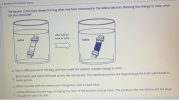 Question Completion Status: The beaker to the right shows the bag after one hour immersed in the iodine solution. Noticing the change in color, what can you conclude? After half an hour or more lodine lodine Starch diffused out of the bag, and that made the solution outside change in color. Both iodine and starch diffused across the membrane. The membrane pores are large enough for both substances to move across Water reacted with the iodine and changed its color...
for this experiment of syntheis of aspirin, was the product obtained pure (based on color)? how...
 for this experiment of syntheis of aspirin, was the product
obtained pure (based on color)? how do you know? the color was
white
Experimental Procedure HAZARD: Sulfuric acid, acetic anhydride and glacial acetic acid are corrosive to the skin. They are also irritants, and all operations in which these substances are used should be carried out under the hood. Prepare a hot-water bath by heating a 400-ml beaker containing about 200 mL of water. 1. Use a centigram balance and...
for this experiment of syntheis of aspirin, was the product
obtained pure (based on color)? how do you know? the color was
white
Experimental Procedure HAZARD: Sulfuric acid, acetic anhydride and glacial acetic acid are corrosive to the skin. They are also irritants, and all operations in which these substances are used should be carried out under the hood. Prepare a hot-water bath by heating a 400-ml beaker containing about 200 mL of water. 1. Use a centigram balance and...
Lab 2A: Introduction In this lab, you will be studying osmosis across the membrane of potato...
 Lab 2A:
Introduction
In this lab, you will be studying osmosis across the membrane of
potato cells. You will create equal-sized pieces of potato and then
place the pieces in solutions with differing concentrations. You
will then, over time, measure any changes that take place in the
size and weight of the potato pieces.
To measure changes in size, you will need either a gram scale
(like a food scale) or a millimetre ruler. It is best if you have...
Lab 2A:
Introduction
In this lab, you will be studying osmosis across the membrane of
potato cells. You will create equal-sized pieces of potato and then
place the pieces in solutions with differing concentrations. You
will then, over time, measure any changes that take place in the
size and weight of the potato pieces.
To measure changes in size, you will need either a gram scale
(like a food scale) or a millimetre ruler. It is best if you have...
 6. Dialysis bags containing a 0.5% sucrose solution are placed in beakers containing the sucrose solutions indicated below. Dialysis bags are NOT permeable to sucrose. -0.5% -0.5% sucrose 0.5% sucrose sucrose -Pure water -0.5% sucrose 1.5% sucrose Chades MN, LLC Indicate the letter of the beaker (A, B, or C) in which the following events or situations occur. a. The dialysis bag remains the same size. b. The dialysis bag shrinks. C. Water moves from the beaker into the dialysis...
 Experiment 2: Diffusion Concentration Gradients and Membrane
Permeability
Data Tables
Table 2: Indicator Reagent Data
Indicator
Starch Positive
Starch Negative
Glucose Positive
Glucose Negative
Glucose Test Strip
n/a
n/a
green
yellow
IKI Solution
dark blue
light brown
n/a
n/a
Table 3: Diffusion of Starch and Glucose Over
Time
Indicator
Dialysis Bag After 60 Minutes
Beaker Water After 60 Minutes
Glucose Test Strip
yellow
green ( if all glucose passed to the beaker from the bag)
IKI
from incolore changed to...
Experiment 2: Diffusion Concentration Gradients and Membrane
Permeability
Data Tables
Table 2: Indicator Reagent Data
Indicator
Starch Positive
Starch Negative
Glucose Positive
Glucose Negative
Glucose Test Strip
n/a
n/a
green
yellow
IKI Solution
dark blue
light brown
n/a
n/a
Table 3: Diffusion of Starch and Glucose Over
Time
Indicator
Dialysis Bag After 60 Minutes
Beaker Water After 60 Minutes
Glucose Test Strip
yellow
green ( if all glucose passed to the beaker from the bag)
IKI
from incolore changed to...
 permeable to the dialysis "membrane." e olute for today's lab is sucrose, which is not Osmosis Procedure 1. Fill four beakers with the following Beaker A: 200 ml of water Beaker B: 200 ml of water Beaker C: 200 ml of 30% sucrose solution Beaker D: 200 ml of water 2. Fill four dialysis bags with the following: Bag A: 10 ml of water Bag B: 10 ml of 30% sucrose Bag C: 10 ml of water Bag D: 10...
 POST-LAB QUESTIONS / HOMEWORK 1. A student performed the following osmosis experiment, similar to the one you did, using a different combination of substances. Determine his/her results and explain them by answering the questions in the table by filling in the blank boxes. Assume that the dialysis bag is impermeable to sucrose. Set-up 1 Set-up 2 Set-up 3 Set-up 4 Set-up 5 Bags 15 mL in each Tap water Tap water 55% sucrose 21% sucrose solution solution Tap water Beakers...
 Question 10 2 pts If you fill up a cellulose bag with a solution of sucrose and table salt; then immerse the cellulose bag into a beaker filled with iodine diluted in water. After 1 hour, you observe the following: the solution in the beaker has become black; the solution inside the cellulose bag is also black. What is your conclusion? lodine turned black because of the presence of proteins Starch leaked out of the bag and iodine diffused into...
 CRITICAL THINKING QUESTIONS 1. A pre-weighed dialysis bag which contained a solution of 10% glucose was placed in a beaker containing a solution of 20% glucose. After one hour, the bag was weighed again a. Calculate the % mass change of this dialysis bag from the following information: • Mass of bag before experiment: 15.39 • Mass of bag after experiment: 12.79 b. Determine the tonicity of the beaker when it is compared to the dialysis bag: 2. facell had...
 Question Completion Status: The beaker to the right shows the bag after one hour immersed in the iodine solution. Noticing the change in color, what can you conclude? After half an hour or more lodine lodine Starch diffused out of the bag, and that made the solution outside change in color. Both iodine and starch diffused across the membrane. The membrane pores are large enough for both substances to move across Water reacted with the iodine and changed its color...
 for this experiment of syntheis of aspirin, was the product
obtained pure (based on color)? how do you know? the color was
white
Experimental Procedure HAZARD: Sulfuric acid, acetic anhydride and glacial acetic acid are corrosive to the skin. They are also irritants, and all operations in which these substances are used should be carried out under the hood. Prepare a hot-water bath by heating a 400-ml beaker containing about 200 mL of water. 1. Use a centigram balance and...
for this experiment of syntheis of aspirin, was the product
obtained pure (based on color)? how do you know? the color was
white
Experimental Procedure HAZARD: Sulfuric acid, acetic anhydride and glacial acetic acid are corrosive to the skin. They are also irritants, and all operations in which these substances are used should be carried out under the hood. Prepare a hot-water bath by heating a 400-ml beaker containing about 200 mL of water. 1. Use a centigram balance and...
 Lab 2A:
Introduction
In this lab, you will be studying osmosis across the membrane of
potato cells. You will create equal-sized pieces of potato and then
place the pieces in solutions with differing concentrations. You
will then, over time, measure any changes that take place in the
size and weight of the potato pieces.
To measure changes in size, you will need either a gram scale
(like a food scale) or a millimetre ruler. It is best if you have...
Lab 2A:
Introduction
In this lab, you will be studying osmosis across the membrane of
potato cells. You will create equal-sized pieces of potato and then
place the pieces in solutions with differing concentrations. You
will then, over time, measure any changes that take place in the
size and weight of the potato pieces.
To measure changes in size, you will need either a gram scale
(like a food scale) or a millimetre ruler. It is best if you have...
Most questions answered within 3 hours.
-
Where is the error in this code sequence?
String s1 = "Hello";
String s2 = "ello";...
asked 10 months ago -
Financial data for Joel de Paris, Inc., for last year
follow:
Joel de Paris, Inc.
Balance...
asked 10 months ago -
Consider this reaction:
Al2(SO4)3 (aq)+ BaCl3
(aq) Al2Cl6 (aq)- +
3BaSO4(s) . What is the...
asked 10 months ago -
Suppose that Savneet is considering increasing her
recent random sample from 20 car rentals to 40...
asked 10 months ago -
Trucks arrive at an unloading terminal at an average rate of 120
per hour.
Trucks arrive...
asked 10 months ago -
Why are methanol and ethanol completely soluble in water while
octanol is not very little soluble....
asked 10 months ago -
A facilities manager at a university reads in a research report
that the mean amount of...
asked 10 months ago -
When the CuSO4 is rehydrated by adding water to the anhydrous
compound, is this an endothermic...
asked 10 months ago -
A ray of sunlight is passing from diamond into crown glass; the
angle of incidence is...
asked 10 months ago -
A block of mass 0.249 kg is placed on top of a light, vertical
spring of...
asked 10 months ago -
how do the kidneys compensate in the presences of acidosis
a) trigger hyperventilate
b) reserve acid...
asked 10 months ago -
Question 501 pts
The rental rate of capital to the firm increases. Which of the
following...
asked 10 months ago