can you help me understand how to get the answer and why it works that way....
can you help me understand how to get the answer and why it works that way. A block of mass 5 kg is on a table, with coefficients of friction of μs=0.50 and μk=0.46. A horizontal force, slowly increasing from zero, is applied until the block is put in motion and then kept constant. What is the acceleration of the block once it starts to move?____m/s2
Homework Answers

Add Answer to:
can you help me understand how to get the answer and why it
works that way....
To understand kinetic and static friction. A block of mass m lies on a horizontal table....
To understand kinetic and static friction. A block of mass m lies on a horizontal table. The coefficient of static friction between the block and the table is μs. The coefficient of kinetic friction isμk, with μk<μs. Part B Suppose you want to move the block, but you want to push it with the least force possible to get it moving. With what force F must you be pushing the block just before the block begins to move? Part C...
To understand kinetic and static friction. A block of mass m lies on a horizontal table. The coefficient of static fric...
To understand kinetic and static friction. A block of mass m lies on a horizontal table. The coefficient of static friction between the block and the table is μs. The coefficient of kinetic friction is μk, with μk<μs. a- Suppose you want to move the block, but you want to push it with the least force possible to get it moving. With what force F must you be pushing the block just before the block begins to move? Express the...
A contestant in a winter sporting event pulls a 42 kg block of ice in the positive horizontal direction
 A contestant in a winter sporting event pulls a 42 kg block of ice in the positive horizontal direction with a rope over his shoulders across a frozen lake as shown in the figure. Assume the coefficients of static and kinetic friction are μs=0.1 and μk=0.03. Part (a) Calculate the minimum force F he must exert to get the block sliding in newtons. Part (b) What is its acceleration in m/s2 once it starts to move, if that force is maintained?
Given: a mass (50) kg is on the edge of a rough horizontal turntable with radius...
 Given: a mass (50) kg is on the edge of a rough horizontal
turntable with radius R = 2.00 m Friction coefficients between the
mass and the table are μs = 0.50 and μk = 0.40. The table starts to
rotate (rotate) around the vertical axis of symmetry with a
constant angular acceleration α = 0.60 rad / s2.
It has been asked to calculate the time at which the mass just
will not shift. Can you help me further?
Given: a mass (50) kg is on the edge of a rough horizontal
turntable with radius R = 2.00 m Friction coefficients between the
mass and the table are μs = 0.50 and μk = 0.40. The table starts to
rotate (rotate) around the vertical axis of symmetry with a
constant angular acceleration α = 0.60 rad / s2.
It has been asked to calculate the time at which the mass just
will not shift. Can you help me further?
Given: a mass (50) kg is on the edge of a rough horizontal turntable with radius...
 Given: a mass (50) kg is on the edge of a rough horizontal turntable with radius R = 2.00 m
Friction coefficients between the mass and the table are μs = 0.50 and μk = 0.40.
The table starts to rotate (rotate) around the vertical axis of symmetry with a constant angular acceleration α = 0.60 rad / s2.
It has been requested to calculate the work of the frictional force from the start to the time t* (the point...
Given: a mass (50) kg is on the edge of a rough horizontal turntable with radius R = 2.00 m
Friction coefficients between the mass and the table are μs = 0.50 and μk = 0.40.
The table starts to rotate (rotate) around the vertical axis of symmetry with a constant angular acceleration α = 0.60 rad / s2.
It has been requested to calculate the work of the frictional force from the start to the time t* (the point...
Given: a mass (50) kg is on the edge of a rough horizontal turntable with radius...
 Given:
a mass (50) kg is on the edge of a rough horizontal turntable
with radius R = 2.00 m
Friction coefficients between the mass and the table are μs =
0.50 and μk = 0.40.
The table starts to rotate (rotate) around the vertical axis of
symmetry with a constant angular acceleration α = 0.60 rad /
s2.
It has been asked to calculate the speed v* on which the mass
just will not shift. We must use a...
Given:
a mass (50) kg is on the edge of a rough horizontal turntable
with radius R = 2.00 m
Friction coefficients between the mass and the table are μs =
0.50 and μk = 0.40.
The table starts to rotate (rotate) around the vertical axis of
symmetry with a constant angular acceleration α = 0.60 rad /
s2.
It has been asked to calculate the speed v* on which the mass
just will not shift. We must use a...
Given: a mass (50) kg is on the edge of a rough horizontal turntable with radius...
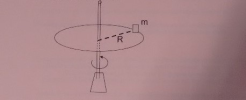 Given:
a mass (50) kg is on the edge of a rough horizontal turntable
with radius R = 2.00 m Friction coefficients between the mass and
the table are μs = 0.50 and μk = 0.40. The table starts to rotate
(rotate) around the vertical axis of symmetry with a constant
angular acceleration α = 0.60 rad / s2. It has been
asked to calculate the specific time t* at which the mass just will
not shift. We must use...
Given:
a mass (50) kg is on the edge of a rough horizontal turntable
with radius R = 2.00 m Friction coefficients between the mass and
the table are μs = 0.50 and μk = 0.40. The table starts to rotate
(rotate) around the vertical axis of symmetry with a constant
angular acceleration α = 0.60 rad / s2. It has been
asked to calculate the specific time t* at which the mass just will
not shift. We must use...
Given: a mass (50) kg is on the edge of a rough horizontal turntable with radius...
 Given:
a mass (50) kg is on the edge of a rough horizontal turntable with radius R = 2.00 m
Friction coefficients between the mass and the table are μs = 0.50 and μk = 0.40.
The table starts to rotate (rotate) around the vertical axis of symmetry with a constant angular acceleration α = 0.60 rad / s2.
It has been requested to calculate the labour that has delivered the frictional force from the start to the time t*...
Given:
a mass (50) kg is on the edge of a rough horizontal turntable with radius R = 2.00 m
Friction coefficients between the mass and the table are μs = 0.50 and μk = 0.40.
The table starts to rotate (rotate) around the vertical axis of symmetry with a constant angular acceleration α = 0.60 rad / s2.
It has been requested to calculate the labour that has delivered the frictional force from the start to the time t*...
Given: a mass (50) kg is on the edge of a rough horizontal turntable with radius...
 Given:
a mass (50) kg is on the edge of a rough horizontal turntable with radius R = 2.00 m
Friction coefficients between the mass and the table are μs = 0.50 and μk = 0.40.
The table starts to rotate (rotate) around the vertical axis of symmetry with a constant angular acceleration α = 0.60 rad / s2.
It has been requested to determine the distance (measured according to the track) that the mass has covered at the time...
Given:
a mass (50) kg is on the edge of a rough horizontal turntable with radius R = 2.00 m
Friction coefficients between the mass and the table are μs = 0.50 and μk = 0.40.
The table starts to rotate (rotate) around the vertical axis of symmetry with a constant angular acceleration α = 0.60 rad / s2.
It has been requested to determine the distance (measured according to the track) that the mass has covered at the time...
A 10.0 kg block is resting on a horizontal surface when a force P is applied...
 A 10.0 kg block is resting on a horizontal surface when a force
P is applied to it for 7.00 seconds. The variation of P with time
is shown in the figure where P is in Newtons and t is in seconds.
If the coefficients of static and kinetic friction between the
block and the surface are μs = 0.600 and μk = 0.400 respectively,
and g = 10.0 m/s2 calculate
a) [2] The time t_1 at which the block...
A 10.0 kg block is resting on a horizontal surface when a force
P is applied to it for 7.00 seconds. The variation of P with time
is shown in the figure where P is in Newtons and t is in seconds.
If the coefficients of static and kinetic friction between the
block and the surface are μs = 0.600 and μk = 0.400 respectively,
and g = 10.0 m/s2 calculate
a) [2] The time t_1 at which the block...
 Given: a mass (50) kg is on the edge of a rough horizontal
turntable with radius R = 2.00 m Friction coefficients between the
mass and the table are μs = 0.50 and μk = 0.40. The table starts to
rotate (rotate) around the vertical axis of symmetry with a
constant angular acceleration α = 0.60 rad / s2.
It has been asked to calculate the time at which the mass just
will not shift. Can you help me further?
Given: a mass (50) kg is on the edge of a rough horizontal
turntable with radius R = 2.00 m Friction coefficients between the
mass and the table are μs = 0.50 and μk = 0.40. The table starts to
rotate (rotate) around the vertical axis of symmetry with a
constant angular acceleration α = 0.60 rad / s2.
It has been asked to calculate the time at which the mass just
will not shift. Can you help me further?
 Given: a mass (50) kg is on the edge of a rough horizontal turntable with radius R = 2.00 m
Friction coefficients between the mass and the table are μs = 0.50 and μk = 0.40.
The table starts to rotate (rotate) around the vertical axis of symmetry with a constant angular acceleration α = 0.60 rad / s2.
It has been requested to calculate the work of the frictional force from the start to the time t* (the point...
Given: a mass (50) kg is on the edge of a rough horizontal turntable with radius R = 2.00 m
Friction coefficients between the mass and the table are μs = 0.50 and μk = 0.40.
The table starts to rotate (rotate) around the vertical axis of symmetry with a constant angular acceleration α = 0.60 rad / s2.
It has been requested to calculate the work of the frictional force from the start to the time t* (the point...
 Given:
a mass (50) kg is on the edge of a rough horizontal turntable
with radius R = 2.00 m
Friction coefficients between the mass and the table are μs =
0.50 and μk = 0.40.
The table starts to rotate (rotate) around the vertical axis of
symmetry with a constant angular acceleration α = 0.60 rad /
s2.
It has been asked to calculate the speed v* on which the mass
just will not shift. We must use a...
Given:
a mass (50) kg is on the edge of a rough horizontal turntable
with radius R = 2.00 m
Friction coefficients between the mass and the table are μs =
0.50 and μk = 0.40.
The table starts to rotate (rotate) around the vertical axis of
symmetry with a constant angular acceleration α = 0.60 rad /
s2.
It has been asked to calculate the speed v* on which the mass
just will not shift. We must use a...
 Given:
a mass (50) kg is on the edge of a rough horizontal turntable
with radius R = 2.00 m Friction coefficients between the mass and
the table are μs = 0.50 and μk = 0.40. The table starts to rotate
(rotate) around the vertical axis of symmetry with a constant
angular acceleration α = 0.60 rad / s2. It has been
asked to calculate the specific time t* at which the mass just will
not shift. We must use...
Given:
a mass (50) kg is on the edge of a rough horizontal turntable
with radius R = 2.00 m Friction coefficients between the mass and
the table are μs = 0.50 and μk = 0.40. The table starts to rotate
(rotate) around the vertical axis of symmetry with a constant
angular acceleration α = 0.60 rad / s2. It has been
asked to calculate the specific time t* at which the mass just will
not shift. We must use...
 Given:
a mass (50) kg is on the edge of a rough horizontal turntable with radius R = 2.00 m
Friction coefficients between the mass and the table are μs = 0.50 and μk = 0.40.
The table starts to rotate (rotate) around the vertical axis of symmetry with a constant angular acceleration α = 0.60 rad / s2.
It has been requested to calculate the labour that has delivered the frictional force from the start to the time t*...
Given:
a mass (50) kg is on the edge of a rough horizontal turntable with radius R = 2.00 m
Friction coefficients between the mass and the table are μs = 0.50 and μk = 0.40.
The table starts to rotate (rotate) around the vertical axis of symmetry with a constant angular acceleration α = 0.60 rad / s2.
It has been requested to calculate the labour that has delivered the frictional force from the start to the time t*...
 Given:
a mass (50) kg is on the edge of a rough horizontal turntable with radius R = 2.00 m
Friction coefficients between the mass and the table are μs = 0.50 and μk = 0.40.
The table starts to rotate (rotate) around the vertical axis of symmetry with a constant angular acceleration α = 0.60 rad / s2.
It has been requested to determine the distance (measured according to the track) that the mass has covered at the time...
Given:
a mass (50) kg is on the edge of a rough horizontal turntable with radius R = 2.00 m
Friction coefficients between the mass and the table are μs = 0.50 and μk = 0.40.
The table starts to rotate (rotate) around the vertical axis of symmetry with a constant angular acceleration α = 0.60 rad / s2.
It has been requested to determine the distance (measured according to the track) that the mass has covered at the time...
 A 10.0 kg block is resting on a horizontal surface when a force
P is applied to it for 7.00 seconds. The variation of P with time
is shown in the figure where P is in Newtons and t is in seconds.
If the coefficients of static and kinetic friction between the
block and the surface are μs = 0.600 and μk = 0.400 respectively,
and g = 10.0 m/s2 calculate
a) [2] The time t_1 at which the block...
A 10.0 kg block is resting on a horizontal surface when a force
P is applied to it for 7.00 seconds. The variation of P with time
is shown in the figure where P is in Newtons and t is in seconds.
If the coefficients of static and kinetic friction between the
block and the surface are μs = 0.600 and μk = 0.400 respectively,
and g = 10.0 m/s2 calculate
a) [2] The time t_1 at which the block...
Most questions answered within 3 hours.
-
Where is the error in this code sequence?
String s1 = "Hello";
String s2 = "ello";...
asked 10 months ago -
Financial data for Joel de Paris, Inc., for last year
follow:
Joel de Paris, Inc.
Balance...
asked 10 months ago -
Consider this reaction:
Al2(SO4)3 (aq)+ BaCl3
(aq) Al2Cl6 (aq)- +
3BaSO4(s) . What is the...
asked 10 months ago -
Suppose that Savneet is considering increasing her
recent random sample from 20 car rentals to 40...
asked 10 months ago -
Trucks arrive at an unloading terminal at an average rate of 120
per hour.
Trucks arrive...
asked 10 months ago -
Why are methanol and ethanol completely soluble in water while
octanol is not very little soluble....
asked 10 months ago -
A facilities manager at a university reads in a research report
that the mean amount of...
asked 10 months ago -
When the CuSO4 is rehydrated by adding water to the anhydrous
compound, is this an endothermic...
asked 10 months ago -
A ray of sunlight is passing from diamond into crown glass; the
angle of incidence is...
asked 10 months ago -
A block of mass 0.249 kg is placed on top of a light, vertical
spring of...
asked 10 months ago -
how do the kidneys compensate in the presences of acidosis
a) trigger hyperventilate
b) reserve acid...
asked 10 months ago -
Question 501 pts
The rental rate of capital to the firm increases. Which of the
following...
asked 10 months ago