choose th correct answer Zn and Cu determined by a)UV b)IR. c) AAS&AES
Homework Answers
Ans - AAS and AES
Atomic Absorption Spectroscopy determined the Zn and Cu
Atomic absorption spectroscopy and atomic emission spectroscopy is a spectroanalytical procedure for the quantitative determination of chemical elements using the absorption of optical radiation by free atoms in the gaseous state. Atomic absorption spectroscopy is based on absorption of light by free metallic ions.
Add Answer to:
choose th correct answer Zn and Cu determined by a)UV b)IR. c)
AAS&AES
Question (3) a) Match A &B in C AAS& UV) AAS & AES NaCl cu AES
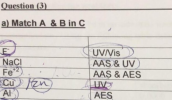 Question (3) a) Match A &B in C AAS& UV) AAS & AES NaCl cu AES
Question (3) a) Match A &B in C AAS& UV) AAS & AES NaCl cu AES
Question (3) a) Match A &B in C AAS& UV) AAS & AES NaCl cu AES
Choose the correct Nernst equation for the cell Zn + Cu2+ à Zn2+ + Cu E...
Choose the correct Nernst equation for the cell Zn + Cu2+ à Zn2+ + Cu E = E° - 0.0296 log(Cu / Zn) E=E° - 0.059 log([Zn2+] / [Cu2+]) E = E° - 0.0296 log(Zn / Cu) E = E° - 0.0296 log([Zn2+] / [Cu2+]) E = E° - 0.0296 log([Cu2+] / [Zn2+]) 20 points
Folder# Grade 1. In the voltaic cell shown below, the electrons flow from Zn(s)|Zn²+ (aq)|| Cu"...
 Folder# Grade 1. In the voltaic cell shown below, the electrons flow from Zn(s)|Zn²+ (aq)|| Cu" (aq)|Cu(s) Cu(s) (a) Cu(s) ® Zn(s) (b) Zn(s) (c) Zn(s) ® cu (d) Cut ® Zn(s) 2. Which of the following statements about the voltaic cell shown below is correct? Zn(s)[Zn** (aq)|| Cu** (aq) Cu(s) (a) Oxidation takes place at the cathode and reduction takes place at the anode. (b) Oxidation takes place at both the cathode and the anode. (c) Reduction takes place...
1. For the Cu-Zn phase diagram. For a 68 wt% Zn-32 wt% Cu alloy, list the...
 1. For the Cu-Zn phase diagram. For a 68 wt% Zn-32 wt% Cu alloy, list the phases and compositions that exist at 1000 °C, 760 °C, 600 °C and 400 °C. 2. For the Cu-Ag phase diagram, answer the following. Label the figure and add is part of your answer sheet.. .....(11 points) a) What is the eutectic temperature and composition? (1 point) b) In the context of this diagram, what does the symbol ß represent? (1 point) Composition (at%...
- Zn2+ Choose... Choose... (1pts) Identify the complete redox reaction for a ZnZn2+1|Cu2+1Cu cell. A. Zn(s)...
 - Zn2+ Choose... Choose... (1pts) Identify the complete redox reaction for a ZnZn2+1|Cu2+1Cu cell. A. Zn(s) + Cu?+ (aq) (aq) + Cu(s) B. Zn(s) + Cu(s) → Zn2+ (aq) + Cu2+ (aq) C. Zn2+ (aq) + Cu(s) Zn(s) + Cu2+ (aq) D. Zn (s) + 2 Cu(s) — Zn2+ (aq) + 2 Cu2+ (aq) (1pts) Identify the complete redox reaction for a Zn/Zn2+||Pb2+1Pb cell. A. Zn (s) + Pb(s) Zn2+ (aq) + Pb2+ (aq) B. Zn2+ (aq) + Pb(s) Zn(s)...
Which of the following is true for reaction Cu + ZnCl2 —> CuCl2 + Zn ?...
 Which of the following is true
for reaction Cu + ZnCl2 —> CuCl2 + Zn ? Write the oxidation
numbers of each species above their formula and write a
half-reaction showing what happens to both the Cu and Zn2+. Please
show work, I want to learn how to do this!
Which of the following is true for reaction Cu + ZnCl2 - numbers of each species above their formula, and write a half-reaction showing what happens to CuCl2 + Zn?...
Which of the following is true
for reaction Cu + ZnCl2 —> CuCl2 + Zn ? Write the oxidation
numbers of each species above their formula and write a
half-reaction showing what happens to both the Cu and Zn2+. Please
show work, I want to learn how to do this!
Which of the following is true for reaction Cu + ZnCl2 - numbers of each species above their formula, and write a half-reaction showing what happens to CuCl2 + Zn?...
12) Which of the following is true for reaction Cu + ZnCl2 --> CuCl2 + Zn...
 12) Which of the following is true for reaction Cu + ZnCl2 --> CuCl2 + Zn ? Write the oxidation numbers of each species above their formula, and write a half-reaction showing what happens to both the Cu and the Zn2+ A) Cu is oxidized B) Zn+2 is reduced C) Cu is a reducing agent D) All of the above statements are correct.
4. Which of the following statements about the voltaic cell shown below is correct? Zn(s)[Zn** (aq)||...
 4. Which of the following statements about the voltaic cell shown below is correct? Zn(s)[Zn** (aq)|| Cu** (aq)|Cu(s) (a) The oxidation half-reaction is clearly Zn(s) ® Zn** (aq) + 2 e. (b) The oxidation half-reaction is clearly Zn() Zn" (aq) +le. (C) The oxidation half-reaction could not be anything other than Cu(s) ® Cu (aq) +2 e. (d) It is obvious that the oxidation half-reaction is Zn(s) ® Cu(s). 5. Which of the following statements about the voltaic cell shown...
answer plz Question 32 (3 points) (32) For a galvanic cell notation: (-) Zn /Zn2+ (aq)...
 answer plz
Question 32 (3 points) (32) For a galvanic cell notation: (-) Zn /Zn2+ (aq) // Cu2+ (aq) / Cu (+), which of the following is fully correct? (a) Zn2+ is oxidized to Zn, and Cu2+ (aq) is reduced to Cu. (b) Zn is oxidized to Zn2+, and Cu2+ (aq) is reduced to Cu. 0 (c) Zn2+ is reduced to Zn, and Cu2+ (aq) is oxidized to Cu. (d) Zn is reduced to Zn2+, and Cu (aq) is reduced...
answer plz
Question 32 (3 points) (32) For a galvanic cell notation: (-) Zn /Zn2+ (aq) // Cu2+ (aq) / Cu (+), which of the following is fully correct? (a) Zn2+ is oxidized to Zn, and Cu2+ (aq) is reduced to Cu. (b) Zn is oxidized to Zn2+, and Cu2+ (aq) is reduced to Cu. 0 (c) Zn2+ is reduced to Zn, and Cu2+ (aq) is oxidized to Cu. (d) Zn is reduced to Zn2+, and Cu (aq) is reduced...
2. Fill in the missing reagent, product or catalyst. H2, Pd/C A. excess) CH2l2, Zn(Cu) B....
 2. Fill in the missing reagent, product or catalyst. H2, Pd/C A. excess) CH2l2, Zn(Cu) B. ether HIO4 C. H20, THF 2) NaHSO3
 Question (3) a) Match A &B in C AAS& UV) AAS & AES NaCl cu AES
Question (3) a) Match A &B in C AAS& UV) AAS & AES NaCl cu AES
Question (3) a) Match A &B in C AAS& UV) AAS & AES NaCl cu AES
 Folder# Grade 1. In the voltaic cell shown below, the electrons flow from Zn(s)|Zn²+ (aq)|| Cu" (aq)|Cu(s) Cu(s) (a) Cu(s) ® Zn(s) (b) Zn(s) (c) Zn(s) ® cu (d) Cut ® Zn(s) 2. Which of the following statements about the voltaic cell shown below is correct? Zn(s)[Zn** (aq)|| Cu** (aq) Cu(s) (a) Oxidation takes place at the cathode and reduction takes place at the anode. (b) Oxidation takes place at both the cathode and the anode. (c) Reduction takes place...
 1. For the Cu-Zn phase diagram. For a 68 wt% Zn-32 wt% Cu alloy, list the phases and compositions that exist at 1000 °C, 760 °C, 600 °C and 400 °C. 2. For the Cu-Ag phase diagram, answer the following. Label the figure and add is part of your answer sheet.. .....(11 points) a) What is the eutectic temperature and composition? (1 point) b) In the context of this diagram, what does the symbol ß represent? (1 point) Composition (at%...
 - Zn2+ Choose... Choose... (1pts) Identify the complete redox reaction for a ZnZn2+1|Cu2+1Cu cell. A. Zn(s) + Cu?+ (aq) (aq) + Cu(s) B. Zn(s) + Cu(s) → Zn2+ (aq) + Cu2+ (aq) C. Zn2+ (aq) + Cu(s) Zn(s) + Cu2+ (aq) D. Zn (s) + 2 Cu(s) — Zn2+ (aq) + 2 Cu2+ (aq) (1pts) Identify the complete redox reaction for a Zn/Zn2+||Pb2+1Pb cell. A. Zn (s) + Pb(s) Zn2+ (aq) + Pb2+ (aq) B. Zn2+ (aq) + Pb(s) Zn(s)...
 Which of the following is true
for reaction Cu + ZnCl2 —> CuCl2 + Zn ? Write the oxidation
numbers of each species above their formula and write a
half-reaction showing what happens to both the Cu and Zn2+. Please
show work, I want to learn how to do this!
Which of the following is true for reaction Cu + ZnCl2 - numbers of each species above their formula, and write a half-reaction showing what happens to CuCl2 + Zn?...
Which of the following is true
for reaction Cu + ZnCl2 —> CuCl2 + Zn ? Write the oxidation
numbers of each species above their formula and write a
half-reaction showing what happens to both the Cu and Zn2+. Please
show work, I want to learn how to do this!
Which of the following is true for reaction Cu + ZnCl2 - numbers of each species above their formula, and write a half-reaction showing what happens to CuCl2 + Zn?...
 12) Which of the following is true for reaction Cu + ZnCl2 --> CuCl2 + Zn ? Write the oxidation numbers of each species above their formula, and write a half-reaction showing what happens to both the Cu and the Zn2+ A) Cu is oxidized B) Zn+2 is reduced C) Cu is a reducing agent D) All of the above statements are correct.
 4. Which of the following statements about the voltaic cell shown below is correct? Zn(s)[Zn** (aq)|| Cu** (aq)|Cu(s) (a) The oxidation half-reaction is clearly Zn(s) ® Zn** (aq) + 2 e. (b) The oxidation half-reaction is clearly Zn() Zn" (aq) +le. (C) The oxidation half-reaction could not be anything other than Cu(s) ® Cu (aq) +2 e. (d) It is obvious that the oxidation half-reaction is Zn(s) ® Cu(s). 5. Which of the following statements about the voltaic cell shown...
 answer plz
Question 32 (3 points) (32) For a galvanic cell notation: (-) Zn /Zn2+ (aq) // Cu2+ (aq) / Cu (+), which of the following is fully correct? (a) Zn2+ is oxidized to Zn, and Cu2+ (aq) is reduced to Cu. (b) Zn is oxidized to Zn2+, and Cu2+ (aq) is reduced to Cu. 0 (c) Zn2+ is reduced to Zn, and Cu2+ (aq) is oxidized to Cu. (d) Zn is reduced to Zn2+, and Cu (aq) is reduced...
answer plz
Question 32 (3 points) (32) For a galvanic cell notation: (-) Zn /Zn2+ (aq) // Cu2+ (aq) / Cu (+), which of the following is fully correct? (a) Zn2+ is oxidized to Zn, and Cu2+ (aq) is reduced to Cu. (b) Zn is oxidized to Zn2+, and Cu2+ (aq) is reduced to Cu. 0 (c) Zn2+ is reduced to Zn, and Cu2+ (aq) is oxidized to Cu. (d) Zn is reduced to Zn2+, and Cu (aq) is reduced...
 2. Fill in the missing reagent, product or catalyst. H2, Pd/C A. excess) CH2l2, Zn(Cu) B. ether HIO4 C. H20, THF 2) NaHSO3
Most questions answered within 3 hours.
-
Where is the error in this code sequence?
String s1 = "Hello";
String s2 = "ello";...
asked 10 months ago -
Financial data for Joel de Paris, Inc., for last year
follow:
Joel de Paris, Inc.
Balance...
asked 10 months ago -
Consider this reaction:
Al2(SO4)3 (aq)+ BaCl3
(aq) Al2Cl6 (aq)- +
3BaSO4(s) . What is the...
asked 10 months ago -
Suppose that Savneet is considering increasing her
recent random sample from 20 car rentals to 40...
asked 10 months ago -
Trucks arrive at an unloading terminal at an average rate of 120
per hour.
Trucks arrive...
asked 10 months ago -
Why are methanol and ethanol completely soluble in water while
octanol is not very little soluble....
asked 10 months ago -
A facilities manager at a university reads in a research report
that the mean amount of...
asked 10 months ago -
When the CuSO4 is rehydrated by adding water to the anhydrous
compound, is this an endothermic...
asked 10 months ago -
A ray of sunlight is passing from diamond into crown glass; the
angle of incidence is...
asked 10 months ago -
A block of mass 0.249 kg is placed on top of a light, vertical
spring of...
asked 10 months ago -
how do the kidneys compensate in the presences of acidosis
a) trigger hyperventilate
b) reserve acid...
asked 10 months ago -
Question 501 pts
The rental rate of capital to the firm increases. Which of the
following...
asked 10 months ago