Convert the following DFA into a regular expression by computing all Rij (k) regular expressions: 0...
Convert the following DFA into a regular expression by computing all Rij (k) regular expressions:
| 0 | 1 | |
| ->A | B | A |
| *B | B | A |
Homework Answers

Add Answer to:
Convert the following DFA into a regular expression by computing
all Rij (k) regular expressions:
0...
a. Draw the transition diagram for the DFA b. Construct a regular expression for the language...
 a. Draw the transition diagram for the DFA
b. Construct a regular expression for the language of the DFA
by computing all the R_ij^(k) regular expressions.
Consider the following DFA: 1 A В C B A C В
a. Draw the transition diagram for the DFA
b. Construct a regular expression for the language of the DFA
by computing all the R_ij^(k) regular expressions.
Consider the following DFA: 1 A В C B A C В
Convert the following DFA to a regular expression. Dead state and transitions to it not shown,...
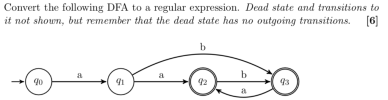 Convert the following DFA to a regular expression. Dead state and transitions to it not shown, but remember that the dead state has no outgoing transitions. [6]
1. Construct a DFA for each of the following regular expressions: a) ab + c...
1. Construct a DFA for each of the following regular expressions: a) ab + c b) a*b + c c) ab*c*+ ac 2. Construct an NFA for the following regular expression: a) (a + b)*ab b) a*b* c) a*b* + c d) a* + b* e) a* + b* + ac*
1.Calculate a regular expression corresponding to the following DFA, available at the jflap.org website, by the...
 1.Calculate a regular expression corresponding to the following
DFA, available at the jflap.org website, by the method of solving a
system of simultaneous equations in standard form. q0 is indicated
as the initial state.
2.Convert your regular expression to an NFA using the procedure
of Hopcroft and Ullman
3.Convert the NFA - to a DFA.
go q1 q2
1.Calculate a regular expression corresponding to the following
DFA, available at the jflap.org website, by the method of solving a
system of simultaneous equations in standard form. q0 is indicated
as the initial state.
2.Convert your regular expression to an NFA using the procedure
of Hopcroft and Ullman
3.Convert the NFA - to a DFA.
go q1 q2
1. Write regular expressions to capture the following regular languages: (a) The set of binary strings...
1. Write regular expressions to capture the following regular languages: (a) The set of binary strings which have a 1 in every even position. (Note: odd positions may be either 0 or 1.) (b) The set of binary strings that do not contain 011 as a substring. (c) Comments in Pascal. These are delimited by (* and *) or by { and }, and can contain anything in between; they are NOT allowed to nest, however. 2. Write a DFA...
Using formulas for r_i, j^k find a regular expression for the following dfa: Determine a right-linear...
 Using formulas for r_i, j^k find a regular expression for the following dfa: Determine a right-linear grammar G for the language accepted by the following dfa: Find the dfa that accepts the intersection of languages accepted by dfas from problem 1 and problem 3. Use the construction based on pairs of states.
Converting a DFA such as the one below to a regular expression requires 0/1 us to...
 Converting a DFA such as the one below to a regular expression requires 0/1 us to develop regular expressions for limited sets of paths --- those that take the automaton from one particular state to another particular state, without passing through some set of states. For the automaton below, determine the languages for the following limitations: 1.LAA = the set of path labels that go from A to A without passing through C or D. 2. LAB = the set...
6. (a) Use Thompson's construction to convert the above regular expression 1(0/1) *101 into an NFA...
 6. (a) Use Thompson's construction to convert the above regular expression 1(0/1) *101 into an NFA (7 points) (b) Convert the NFA of part (&) into a DFA using the subset construction (points)
Regular expression to DFA Regular expression: [AZ]3*((4?q+)|(6*y))?z+ DFA: ????
Regular expression to DFA Regular expression: [AZ]3*((4?q+)|(6*y))?z+ DFA: ????
31. Scanner Construction (10 pts) Construct a regular expression for recognizing all non-em and b that...
 31. Scanner Construction (10 pts) Construct a regular expression for recognizing all non-em and b that do not end in b. a) pty strings gs composed of the letters b) Convert the regular expression to an NF c) Convert the NFA to a DFA (show the sets of NFA states for each DFA state).
 a. Draw the transition diagram for the DFA
b. Construct a regular expression for the language of the DFA
by computing all the R_ij^(k) regular expressions.
Consider the following DFA: 1 A В C B A C В
a. Draw the transition diagram for the DFA
b. Construct a regular expression for the language of the DFA
by computing all the R_ij^(k) regular expressions.
Consider the following DFA: 1 A В C B A C В
 Convert the following DFA to a regular expression. Dead state and transitions to it not shown, but remember that the dead state has no outgoing transitions. [6]
 1.Calculate a regular expression corresponding to the following
DFA, available at the jflap.org website, by the method of solving a
system of simultaneous equations in standard form. q0 is indicated
as the initial state.
2.Convert your regular expression to an NFA using the procedure
of Hopcroft and Ullman
3.Convert the NFA - to a DFA.
go q1 q2
1.Calculate a regular expression corresponding to the following
DFA, available at the jflap.org website, by the method of solving a
system of simultaneous equations in standard form. q0 is indicated
as the initial state.
2.Convert your regular expression to an NFA using the procedure
of Hopcroft and Ullman
3.Convert the NFA - to a DFA.
go q1 q2
 Using formulas for r_i, j^k find a regular expression for the following dfa: Determine a right-linear grammar G for the language accepted by the following dfa: Find the dfa that accepts the intersection of languages accepted by dfas from problem 1 and problem 3. Use the construction based on pairs of states.
 Converting a DFA such as the one below to a regular expression requires 0/1 us to develop regular expressions for limited sets of paths --- those that take the automaton from one particular state to another particular state, without passing through some set of states. For the automaton below, determine the languages for the following limitations: 1.LAA = the set of path labels that go from A to A without passing through C or D. 2. LAB = the set...
 6. (a) Use Thompson's construction to convert the above regular expression 1(0/1) *101 into an NFA (7 points) (b) Convert the NFA of part (&) into a DFA using the subset construction (points)
 31. Scanner Construction (10 pts) Construct a regular expression for recognizing all non-em and b that do not end in b. a) pty strings gs composed of the letters b) Convert the regular expression to an NF c) Convert the NFA to a DFA (show the sets of NFA states for each DFA state).
Most questions answered within 3 hours.
-
Where is the error in this code sequence?
String s1 = "Hello";
String s2 = "ello";...
asked 10 months ago -
Financial data for Joel de Paris, Inc., for last year
follow:
Joel de Paris, Inc.
Balance...
asked 10 months ago -
Consider this reaction:
Al2(SO4)3 (aq)+ BaCl3
(aq) Al2Cl6 (aq)- +
3BaSO4(s) . What is the...
asked 10 months ago -
Suppose that Savneet is considering increasing her
recent random sample from 20 car rentals to 40...
asked 10 months ago -
Trucks arrive at an unloading terminal at an average rate of 120
per hour.
Trucks arrive...
asked 10 months ago -
Why are methanol and ethanol completely soluble in water while
octanol is not very little soluble....
asked 10 months ago -
A facilities manager at a university reads in a research report
that the mean amount of...
asked 10 months ago -
When the CuSO4 is rehydrated by adding water to the anhydrous
compound, is this an endothermic...
asked 10 months ago -
A ray of sunlight is passing from diamond into crown glass; the
angle of incidence is...
asked 10 months ago -
A block of mass 0.249 kg is placed on top of a light, vertical
spring of...
asked 10 months ago -
how do the kidneys compensate in the presences of acidosis
a) trigger hyperventilate
b) reserve acid...
asked 10 months ago -
Question 501 pts
The rental rate of capital to the firm increases. Which of the
following...
asked 10 months ago