If we start with an original tube of bacteria and tube 1 is a 1:10 dilution...
If we start with an original tube of bacteria and tube 1 is a 1:10 dilution of the original, tube 2 is a 1:10 dilution of tube 1, and tube 3 is a 1:10 dilution of tube 2, what is the total dilution of tube 3? Show your calculations.
Homework Answers
Total dilution of tube 1 is 1/10
Total dilution of tube 2 = dilution of tube 2 × total dilution of tube 1
= 1/10 × 1/10 = 1/100
Total dilution of tube 3 = dilution of tube 3 × total dilution of tube 2
= 1/10 × 1/100 = 1/1000 or 1:1000
Add Answer to:
If we start with an original tube of bacteria and tube 1
is a 1:10 dilution...
Bacteria #2 is a Bacteria #3 is a III. Calculation: (1) Serial dilution: (3 pts/each) 1....
 Bacteria #2 is a Bacteria #3 is a III. Calculation: (1) Serial dilution: (3 pts/each) 1. 0.2 mL of sample is added to 0.8 mL of diluent, what is the Dilution? 2. 0.01 mL of sample is added to 0.99 mL of diluent, what is the Dilution? :100 mL 0.2 mL of a sample was added to 0.8 mL of a diluent. Then, 0.1 mL of this first dilution was added to 0.4 mL of a diluent. What is the...
Microbiology In tube #1, the original concentration of penicillin is 1000 units per ml. In a...
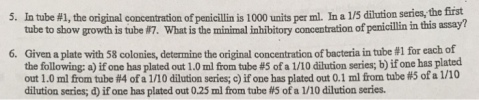 Microbiology
In tube #1, the original concentration of penicillin is 1000 units per ml. In a 1/5 dilution series, the first tube to show growth is tube #7. What is the m nmal hibitory concentration of penicillin in this assay? Given a plate with 58 colonies, determine the original concentration of bacteria in tube #1 for each of out 1.0 ml fontube #4 of a 1/10 dilution series, c) if one has plated out 0.1 ml from tube #5 of...
Microbiology
In tube #1, the original concentration of penicillin is 1000 units per ml. In a 1/5 dilution series, the first tube to show growth is tube #7. What is the m nmal hibitory concentration of penicillin in this assay? Given a plate with 58 colonies, determine the original concentration of bacteria in tube #1 for each of out 1.0 ml fontube #4 of a 1/10 dilution series, c) if one has plated out 0.1 ml from tube #5 of...
14. Analyze the following serial dilution experiment and answer the questions, each (a and b) worth...
 14. Analyze the following serial dilution experiment and answer the questions, each (a and b) worth 10 pts. Given: One ml of the original bacterial culture (tube 0) was added to experiment tube 1, containing 9 ml of media. 7 more experiment tubes were serially diluted in order, the same way, for a total of 8. Each originally contained 9 ml of media, and each received 1 ml from the tube number preceeding it. Two drops from tube #8 were...
1)How many microliters of original sample are required to produce a final dilution of 10-2 in...
1)How many microliters of original sample are required to produce a final dilution of 10-2 in a total volume of 5 mL? 1 microliter is 10-6 L or 10-3 mL. 2)A 0.00001 dilution is performed on a culture of bacteria in order to perform viable plate counts. From the dilution, *0.1 mL* of solution is plated on solid media, and 197 colony forming units grow on the plate. How many bacteria are in a single mL of the original culture?...
3. A serial dilution of a swab sample was prepared by adding 10 uL to a...
 3. A serial dilution of a swab sample was prepared by adding 10 uL to a volume of 990 ML water in tube 1, and 10 uL to a volume of 990 uL water in tube 2. a. What is the overall dilution and dilution factor of each tube? Overall Dilution Dilution Factor Tube 1 Tube 2 b. If 100 uL of tube 2 is spread plated and 126 colonies grow, what was the #cells/mL in the original sample?
A. You have been given a tube of E. coli. You are asked to make 1...
A. You have been given a tube of E. coli. You are asked to make 1 mL total volume of 10-1 dilution of the bacterial culture. Explain how you would do this. Show all necessary calculations. ____ ml cells + _____ ml water = 1 ml (total volume) B. Next, you were asked to make a 10-2 dilution of the bacterial sample. Explain how you would perform this. Show all necessary calculations. You have bacteria at a concentration of 2...
Also— what is the dilution factor in tube 2? please show the steps to the answers!...
 Also— what is the dilution factor in tube 2?
please show the steps to the answers!
Practice Problems Solve the following practice problems to further master the material. Answers and explanations to some problems can be found at the end of the book. Calculate the dilution factors for the following problems: 1.5 mL sample added to 95 mL diluent 2. 20 mL sample added to 180 mL diluent 3. 40 mL sample added to 200 mL diluent 4. 2 mL...
Also— what is the dilution factor in tube 2?
please show the steps to the answers!
Practice Problems Solve the following practice problems to further master the material. Answers and explanations to some problems can be found at the end of the book. Calculate the dilution factors for the following problems: 1.5 mL sample added to 95 mL diluent 2. 20 mL sample added to 180 mL diluent 3. 40 mL sample added to 200 mL diluent 4. 2 mL...
RESULTS For your dilution plates draw your results below. IMI Calculate the original CFU/ml in your...
 RESULTS For your dilution plates draw your results below. IMI Calculate the original CFU/ml in your original broth tube, if you are within 500 CFU/ml of what the instructor calculated, you earn an extra credit point REVIEW QUESTIONS 1. A plate has 72 colonies with a total dilution factor of 10-7.0.1 ml was pipetted onto the plate, what was the original CFU/ml concentration of that sample?
Dilution, help?? 5. You add 25uls of antibody to 475 uls of water - what dilution...
 Dilution, help??
5. You add 25uls of antibody to 475 uls of water - what dilution did you just make? 6. (3 pts) To obtain a countable plate to quantify your bacterial sample you first dilute the sample 1/500 in Tube 1 and then make a 1/25 dilution of this sample in Tube 2. If the total volume for your dilutions is 1 ml: a. How much water should be in Tube 1 and how much of your initial bacterial...
Dilution, help??
5. You add 25uls of antibody to 475 uls of water - what dilution did you just make? 6. (3 pts) To obtain a countable plate to quantify your bacterial sample you first dilute the sample 1/500 in Tube 1 and then make a 1/25 dilution of this sample in Tube 2. If the total volume for your dilutions is 1 ml: a. How much water should be in Tube 1 and how much of your initial bacterial...
Answer and do the following calculations: 1. Suppose your professor handed you a test tube with...
Answer and do the following calculations: 1. Suppose your professor handed you a test tube with 2.0 mL of an E. coli broth culture in it and told you to make a 10–2 dilution of the entire culture. Explain how you would do this. Show your calculations. 2. How would you produce a 10–1 dilution of a 3 mL bacterial sample using the entire 3 mL volume? 3. You have 0.05 mL of an undiluted culture at a concentration of...
 Bacteria #2 is a Bacteria #3 is a III. Calculation: (1) Serial dilution: (3 pts/each) 1. 0.2 mL of sample is added to 0.8 mL of diluent, what is the Dilution? 2. 0.01 mL of sample is added to 0.99 mL of diluent, what is the Dilution? :100 mL 0.2 mL of a sample was added to 0.8 mL of a diluent. Then, 0.1 mL of this first dilution was added to 0.4 mL of a diluent. What is the...
 Microbiology
In tube #1, the original concentration of penicillin is 1000 units per ml. In a 1/5 dilution series, the first tube to show growth is tube #7. What is the m nmal hibitory concentration of penicillin in this assay? Given a plate with 58 colonies, determine the original concentration of bacteria in tube #1 for each of out 1.0 ml fontube #4 of a 1/10 dilution series, c) if one has plated out 0.1 ml from tube #5 of...
Microbiology
In tube #1, the original concentration of penicillin is 1000 units per ml. In a 1/5 dilution series, the first tube to show growth is tube #7. What is the m nmal hibitory concentration of penicillin in this assay? Given a plate with 58 colonies, determine the original concentration of bacteria in tube #1 for each of out 1.0 ml fontube #4 of a 1/10 dilution series, c) if one has plated out 0.1 ml from tube #5 of...
 14. Analyze the following serial dilution experiment and answer the questions, each (a and b) worth 10 pts. Given: One ml of the original bacterial culture (tube 0) was added to experiment tube 1, containing 9 ml of media. 7 more experiment tubes were serially diluted in order, the same way, for a total of 8. Each originally contained 9 ml of media, and each received 1 ml from the tube number preceeding it. Two drops from tube #8 were...
 3. A serial dilution of a swab sample was prepared by adding 10 uL to a volume of 990 ML water in tube 1, and 10 uL to a volume of 990 uL water in tube 2. a. What is the overall dilution and dilution factor of each tube? Overall Dilution Dilution Factor Tube 1 Tube 2 b. If 100 uL of tube 2 is spread plated and 126 colonies grow, what was the #cells/mL in the original sample?
 Also— what is the dilution factor in tube 2?
please show the steps to the answers!
Practice Problems Solve the following practice problems to further master the material. Answers and explanations to some problems can be found at the end of the book. Calculate the dilution factors for the following problems: 1.5 mL sample added to 95 mL diluent 2. 20 mL sample added to 180 mL diluent 3. 40 mL sample added to 200 mL diluent 4. 2 mL...
Also— what is the dilution factor in tube 2?
please show the steps to the answers!
Practice Problems Solve the following practice problems to further master the material. Answers and explanations to some problems can be found at the end of the book. Calculate the dilution factors for the following problems: 1.5 mL sample added to 95 mL diluent 2. 20 mL sample added to 180 mL diluent 3. 40 mL sample added to 200 mL diluent 4. 2 mL...
 RESULTS For your dilution plates draw your results below. IMI Calculate the original CFU/ml in your original broth tube, if you are within 500 CFU/ml of what the instructor calculated, you earn an extra credit point REVIEW QUESTIONS 1. A plate has 72 colonies with a total dilution factor of 10-7.0.1 ml was pipetted onto the plate, what was the original CFU/ml concentration of that sample?
 Dilution, help??
5. You add 25uls of antibody to 475 uls of water - what dilution did you just make? 6. (3 pts) To obtain a countable plate to quantify your bacterial sample you first dilute the sample 1/500 in Tube 1 and then make a 1/25 dilution of this sample in Tube 2. If the total volume for your dilutions is 1 ml: a. How much water should be in Tube 1 and how much of your initial bacterial...
Dilution, help??
5. You add 25uls of antibody to 475 uls of water - what dilution did you just make? 6. (3 pts) To obtain a countable plate to quantify your bacterial sample you first dilute the sample 1/500 in Tube 1 and then make a 1/25 dilution of this sample in Tube 2. If the total volume for your dilutions is 1 ml: a. How much water should be in Tube 1 and how much of your initial bacterial...
Most questions answered within 3 hours.
-
Where is the error in this code sequence?
String s1 = "Hello";
String s2 = "ello";...
asked 11 months ago -
Financial data for Joel de Paris, Inc., for last year
follow:
Joel de Paris, Inc.
Balance...
asked 11 months ago -
Consider this reaction:
Al2(SO4)3 (aq)+ BaCl3
(aq) Al2Cl6 (aq)- +
3BaSO4(s) . What is the...
asked 11 months ago -
Suppose that Savneet is considering increasing her
recent random sample from 20 car rentals to 40...
asked 11 months ago -
Trucks arrive at an unloading terminal at an average rate of 120
per hour.
Trucks arrive...
asked 11 months ago -
Why are methanol and ethanol completely soluble in water while
octanol is not very little soluble....
asked 11 months ago -
A facilities manager at a university reads in a research report
that the mean amount of...
asked 11 months ago -
When the CuSO4 is rehydrated by adding water to the anhydrous
compound, is this an endothermic...
asked 11 months ago -
A ray of sunlight is passing from diamond into crown glass; the
angle of incidence is...
asked 11 months ago -
A block of mass 0.249 kg is placed on top of a light, vertical
spring of...
asked 11 months ago -
how do the kidneys compensate in the presences of acidosis
a) trigger hyperventilate
b) reserve acid...
asked 11 months ago -
Question 501 pts
The rental rate of capital to the firm increases. Which of the
following...
asked 11 months ago