What does “genetically tagging” mean? Why is this useful for imaging a specific protein? How would...
Homework Answers
Attaching a label to gene is called gene tagging. This is done to highlight that specific gene, or searching or isolation of any particular gene. The agent used for tagging are removable.
Tagging a specific protien is done to track activities, functions, and interaction of that protien. Tagging can also used in process of purification.
Most common approach is used for tagging is by using recombinant DNA to express a protien tag. A gene which has affinity for protien is used. Antibodies or fluroscent tags are also used. Fusion of some fluroscent tag with protien enable for protien visualisation in in-vivo system.
Polyhistidine, Glutathione S-transferase, maltose binding protiens are commonaly used for tagging.
Add Answer to:
What does “genetically tagging” mean? Why is this useful for
imaging a specific protein? How would...
4. How does a cell regulate protein activity to impact mechanisms/cell functions? Why is this important?...
4. How does a cell regulate protein activity to impact mechanisms/cell functions? Why is this important? Have five specific examples and do not include any mechanisms that completely degrade the protein of interest.
1) What is the great benefit of FLIM as compared to FRET? What is ratiometric FRET?...
1) What is the great benefit of FLIM as compared to FRET? What is ratiometric FRET? Explain with diagrams. Which is the more precise method to use if you wanted to monitor the proteolytic processing of a genetically encoded fluorescent peptide reporter in vivo – explain why? 2) What was the major advance made in quantum dots for biological imaging discussed in class that involved the use of Protein A (SpA)? Explain the significance of the report and why it...
Fluorescent Protein Gene Fusia for Subcellular Localization Imaging 5. (2 pts) You are studying the human...
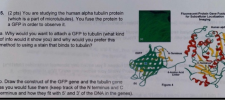 Fluorescent Protein Gene Fusia for Subcellular Localization Imaging 5. (2 pts) You are studying the human alpha tubulin protein (which is a part of microtubules). You fuse the protein to a GFP in order to observe it. a. Why would you want to attach a GFP to tubulin (what kind of info would it show you) and why would you prefer this method to using a stain that binds to tubulin? 26 Humana EOFI Se Termine A Acid Figure 4...
What percent of total kcals came from protein? Are you within recommendations (AMDRs) for protein? Why...
What percent of total kcals came from protein? Are you within recommendations (AMDRs) for protein? Why is adequate protein necessary for the body (think functions of protein)? What are the consequences of a diet too low in protein? What are the consequences of a diet too high in protein? Why is it important to consider saturated fat grams when choosing sources of protein? How can you decrease fat and retain protein grams? How does your intake compare to your recommendation?...
what does the “medicalization of aging” mean to you? Be specific. Identify three reasons why our...
what does the “medicalization of aging” mean to you? Be specific. Identify three reasons why our public policy initiatives need to shift from medical care to wellness care and how this can be accomplished.
*Biochemistry Lab Question 1. Chromatography columns have a limited protein binding capacity (Consider not overloading the...
*Biochemistry Lab Question 1. Chromatography columns have a limited protein binding capacity (Consider not overloading the column) Yet you may have noticed that the Wash fraction fluoresced slightly. If you see a band in the Western Blot Wash lane, what does this data say about the physical protein structure of rGFP in that lane? Give a possible MW for this band. 2. (4pts) If overloaded the Ni+2 Agarose column with a crude extract sample that contained too much rGFP, would...
You are assigned to purify a protein from an E.coli cell lysate. The following information is...
You are assigned to purify a protein from an E.coli cell lysate. The following information is provided to you about the target protein. The protein has an N-terminal 6X histidine tag (His-tag) attached to it The protein is very stable in PBS (Phosphate Buffered Saline) buffer that you need to use as the storage buffer after purification It is an enzyme that will be used as a potential drug. You have the amino acid sequence of the protein. Based on...
How would SEC (size-exclusive chromatography) enhance (or not) for protein purification and why? What advantages or...
How would SEC (size-exclusive chromatography) enhance (or not) for protein purification and why? What advantages or disadvantages? What could be done in the future for greater purification? SEC means size-exclusive chromatography
Questions 1. What does the term IMVIC mean? 2. Why is the IMVIC useful in identifying...
 Questions 1. What does the term IMVIC mean? 2. Why is the IMVIC useful in identifying Enterobacteriaceae? Are further biochemical tests necessary for complete identification? 3. What diagnostic test differentiates Proteus and Providencia species from other Enterobacteriaceae? om other Enterobacteriaceae 4. How is E. coli distinguished from P. vulgaris on MacConkey agar? On a TSI slant? 5. Instead of TSI, why would a slant medium containing only dextrose and lactose (not sucrose) be preferable for detecting Y enterocolitica? Name such...
what does the concept of "core competence" mean? why is this concept important? How would you...
what does the concept of "core competence" mean? why is this concept important? How would you determine if the information an organization "claims" as its core competence actually matches what they achieve? Provide an example where there is a match between core competence and organizational achievement. Discuss where you you obtain the information used to "test" the organization's ability to deliver on its core competence.
 Fluorescent Protein Gene Fusia for Subcellular Localization Imaging 5. (2 pts) You are studying the human alpha tubulin protein (which is a part of microtubules). You fuse the protein to a GFP in order to observe it. a. Why would you want to attach a GFP to tubulin (what kind of info would it show you) and why would you prefer this method to using a stain that binds to tubulin? 26 Humana EOFI Se Termine A Acid Figure 4...
 Questions 1. What does the term IMVIC mean? 2. Why is the IMVIC useful in identifying Enterobacteriaceae? Are further biochemical tests necessary for complete identification? 3. What diagnostic test differentiates Proteus and Providencia species from other Enterobacteriaceae? om other Enterobacteriaceae 4. How is E. coli distinguished from P. vulgaris on MacConkey agar? On a TSI slant? 5. Instead of TSI, why would a slant medium containing only dextrose and lactose (not sucrose) be preferable for detecting Y enterocolitica? Name such...
Most questions answered within 3 hours.
-
Where is the error in this code sequence?
String s1 = "Hello";
String s2 = "ello";...
asked 10 months ago -
Financial data for Joel de Paris, Inc., for last year
follow:
Joel de Paris, Inc.
Balance...
asked 10 months ago -
Consider this reaction:
Al2(SO4)3 (aq)+ BaCl3
(aq) Al2Cl6 (aq)- +
3BaSO4(s) . What is the...
asked 10 months ago -
Suppose that Savneet is considering increasing her
recent random sample from 20 car rentals to 40...
asked 10 months ago -
Trucks arrive at an unloading terminal at an average rate of 120
per hour.
Trucks arrive...
asked 10 months ago -
Why are methanol and ethanol completely soluble in water while
octanol is not very little soluble....
asked 10 months ago -
A facilities manager at a university reads in a research report
that the mean amount of...
asked 10 months ago -
When the CuSO4 is rehydrated by adding water to the anhydrous
compound, is this an endothermic...
asked 10 months ago -
A ray of sunlight is passing from diamond into crown glass; the
angle of incidence is...
asked 10 months ago -
A block of mass 0.249 kg is placed on top of a light, vertical
spring of...
asked 10 months ago -
how do the kidneys compensate in the presences of acidosis
a) trigger hyperventilate
b) reserve acid...
asked 10 months ago -
Question 501 pts
The rental rate of capital to the firm increases. Which of the
following...
asked 10 months ago