What is the difference between a virus and an obligate intracellular bacteria?
What is the difference between a virus and an obligate intracellular bacteria?
Homework Answers
Viruses are obligate intracellular parasites which cannot live without the host cell. The obligate intracellular bacteria also cannot live without the host cell. Both of them require an obligate presence of host cell to survive.
Both of them cannot be cultured on nutrient media but can be cultured and isolated from their host cell.
The metabolism of infecting a host cell is similar for both of them.
The differences between the two are -
Viruses are non cellular entities whereas obligate intracellular Bacteria is a cellular organism.
The outermost covering in viruses is made up of a protein capsid whereas in bacteria it is cell wall of sugars.
Viruses have either RNA or DNA as the genetic material but obligate intracellular bacteria always have DNA as the genetic material.
Viruses incorporate their genome into the host cell but the obligate intracellular bacteria does not.
Before writing the differences, I have written the similarities because they will help you to understand the relationship between viruses and obligate intracellular bacteria in a better way.
Please give a high rating.
Add Answer to:
What is the difference between a virus and an obligate
intracellular bacteria?
Which of A-F is not considered an obligate or facultative type intracellular pathogen? A. Legionella pneumophilia...
 Which of A-F is not considered an obligate or facultative type intracellular pathogen? A. Legionella pneumophilia OB. Listeria monocytogenes OC. Rabies virus OD. Salmonella enterica OE. Enteroinvasive E. coli (EIEC) OF. Neisseria meningitidis OG. All are either obligate, or facultative, intracellular pathogen
discuss some basic characteristic difference between a bacteria and virus
discuss some basic characteristic difference between a bacteria and virus
Explain why Mycoplasmas are referred to as "obligate intracellular parasites" Describe the relat1onsh1p between their genome...
Explain why Mycoplasmas are referred to as "obligate intracellular parasites" Describe the relat1onsh1p between their genome size and growth. 10
7. What is the difference between "obligate" and facultative relationships?
 7. What is the difference between "obligate" and facultative relationships?
I need short answer. please answer all questions. 1. What the difference between a bacteria and...
I need short answer. please answer all questions. 1. What the difference between a bacteria and virus. 2. Could you name few organelles which are present in eukaryotes but absent in bacteria. 3. What is the most common difference between two classes of viruses. 4. Archea are included in which kingdom? Extra chromosomal DNA present in bacteria are called what?
_Please explain, What is the difference between (+)Sense Virus, (-)sense virus, and retroviruses? _What is the...
_Please explain, What is the difference between (+)Sense Virus, (-)sense virus, and retroviruses? _What is the difference between single ORF and multiple ORF, I know one is single reading frame and one is multiple reading frame, but what the use of them in term of genetics of viruses?
Is bacteria Arthrobacter nitroguajacolicus, which is an obligate aerobe, capable of carbohydrate fermentation? What is carbohydrate...
Is bacteria Arthrobacter nitroguajacolicus, which is an obligate aerobe, capable of carbohydrate fermentation? What is carbohydrate fermentation and what does it have to do with oxygen class of organisms?
An obligate intracellular organism is one that a. can reproduce outside the host cell b. cannot...
An obligate intracellular organism is one that a. can reproduce outside the host cell b. cannot reproduce outside the host cell c. has its own reproductive machinery d. can live both inside and outside of a host cell
-What is the difference between the quantal and quantitative method of virus titration?
-What is the difference between the quantal and quantitative method of virus titration?
Question 9 (1 point) Which of the following microbes is a Gram negative, obligate intracellular parasite?...
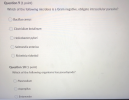 Question 9 (1 point) Which of the following microbes is a Gram negative, obligate intracellular parasite? Bacillus cereus Clostridium botulinum Helicobacter pylori Salmonella enterica Rickettsia rickettsii Question 10 (1 point) Which of the following organisms has pseudopods? Plasmodium Aspergillus Entamoeba
 Which of A-F is not considered an obligate or facultative type intracellular pathogen? A. Legionella pneumophilia OB. Listeria monocytogenes OC. Rabies virus OD. Salmonella enterica OE. Enteroinvasive E. coli (EIEC) OF. Neisseria meningitidis OG. All are either obligate, or facultative, intracellular pathogen
 7. What is the difference between "obligate" and facultative relationships?
 Question 9 (1 point) Which of the following microbes is a Gram negative, obligate intracellular parasite? Bacillus cereus Clostridium botulinum Helicobacter pylori Salmonella enterica Rickettsia rickettsii Question 10 (1 point) Which of the following organisms has pseudopods? Plasmodium Aspergillus Entamoeba
Most questions answered within 3 hours.
-
Where is the error in this code sequence?
String s1 = "Hello";
String s2 = "ello";...
asked 10 months ago -
Financial data for Joel de Paris, Inc., for last year
follow:
Joel de Paris, Inc.
Balance...
asked 10 months ago -
Consider this reaction:
Al2(SO4)3 (aq)+ BaCl3
(aq) Al2Cl6 (aq)- +
3BaSO4(s) . What is the...
asked 10 months ago -
Suppose that Savneet is considering increasing her
recent random sample from 20 car rentals to 40...
asked 10 months ago -
Trucks arrive at an unloading terminal at an average rate of 120
per hour.
Trucks arrive...
asked 10 months ago -
Why are methanol and ethanol completely soluble in water while
octanol is not very little soluble....
asked 10 months ago -
A facilities manager at a university reads in a research report
that the mean amount of...
asked 10 months ago -
When the CuSO4 is rehydrated by adding water to the anhydrous
compound, is this an endothermic...
asked 10 months ago -
A ray of sunlight is passing from diamond into crown glass; the
angle of incidence is...
asked 10 months ago -
A block of mass 0.249 kg is placed on top of a light, vertical
spring of...
asked 10 months ago -
how do the kidneys compensate in the presences of acidosis
a) trigger hyperventilate
b) reserve acid...
asked 10 months ago -
Question 501 pts
The rental rate of capital to the firm increases. Which of the
following...
asked 10 months ago