One of the major challenges faced by plants is preventing excessive water loss (upwards of 300...
One of the major challenges faced by plants is preventing excessive water loss (upwards of 300 water molecules for each CO2 molecule absorbed) while maintaining photosynthetic rate.
a) Explain why plants have such poor water use efficiency. Plants can reduce water loss by closing their stomata, but this also has negative consequences.
b) Explain how stomatal closure reduces CO2 fixation and enhances photorespiration, heat stress, and radiation stress.
c) Explain how plants that use CAM or C4 are able to improve their water use efficiency.
Homework Answers
A- picture explaining the reason why plant not closes stomata
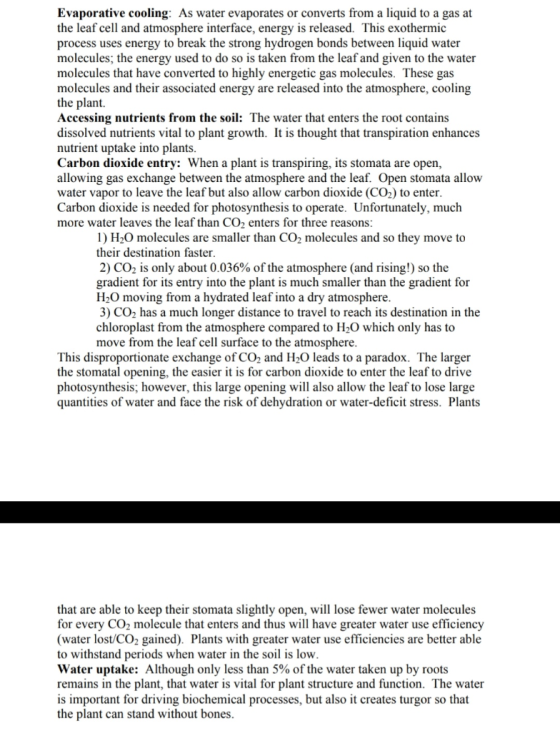
B- effects that such higher concentrations of CO2 are likely to have on global climate, rising CO2 concentrations are also likely to have profound direct effects on the growth, physiology, and chemistry of plants, independent of any effects on climate (Ziska 2008). These effects result from the central importance of CO2 to plant metabolism. As photosynthetic organisms, plants take up atmospheric CO2, chemically reducing the carbon. This represents not only an acquisition of stored chemical energy for the plant, but also provides the carbon skeletons for the organic molecules that make up a plants’ structure. Overall, the carbon, hydrogen and oxygen assimilated into organic molecules by photosynthesis make up ~96% of the total dry mass of a typical plant (Marschner 1995). Photosynthesis is therefore at the heart of the nutritional metabolism of plants, and increasing the availability of CO2 for photosynthesis can have profound effects on plant growth and many aspects of plant physiology.
C-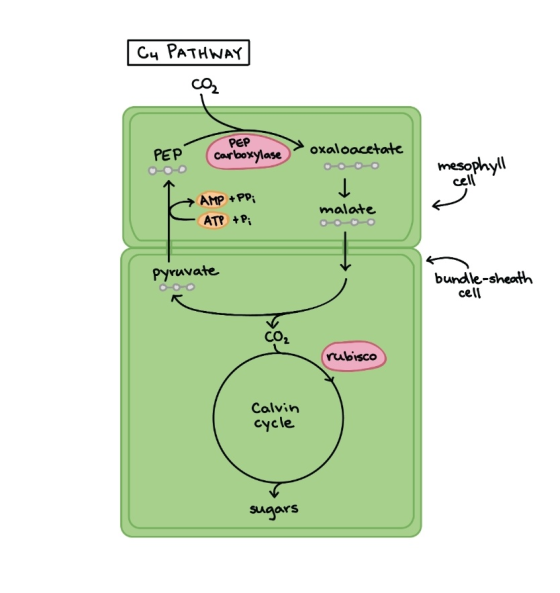
The light-dependent reactions and the Calvin cycle are physically s
eparated, with the light-dependent reactions occurring in the mesophyll cells (spongy tissue in the middle of the leaf) and the Calvin cycle occurring in special cells around the leaf veins. These cells are called bundle-sheath cells.
To see how this division helps, in a given diagram his step is carried out by a non-rubisco enzyme, PEP carboxylase, that has no tendency to bind \text O_2O2O, start subscript, 2, end subscript. Oxaloacetate is then converted to a similar molecule, malate, that can be transported in to the bundle-sheath cells. Inside the bundle sheath, malate breaks down, releasing a molecule of sugar.
In the C4 pathway, initial carbon fixation takes place in mesophyll cells and the Calvin cycle takes place in bundle-sheath cells. PEP carboxylase attaches an incoming carbon dioxide molecul to the three-carbon molecule PEP, producing oxaloacetate (a four-carbon molecule). The oxaloacetate is converted to malate, which travels out of the mesophyll cell and into a neighboring bundle-sheath. Inside the bundle sheath cell, malate is broken down to release , which then enters the Calvin cycle. Pyruvate is also produced in this step and moves back into the mesophyll cell, where it is converted into PEP (a reaction that converts ATP and Pi into AMP and PPi).
This process isn't without its energetic price: ATP must be expended to return the three-carbon “ferry” molecule from the bundle sheath cell and get it ready to pick up another molecule neighboring bundle-sheath cells in the form of malate, there’s always a high concentration oof this strategy minimizes photorespiration.
Percent of all vascular plants; some examples are crabgrass, sugarcane and corn. plants are common in habitats that are hot, but are less abundant in areas that are cooler. In hot conditions, the benefits of reduced photorespiration likely exceed the ATP cost of moving to bundle sheath to mesophyll.
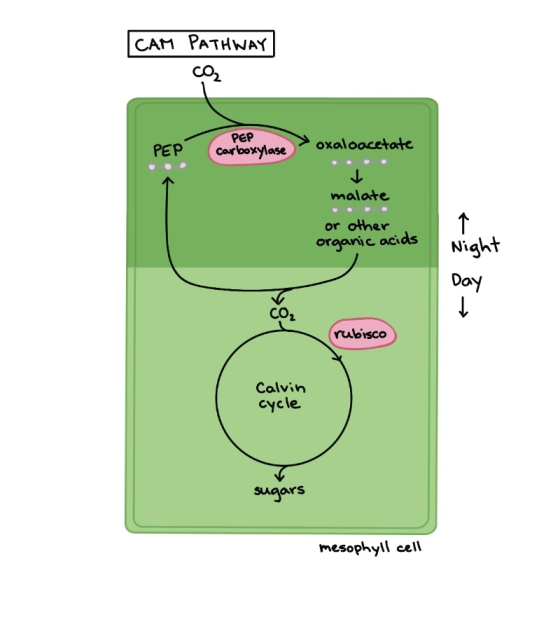
CAM plants
Some plants that are adapted to dry environments, such as cacti and pineapples, use the crassulacean acid metabolism (CAM) pathway to minimize photorespiration. This name comes from the family of plants, the Crassulaceae, in which scientists first discovered the pathway.
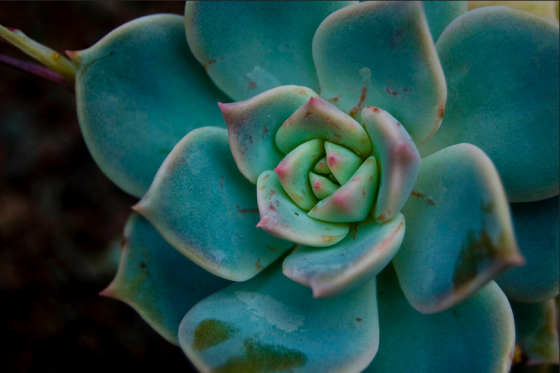
Image of a succulents
CAM plants temporally separate carbon fixation and the Calvin cycle. Carbon dioxide diffuses into leaves during the night (when stomata are open) and is fixed into oxaloacetate by PEP carboxylase, which attaches the carbon dioxide to the three-carbon molecule PEP. The oxaloacetate is converted to another organic acid, such as malate. The organic acid is stored until the next day and is then broken down, releasing carbon dioxide that can be fixed by rubisco and enter the Calvin cycle to make sugars.
The CAM pathway requires ATP at multiple steps (not shown above), so like \text {C}_4C4C, start subscript, 4, end subscriptphotosynthesis, it is not an energetic "freebie." ^33start superscript, 3, end superscriptHowever, plant species that use CAM photosynthesis not only avoid photorespiration, but are also very water-efficient. Their stomata only open at night, when humidity tends to be higher and temperatures are cooler, both factors that reduce water loss from leaves. CAM plants are typically dominant in very hot, dry areas, like deserts.
Add Answer to:
One of the major challenges faced by plants is
preventing excessive water loss (upwards of 300...
. Describe why CAM plants have an advantage over C3 plants in the desert and why...
. Describe why CAM plants have an advantage over C3 plants in the desert and why C4 plants have an advantage over C3 plants in tropical climates. (Be sure to discuss the relevance of photosynthetic enzymes and their location, photorespiration, water use efficiency, and stomatal behavior and leaf anatomy.) 4. Thinking about anatomy, morphology, and “behavior” describe ways that plant leaves are adapted to intercepting light, increasing CO2 diffusion while reducing water loss. 5. In general terms, describe the characteristics...
CAM plants keep stomata closed in the daytime, thus reducing loss of water. They can do...
 CAM plants keep stomata closed in the daytime, thus reducing loss of water. They can do this because they Ofix CO2 into pyruvate in the mesophyll cells Ofix CO2 into sugars in the bundle sheath cells use photosystem I and photosystem II at night fix CO2 into organic acids during the night
 CAM plants keep stomata closed in the daytime, thus reducing loss of water. They can do this because they Ofix CO2 into pyruvate in the mesophyll cells Ofix CO2 into sugars in the bundle sheath cells use photosystem I and photosystem II at night fix CO2 into organic acids during the night
Most questions answered within 3 hours.
-
Where is the error in this code sequence?
String s1 = "Hello";
String s2 = "ello";...
asked 11 months ago -
Financial data for Joel de Paris, Inc., for last year
follow:
Joel de Paris, Inc.
Balance...
asked 11 months ago -
Consider this reaction:
Al2(SO4)3 (aq)+ BaCl3
(aq) Al2Cl6 (aq)- +
3BaSO4(s) . What is the...
asked 11 months ago -
Suppose that Savneet is considering increasing her
recent random sample from 20 car rentals to 40...
asked 11 months ago -
Trucks arrive at an unloading terminal at an average rate of 120
per hour.
Trucks arrive...
asked 11 months ago -
Why are methanol and ethanol completely soluble in water while
octanol is not very little soluble....
asked 11 months ago -
A facilities manager at a university reads in a research report
that the mean amount of...
asked 11 months ago -
When the CuSO4 is rehydrated by adding water to the anhydrous
compound, is this an endothermic...
asked 11 months ago -
A ray of sunlight is passing from diamond into crown glass; the
angle of incidence is...
asked 11 months ago -
A block of mass 0.249 kg is placed on top of a light, vertical
spring of...
asked 11 months ago -
how do the kidneys compensate in the presences of acidosis
a) trigger hyperventilate
b) reserve acid...
asked 11 months ago -
Question 501 pts
The rental rate of capital to the firm increases. Which of the
following...
asked 11 months ago