I have a 2D character array like this: [ [1 D E F G H] [2...
I have a 2D character array like this: [ [1 D E F G H]
[2 C E]
[3 A C]
[4 H I J]
[5 A B D]]
How do you make a character array consisting of distinct alphabets?
That is the output should be [A B C D E F G H I J].
I need a C++ code for the same.
Homework Answers
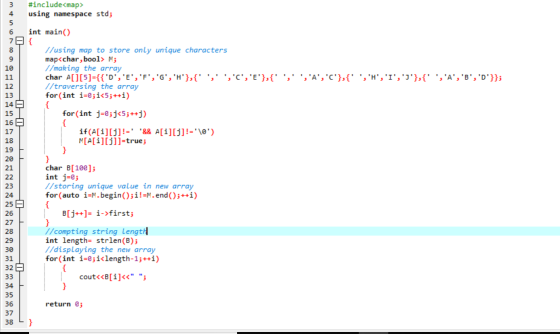
Here is the solution to above problem. Please refer to code
screenshot for indentation help and read code comments for more
help.
I am using c++ map to make sure the characters are unique similarly you can use another character array
char C[] to mark all the unique characters just like the map
C++ Code
#include<iostream>
#include<string.h>
#include<map>
using namespace std;
int main()
{
//using map to store only unique characters
map<char,bool> M;
//making the array
char A[][5]={{'D','E','F','G','H'},{' ','
','C','E'},{' ',' ','A','C'},{' ','H','I','J'},{'
','A','B','D'}};
//traversing the array
for(int i=0;i<5;++i)
{
for(int j=0;j<5;++j)
{
if(A[i][j]!='
'&& A[i][j]!='\0')
M[A[i][j]]=true;
}
}
char B[100];
int j=0;
//storing unique value in new array
for(auto i=M.begin();i!=M.end();++i)
{
B[j++]= i->first;
}
//compting string length
int length= strlen(B);
//displaying the new array
for(int i=0;i<length-1;++i)
{
cout<<B[i]<<" ";
}
return 0;
}
OUTPUT OF THE CODE

SCREENSHOT OF THE CODE
A chromosome with genetic markers A, B, C, D, E, F, G, H, I and J...
A chromosome with genetic markers A, B, C, D, E, F, G, H, I and J ( “*” represents the centromere ) is shown below: A B C D E * F G H I J Another chromosome is found to contain a b c d i h g f * e j If these two chromosomes are paired during meiosis, a single crossover takes place between F and G, and another single crossover takes place between H and I....
- A. B. C. D. E. F. G. H. I. J. K. ...
- A. B. C. D. E. F. G. H. I. J. K. L. M. N. O. Telecommuting - A. B. C. D. E. F. G. H. I. J. K. L. M. N. O. Change - A. B. C. D. E. F. G. H. I. J. K. L. M. N. O. Job Sharing - A. B. C. D. E. F. G. H. I. J. K. L. M. N. O. Job Redesign - A. B. C. D. E. F. G. H. I. ...
C++ program 2D array of intergers Initialize the 2-D array of integers detailed below. { 25,...
C++ program 2D array of intergers Initialize the 2-D array of integers detailed below. { 25, 50, 75, 100, 125 }, { 50, 100, 150, 200, 250}, { 75, 150, 225, 300, 375}, { 100, 200, 300, 400, 500}, { 125, 250, 375, 500, 625 }, Traverse and output array elements for the 2D array above in reverse order. Starting with 625, 500, 375, 250, etc…. Attach Snipping Photo of Source Code and Output below. Directly Access and output 225...
Write a Java method that searches a 2-d array for a specific character. Return the index...
Write a Java method that searches a 2-d array for a specific character. Return the index of the first location of the character. Method header: public static void play(char c, char[][]wordSearch){ Example: a e v s l g r e d k h k q s e z j c p o a t s o v a n m n l q p f o x b The character 's' appears at index 0,3.
How to replace elements in a 2D array? Okay so for my program, I am trying...
How to replace elements in a 2D array? Okay so for my program, I am trying to create a fish tank. My program is to generate 4 different FISH: ><))'> in a tank of tilde (~) characters. The tank is a 2D array of 8 rows and 32 columns so it would look like ~~~~~~~~~~~~~~~~~~~~~~~~~~~~~~~~ for one of the eight rows (before I generate the random positions of the fish in the rank). Then one row could look like ~~~~~~~~~~><))'>~~~~~~~~~~~~~~~~...
4. R(A, B, C, D, E, F, G, H, I, J) where A → B, C,...
 4. R(A, B, C, D, E, F, G, H, I, J) where A → B, C, D BE F→ G, H, I (A, F) → B, C, D, E, G, H, I, J For each of the following relations, normalize it into a set of BCNF relations.
Design the optimal (Huffman) code for the alphabet {a, b, c, d, e, f, g, h,...
 Design the optimal (Huffman) code for the alphabet {a, b, c,
d, e, f, g, h, i, j, k, l}, where frequencies are given in the
table below:
Draw the appropriate decoding tree.
a 0.25 g 0.02 b 0.01 h 0.12 c 0.09 i 0.15 d 0.02 j 0.04 e 0.24 k 0.01 f 0.04 l 0.01
Design the optimal (Huffman) code for the alphabet {a, b, c,
d, e, f, g, h, i, j, k, l}, where frequencies are given in the
table below:
Draw the appropriate decoding tree.
a 0.25 g 0.02 b 0.01 h 0.12 c 0.09 i 0.15 d 0.02 j 0.04 e 0.24 k 0.01 f 0.04 l 0.01
What is the output of the following code:for(int i = 1; i < 5; i++) {...
What is the output of the following code:for(int i = 1; i < 5; i++) { cout << i << " "; for(int j = 1; j <= i; j++) { cout << j << " "; } cout << endl; } Write C++ code that will store the input “John” in a character array. Make sure to use an array initializer. //CODE int g(int a, int b); void g(int a, int b); True or False? Function g above...
We have the symbols A, B, C, D, E, F, G, H with frequencies 1, 1,...
We have the symbols A, B, C, D, E, F, G, H with frequencies 1, 1, 2, 4, 8, 16, 32, 64. Show the Huffman tree and Huffman code for the symbols. How much compression does a 1000 digit file use when using this Huffman code based on an 8-bit ASCII code (ie, ISO 8859-1)?
There are 10 letters - a, b, c, d, e, f, g, h, n, g. I...
There are 10 letters - a, b, c, d, e, f, g, h, n, g. I have to arrange them in a way that "a" wouldn't be near "c" and also "a" wouldn't be near "g" How many possible combinations are possible? How to solve it mathematically?
 4. R(A, B, C, D, E, F, G, H, I, J) where A → B, C, D BE F→ G, H, I (A, F) → B, C, D, E, G, H, I, J For each of the following relations, normalize it into a set of BCNF relations.
 Design the optimal (Huffman) code for the alphabet {a, b, c,
d, e, f, g, h, i, j, k, l}, where frequencies are given in the
table below:
Draw the appropriate decoding tree.
a 0.25 g 0.02 b 0.01 h 0.12 c 0.09 i 0.15 d 0.02 j 0.04 e 0.24 k 0.01 f 0.04 l 0.01
Design the optimal (Huffman) code for the alphabet {a, b, c,
d, e, f, g, h, i, j, k, l}, where frequencies are given in the
table below:
Draw the appropriate decoding tree.
a 0.25 g 0.02 b 0.01 h 0.12 c 0.09 i 0.15 d 0.02 j 0.04 e 0.24 k 0.01 f 0.04 l 0.01
Most questions answered within 3 hours.
-
Where is the error in this code sequence?
String s1 = "Hello";
String s2 = "ello";...
asked 10 months ago -
Financial data for Joel de Paris, Inc., for last year
follow:
Joel de Paris, Inc.
Balance...
asked 10 months ago -
Consider this reaction:
Al2(SO4)3 (aq)+ BaCl3
(aq) Al2Cl6 (aq)- +
3BaSO4(s) . What is the...
asked 10 months ago -
Suppose that Savneet is considering increasing her
recent random sample from 20 car rentals to 40...
asked 10 months ago -
Trucks arrive at an unloading terminal at an average rate of 120
per hour.
Trucks arrive...
asked 10 months ago -
Why are methanol and ethanol completely soluble in water while
octanol is not very little soluble....
asked 10 months ago -
A facilities manager at a university reads in a research report
that the mean amount of...
asked 10 months ago -
When the CuSO4 is rehydrated by adding water to the anhydrous
compound, is this an endothermic...
asked 10 months ago -
A ray of sunlight is passing from diamond into crown glass; the
angle of incidence is...
asked 10 months ago -
A block of mass 0.249 kg is placed on top of a light, vertical
spring of...
asked 10 months ago -
how do the kidneys compensate in the presences of acidosis
a) trigger hyperventilate
b) reserve acid...
asked 10 months ago -
Question 501 pts
The rental rate of capital to the firm increases. Which of the
following...
asked 10 months ago