A chromosome with genetic markers A, B, C, D, E, F, G, H, I and J...
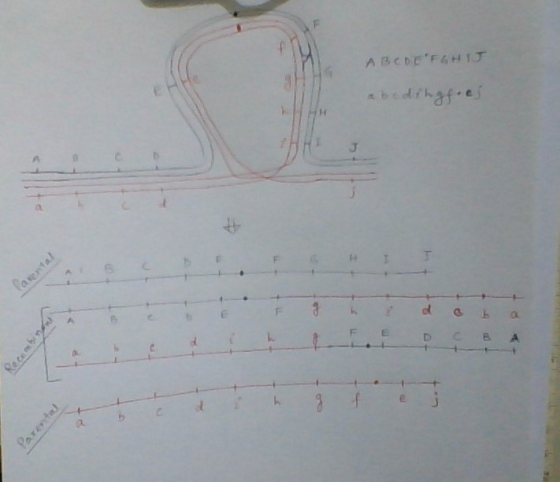
A chromosome with genetic markers A, B, C, D, E, F, G, H, I and J ( “*” represents the centromere ) is shown below: A B C D E * F G H I J Another chromosome is found to contain a b c d i h g f * e j If these two chromosomes are paired during meiosis, a single crossover takes place between F and G, and another single crossover takes place between H and I. How would the expected recombinant chromosomes look like?
Homework Answers
The expected recombinant chromosomes would be as follows:
ABCDE*Fghidcba
abcdihgF*EDCBA
For detailed structure for the single point cross over please find the attachment.
Add Answer to:
A chromosome with genetic markers A, B, C, D, E, F, G, H, I and
J...
Given a chromosome with the gene order, A B C D ∙ E F G H,...
Given a chromosome with the gene order, A B C D ∙ E F G H, and an inverted chromosome with this gene order, A F E ∙ D C B G H, which of the following recombinant chromosomes would result from a crossover between C and D? A) A B C C B G H and H G F E ∙ D C B G H B) A B C D ∙ E F A and H ∙ G...
2, An individual is heterozygous for an inversion chromosome as shown below: A. Draw the looped...
 2, An individual is heterozygous for an inversion
chromosome as shown below:
A. Draw the looped arrangement of the chromosomes that
you would expect to see when they are paired for meiosis I.
(Although there are four strands present at meiosis I, only two are
shown here; you need only draw two strands).
B. Assume that a crossover
exchange takes place in the interval between T and E at meiosis I.
Draw the structure of the products you would expect...
2, An individual is heterozygous for an inversion
chromosome as shown below:
A. Draw the looped arrangement of the chromosomes that
you would expect to see when they are paired for meiosis I.
(Although there are four strands present at meiosis I, only two are
shown here; you need only draw two strands).
B. Assume that a crossover
exchange takes place in the interval between T and E at meiosis I.
Draw the structure of the products you would expect...
In this diagram, the top chromosome is the wild-type chromosome, while the bottom one carries an...
In this diagram, the top chromosome is the wild-type chromosome, while the bottom one carries an inversion. The star is the centromere. A B C * D E F G A B F E D * C G 1. During meiosis recombination occurs between the centromere and the region marked "D". Draw out the recombinant gametes showing the gene order and position of the centromeres in each. 2. Are either of the recombinant gametes likely to give rise to viable...
- A. B. C. D. E. F. G. H. I. J. K. ...
- A. B. C. D. E. F. G. H. I. J. K. L. M. N. O. Telecommuting - A. B. C. D. E. F. G. H. I. J. K. L. M. N. O. Change - A. B. C. D. E. F. G. H. I. J. K. L. M. N. O. Job Sharing - A. B. C. D. E. F. G. H. I. J. K. L. M. N. O. Job Redesign - A. B. C. D. E. F. G. H. I. ...
1. A genetic cross in which the inheritance of two traits is observed is called a...
 1. A genetic cross in which the inheritance of two traits is observed is called a A) Dihybrid cross. B) Monohybrid cross C) Backeross D) Testcross 2. For single crossovers, the frequency of recombinant gametes is half the frequency of crossing over because A) A testeross between a homozygous and heterozygote produces 1/2 heterozygous and 1/2 homozygous progeny. B) The frequency of recombination is always 50%. C) Each crossover takes place between only two of the four chromatids of a...
4. R(A, B, C, D, E, F, G, H, I, J) where A → B, C,...
 4. R(A, B, C, D, E, F, G, H, I, J) where A → B, C, D BE F→ G, H, I (A, F) → B, C, D, E, G, H, I, J For each of the following relations, normalize it into a set of BCNF relations.
1. A flower is heterozygous for the following inversion of chromosome 1 (dot=centromere) A B C ...
1. A flower is heterozygous for the following inversion of chromosome 1 (dot=centromere) A B C ● D E F G a b e d ● c f g a. Is this a paracentric or pericentric inversion? I am thinking Pericentric? b. Draw the pairing configuration at prophase I including all 4 chromatids. I wasnt too sure how to map the loop out for this one c. Give the genotypes of the gametes from this meiosis if there is a...
please show all steps and explain thoroughly ! thank you! 2. An individual is heterozygous for...
 please show all steps and explain thoroughly ! thank
you!
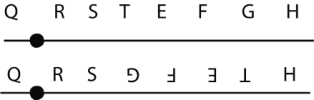
2. An individual is heterozygous for an inversion chromosome as shown below: Q R S T E F G H Q R S 9 3 1 H A. Draw the looped arrangement of the chromosomes that you would expect to see when they are paired for meiosis I. (Although there are four strands present at meiosis I, only two are shown here; you need only draw two strands). B. Assume...
please show all steps and explain thoroughly ! thank
you!
2. An individual is heterozygous for an inversion chromosome as shown below: Q R S T E F G H Q R S 9 3 1 H A. Draw the looped arrangement of the chromosomes that you would expect to see when they are paired for meiosis I. (Although there are four strands present at meiosis I, only two are shown here; you need only draw two strands). B. Assume...
13. For an F+ strain with the genetic markers on the circular chromosome ordered stnopm, which...
 13. For an F+ strain with the genetic markers on the circular chromosome ordered stnopm, which of the following conjugation results is impossible: a. c. p enters first and m last e. n enters first and p last b. d. o enters first and n last o enters first and p last n enters first and o last
1. Consider the sets: A = {a, b, c, d, e, f, h, j}, B =...
 1. Consider the sets: A = {a, b, c, d, e, f, h, j}, B = {a, b, i }, C = {f, h} and U = {a,b,c,d,e,f,g, h,i,j} a. Draw a Venn diagram and place each element in its appropriate region. Insert a photo of your diagram into your HW document. b. Is C a subset of A? Why? C. Is C a subset of B? Why? d. Is A a subset of B? Why? e. Are B and...
 2, An individual is heterozygous for an inversion
chromosome as shown below:
A. Draw the looped arrangement of the chromosomes that
you would expect to see when they are paired for meiosis I.
(Although there are four strands present at meiosis I, only two are
shown here; you need only draw two strands).
B. Assume that a crossover
exchange takes place in the interval between T and E at meiosis I.
Draw the structure of the products you would expect...
2, An individual is heterozygous for an inversion
chromosome as shown below:
A. Draw the looped arrangement of the chromosomes that
you would expect to see when they are paired for meiosis I.
(Although there are four strands present at meiosis I, only two are
shown here; you need only draw two strands).
B. Assume that a crossover
exchange takes place in the interval between T and E at meiosis I.
Draw the structure of the products you would expect...
 1. A genetic cross in which the inheritance of two traits is observed is called a A) Dihybrid cross. B) Monohybrid cross C) Backeross D) Testcross 2. For single crossovers, the frequency of recombinant gametes is half the frequency of crossing over because A) A testeross between a homozygous and heterozygote produces 1/2 heterozygous and 1/2 homozygous progeny. B) The frequency of recombination is always 50%. C) Each crossover takes place between only two of the four chromatids of a...
 4. R(A, B, C, D, E, F, G, H, I, J) where A → B, C, D BE F→ G, H, I (A, F) → B, C, D, E, G, H, I, J For each of the following relations, normalize it into a set of BCNF relations.
 please show all steps and explain thoroughly ! thank
you!
2. An individual is heterozygous for an inversion chromosome as shown below: Q R S T E F G H Q R S 9 3 1 H A. Draw the looped arrangement of the chromosomes that you would expect to see when they are paired for meiosis I. (Although there are four strands present at meiosis I, only two are shown here; you need only draw two strands). B. Assume...
please show all steps and explain thoroughly ! thank
you!
2. An individual is heterozygous for an inversion chromosome as shown below: Q R S T E F G H Q R S 9 3 1 H A. Draw the looped arrangement of the chromosomes that you would expect to see when they are paired for meiosis I. (Although there are four strands present at meiosis I, only two are shown here; you need only draw two strands). B. Assume...
 13. For an F+ strain with the genetic markers on the circular chromosome ordered stnopm, which of the following conjugation results is impossible: a. c. p enters first and m last e. n enters first and p last b. d. o enters first and n last o enters first and p last n enters first and o last
 1. Consider the sets: A = {a, b, c, d, e, f, h, j}, B = {a, b, i }, C = {f, h} and U = {a,b,c,d,e,f,g, h,i,j} a. Draw a Venn diagram and place each element in its appropriate region. Insert a photo of your diagram into your HW document. b. Is C a subset of A? Why? C. Is C a subset of B? Why? d. Is A a subset of B? Why? e. Are B and...
Most questions answered within 3 hours.
-
Where is the error in this code sequence?
String s1 = "Hello";
String s2 = "ello";...
asked 11 months ago -
Financial data for Joel de Paris, Inc., for last year
follow:
Joel de Paris, Inc.
Balance...
asked 11 months ago -
Consider this reaction:
Al2(SO4)3 (aq)+ BaCl3
(aq) Al2Cl6 (aq)- +
3BaSO4(s) . What is the...
asked 11 months ago -
Suppose that Savneet is considering increasing her
recent random sample from 20 car rentals to 40...
asked 11 months ago -
Trucks arrive at an unloading terminal at an average rate of 120
per hour.
Trucks arrive...
asked 11 months ago -
Why are methanol and ethanol completely soluble in water while
octanol is not very little soluble....
asked 11 months ago -
A facilities manager at a university reads in a research report
that the mean amount of...
asked 11 months ago -
When the CuSO4 is rehydrated by adding water to the anhydrous
compound, is this an endothermic...
asked 11 months ago -
A ray of sunlight is passing from diamond into crown glass; the
angle of incidence is...
asked 11 months ago -
A block of mass 0.249 kg is placed on top of a light, vertical
spring of...
asked 11 months ago -
how do the kidneys compensate in the presences of acidosis
a) trigger hyperventilate
b) reserve acid...
asked 11 months ago -
Question 501 pts
The rental rate of capital to the firm increases. Which of the
following...
asked 11 months ago