A student touches an electroscope with her finger, and a second student then brings a charged...
A student touches an electroscope with her finger, and a second student then brings a charged plexiglass rod near the electroscope but does not touch it. The first student removes her finger from the electroscope before the second student removes the plexiglass. Meanwhile a third student touches a different electroscope with a charged PVC pipe. Are both electroscopes charged? If so, are they the same charge or different charges? Explain your reasoning. Feel free to include any drawings or diagrams
Homework Answers
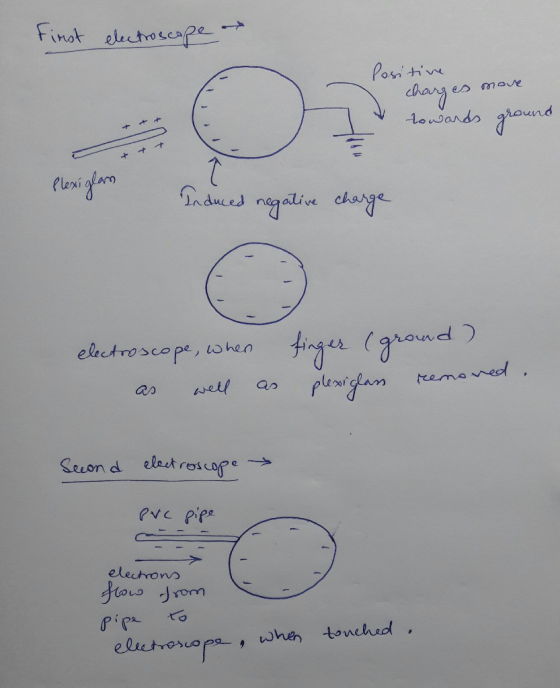
As the first student touches the electroscope with her finger, any excess charge present in the electroscope flows out of it and into the ground through the student, making it neutral. A plexiglass when rubbed, becomes positively charged. As this rod is brought near to the neutral electroscope, the free electrons in the electroscope are drawn towards the rod, whereas positive charges moves to the ground. As the first student removes her finger, the ground is removed and the electroscope becomes negatively charged due to excess electrons.
A pvc pipe, when rubbed, becomes negatively charged. If it is touched to the electroscope, negative charges from the pipe flows into the electroscope, making the electroscope negatively charged.
So both electroscopes become negatively charged.
we will consider electroscope as a conducting sphere for simplicity.
Add Answer to:
A student touches an electroscope with her finger, and a second
student then brings a charged...
Two students each bring a charged PVC rod near and electroscope. In each case another student...
 Two students each bring a charged PVC rod near and electroscope. In each case another student touches the electroscope with their finger and then removes it. The only difference between the two situations is in where the student holding the PVC places it next to the electroscope. The first student holds the PVC near the ball on the top of the electroscope, as shown in the figure below. The second student holds the PVC next to the leaves". What will...
Next the student brings a plexiglass rod near the pith ball. What can you conclude about...
Next the student brings a plexiglass rod near the pith ball. What can you conclude about the charge state of the pith ball if it has a different reaction to the plexiglass rod as it did to the PVC pipe? (10 pts)
3 charge diagram questions: 1. A positively charged rod is rubbed against an electroscope 2. A positively charged rod i...
 3 charge diagram questions:
1. A positively charged rod is rubbed against an
electroscope
2. A positively charged rod is brought closed to an
electroscope
3. A negatively charge ruler is brought near an electroscope
Charge Diagrams 1. Suppose that a positively charged rod is rubbed against the electroscope shown at right and transfers electroscope. The rod is then moved far away from the electroscope. Draw the position of the needle. Draw a charge diagram for the electroscope. Charging Plate...
3 charge diagram questions:
1. A positively charged rod is rubbed against an
electroscope
2. A positively charged rod is brought closed to an
electroscope
3. A negatively charge ruler is brought near an electroscope
Charge Diagrams 1. Suppose that a positively charged rod is rubbed against the electroscope shown at right and transfers electroscope. The rod is then moved far away from the electroscope. Draw the position of the needle. Draw a charge diagram for the electroscope. Charging Plate...
just 5-7 Ground your electroscope. Touch a negatively charged rod to the metal plate of the...
 just 5-7
Ground your electroscope. Touch a negatively charged rod to the metal plate of the electroscope. Draw in the schematic how the charges are distributed, and indicate the new deflection of the rotating pointer once it has come to equilibrium + Perform this experiment with the charge remaining from step 3. Recharge your negatively charged object and bring it into close proximity to the metal plate without touching. We are charging by induction in this case. How does the...
just 5-7
Ground your electroscope. Touch a negatively charged rod to the metal plate of the electroscope. Draw in the schematic how the charges are distributed, and indicate the new deflection of the rotating pointer once it has come to equilibrium + Perform this experiment with the charge remaining from step 3. Recharge your negatively charged object and bring it into close proximity to the metal plate without touching. We are charging by induction in this case. How does the...
What is meant when you say that two objects have like charges How do we tell...
 What is meant when you say that two objects have like charges How do we tell that objects "like charges" How do we make objects with like charges Two objects are observed attract What do we know and what do we NOT know about them Your are given a piece of material. Propose an experiment or a series of experiments to determine if the material is a conductor or an insulator. State clearly what the outcome of each experiment will...
Fraud at Berry, CPA’s BERRY, CERTIFIED PUBLIC ACCOUNTANTS Brief History of the Firm In 1999, John...
Fraud at Berry, CPA’s BERRY, CERTIFIED PUBLIC ACCOUNTANTS Brief History of the Firm In 1999, John Berry graduated from college with an accounting degree. After 10 years at an international accounting firm, John decided to start his firm, Berry, CPA’s. The firm, located in Oakwood, caters to local clients; specifically, John and his staff of four professionals specialize in non-public companies. The majority of the services provided by Berry, CPA’s are tax planning and preparation; however, the firm also performs...
Write down your analysis of this case on factors like the interests involved, context and power...
Write down your analysis of this case on factors like the interests involved, context and power PACIFIC OIL COMPANY (A)* "Look, you asked for my advice, and I gave it to you," Frank Kelsey said. "If I were you, I wouldn't make any more concessions! I really don't think you ought to agree to their last demand! But you're the one who has to live with the contract, not me!" Static on the transatlantic telephone connection obscured Jean Fontaine's reply....
Write down your analysis of this case on factors like 1. the negotiation process, strategy and...
Write down your analysis of this case on factors like 1. the negotiation process, strategy and tactics PACIFIC OIL COMPANY (A)* "Look, you asked for my advice, and I gave it to you," Frank Kelsey said. "If I were you, I wouldn't make any more concessions! I really don't think you ought to agree to their last demand! But you're the one who has to live with the contract, not me!" Static on the transatlantic telephone connection obscured Jean Fontaine's...
Hi there! I need to compare two essay into 1 essay, and make it interesting and...
Hi there! I need to compare two essay into 1 essay, and make it interesting and choose couple topics which im going to talk about in my essay FIRST ESSAY “Teaching New Worlds/New Words” bell hooks Like desire, language disrupts, refuses to be contained within boundaries. It speaks itself against our will, in words and thoughts that intrude, even violate the most private spaces of mind and body. It was in my first year of college that I read Adrienne...
A. Issues [1] In addition to damages for one year's notice period, can a trial judge...
 A. Issues [1] In addition to damages for one year's notice period, can a trial judge award significant damages for the mere fact of an employee's dismissal, or for the stigma that that dismissal brings? Or for the employer thereafter competing with the ex-employee for the clients, before the ex-employee has got a new job? B. Basic Facts [2] This is an appeal from 2009 ABQB 591 (CanLII), 473 A.R. 254. [3] Usually a judgment recites facts before law. But...
 Two students each bring a charged PVC rod near and electroscope. In each case another student touches the electroscope with their finger and then removes it. The only difference between the two situations is in where the student holding the PVC places it next to the electroscope. The first student holds the PVC near the ball on the top of the electroscope, as shown in the figure below. The second student holds the PVC next to the leaves". What will...
 3 charge diagram questions:
1. A positively charged rod is rubbed against an
electroscope
2. A positively charged rod is brought closed to an
electroscope
3. A negatively charge ruler is brought near an electroscope
Charge Diagrams 1. Suppose that a positively charged rod is rubbed against the electroscope shown at right and transfers electroscope. The rod is then moved far away from the electroscope. Draw the position of the needle. Draw a charge diagram for the electroscope. Charging Plate...
3 charge diagram questions:
1. A positively charged rod is rubbed against an
electroscope
2. A positively charged rod is brought closed to an
electroscope
3. A negatively charge ruler is brought near an electroscope
Charge Diagrams 1. Suppose that a positively charged rod is rubbed against the electroscope shown at right and transfers electroscope. The rod is then moved far away from the electroscope. Draw the position of the needle. Draw a charge diagram for the electroscope. Charging Plate...
 just 5-7
Ground your electroscope. Touch a negatively charged rod to the metal plate of the electroscope. Draw in the schematic how the charges are distributed, and indicate the new deflection of the rotating pointer once it has come to equilibrium + Perform this experiment with the charge remaining from step 3. Recharge your negatively charged object and bring it into close proximity to the metal plate without touching. We are charging by induction in this case. How does the...
just 5-7
Ground your electroscope. Touch a negatively charged rod to the metal plate of the electroscope. Draw in the schematic how the charges are distributed, and indicate the new deflection of the rotating pointer once it has come to equilibrium + Perform this experiment with the charge remaining from step 3. Recharge your negatively charged object and bring it into close proximity to the metal plate without touching. We are charging by induction in this case. How does the...
 What is meant when you say that two objects have like charges How do we tell that objects "like charges" How do we make objects with like charges Two objects are observed attract What do we know and what do we NOT know about them Your are given a piece of material. Propose an experiment or a series of experiments to determine if the material is a conductor or an insulator. State clearly what the outcome of each experiment will...
 A. Issues [1] In addition to damages for one year's notice period, can a trial judge award significant damages for the mere fact of an employee's dismissal, or for the stigma that that dismissal brings? Or for the employer thereafter competing with the ex-employee for the clients, before the ex-employee has got a new job? B. Basic Facts [2] This is an appeal from 2009 ABQB 591 (CanLII), 473 A.R. 254. [3] Usually a judgment recites facts before law. But...
Most questions answered within 3 hours.
-
Where is the error in this code sequence?
String s1 = "Hello";
String s2 = "ello";...
asked 11 months ago -
Financial data for Joel de Paris, Inc., for last year
follow:
Joel de Paris, Inc.
Balance...
asked 11 months ago -
Consider this reaction:
Al2(SO4)3 (aq)+ BaCl3
(aq) Al2Cl6 (aq)- +
3BaSO4(s) . What is the...
asked 11 months ago -
Suppose that Savneet is considering increasing her
recent random sample from 20 car rentals to 40...
asked 11 months ago -
Trucks arrive at an unloading terminal at an average rate of 120
per hour.
Trucks arrive...
asked 11 months ago -
Why are methanol and ethanol completely soluble in water while
octanol is not very little soluble....
asked 11 months ago -
A facilities manager at a university reads in a research report
that the mean amount of...
asked 11 months ago -
When the CuSO4 is rehydrated by adding water to the anhydrous
compound, is this an endothermic...
asked 11 months ago -
A ray of sunlight is passing from diamond into crown glass; the
angle of incidence is...
asked 11 months ago -
A block of mass 0.249 kg is placed on top of a light, vertical
spring of...
asked 11 months ago -
how do the kidneys compensate in the presences of acidosis
a) trigger hyperventilate
b) reserve acid...
asked 11 months ago -
Question 501 pts
The rental rate of capital to the firm increases. Which of the
following...
asked 11 months ago