What is the relationship of temperate phages to the disease-producing ability of some bacteria? Why does...
What is the relationship of temperate phages to the disease-producing ability of some bacteria? Why does this occur? What effect would treating the infection with antibiotics have? (detailed explanation please)
Homework Answers
Temperate phage - In virology, temperate refers to the ability of some bacteriophages (notably coliphage λ) to display a lysogenic life cycle. Many (but not all) temperate phages can integrate their genomes into their host bacterium's chromosome, together with becoming a lysogen as the phage genome becomes a prophage
Infection caused by a temperate phage
The process in which a bacterium is infected by a temperate phage is called lysogeny. It is typical of temperate phages to be latent or inactive within the cell. As the bacterium replicates its chromosome, it also replicates the phage's DNA and passes it on to new daughter cells during reproduction.
Bacteriophages are viruses that infect bacteria. There are an estimated 1031 phage on the planet, making them the most abundant form of life
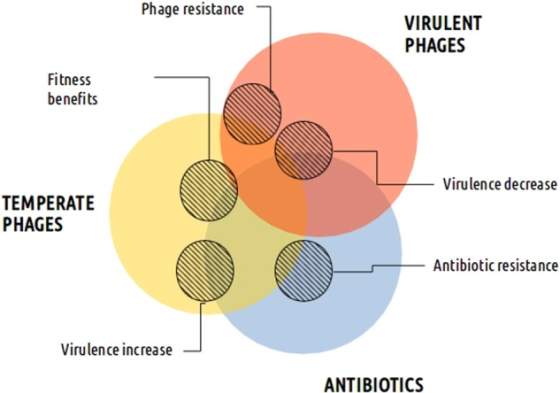
Temperate prophage carriage is often associated with increased bacterial virulence. The rise in the use of technologies, such as genome sequencing and transcriptomics, has highlighted more subtle ways in which prophages contribute to pathogenicity.
Bacteriophages (phage) are viruses that infect and replicate within bacterial hosts and are ubiquitous and abundant in every niche studied
They are broadly divided into two categories. Virulent phage follows a strictly productive lytic life cycle, whereas temperate phage switch between dormant and productive states. All phage infects the host bacterium by binding to specific surface receptors and injecting their genome into the cytoplasm. Virulent (lytic) phage infection immediately commandeers the bacterial replicative machinery for multiplication. Phage genes encode structural head and tail proteins and lytic enzymes that cause a bacterial cell to lyse, releasing lytic phage progeny into the environment. The characteristics of lytic phage offer an attractive alternative to antibiotics.
Temperate (lysogenic) phage follow an alternative life cycle involving the integration of their genome into the host chromosome to become a prophage. In this state, the phage DNA replicates along with the host cell (lysogen) and is maintained in the bacterial population. Lysogenic phage can switch to a lytic life cycle, particularly in response to environmental stresses
Lambdoid phage employ repressor genes such as cI, which act as a genetic switch to control the balance between lysis and lysogeny. The expression of these repressors prevents the lytic pathway and maintains the prophage state. The CI repressor also inhibits the integration of any incoming phage genomes conferring immunity to superinfection. There are a wide range of other phage resistance mechanisms
The balance between lytic and lysogenic states is thought to be largely dependent on the metabolic condition of the bacterial host cell. Temperate phage infection tends towards lysogeny in starving cells and this is thought to be a phage survival tactic during periods of resource limitation. Integration into the chromosome is facilitated by integrase and transposase enzymes that can act at specific sites or randomly. This means that lysogenic phage can drive bacterial diversity by introducing mutations with each integration event. Active prophage retains the ability to switch to a lytic cycle of productive replication. This occurs spontaneously in a proportion of cells within a population of lysogenic bacteria
PROPHAGE CONTRIBUTION TO INFECTION
Lysogenic infection and subsequent expression by the host of phage-encoded genes is termed lysogenic conversion and can have profound effects on bacterial phenotype. Prophages often encode ‘morons’ that are not directly involved in viral replication and can confer a benefit to their bacterial host. Such genes are independent transcriptional units of DNA that are expressed whilst the phage is in the prophage state Morons can include genes that enhance the virulence of their bacterial host, either directly (e.g. phage-encoded toxins) or indirectly, by enhancing the ecological fitness of bacteria during infection The role of temperate phage in disease situations is thus becoming increasingly recognized.
the recent growth in whole bacterial genome sequencing has revealed high numbers of integrated prophage Winstanley Pathogenic strains have been shown to carry a greater proportion of phage-related genes than non-pathogenic strains , many maintaining multiple prophages in the same chromosome For example, the majority of the genetic difference between avirulent and virulent strains of Escherichia coli is due to mobile genetic elements, notably phages
OCCURS - when the phage DNA integrates into the bacterial genome.
 Answer-
Effects of antibiotic treatment
Long-term antibiotic treatment is likely to play a crucial role in the dynamics between prophage and their hosts in vivo. A longitudinal study of CF patient sputa tracked the density of six P. aeruginosa phage that is all maintained as active prophages in the same LES chromosome. A consistently high density of DNA from LES phage virions (104–109° copies μl−1) was observed that correlated positively with LES host numbers over a two-year period. Free-phage density exceeded specific bacterial host density (11–90-fold), consistent with ongoing lytic activity.
This was expected as CF patients are often treated with high doses of intravenous antibiotics during exacerbation of symptoms. Surprisingly, there was no correlation between LES phage density and treatment of exacerbated symptoms. These patients were subject to variable cocktails of different antibiotic classes over several years irrespective of exacerbations
Not all antibiotics induce the phage lytic cycle; in fact, some are known to suppress lytic activity. As next-generation sequencing technologies advance, the interaction between antibiotics, phage, and their hosts during chronic infections can be teased apart in further longitudinal studies.
Antibiotic resistance gene transfer between bacteria mediated by phages
It is well established that when bacteria acquire antibiotic resistance, new mutations can spontaneously occur or be achieved via horizontal transfer between cells of the same or different species. Phages are one of the vehicles of this genetic exchange. Antibiotic resistance genes (ARGs) in bacterial chromosomes or plasmids can be mobilized by phages during the infection cycle, a consequence of the inaccurate excision or encapsidation of the phage genome that allows for the incorporation of host genes by mistake. This mechanism, called transduction, was described in 1951 for many bacterial species and soon became a tool for molecular biology used to study bacterial genome
Add Answer to:
What is the relationship of temperate phages to the
disease-producing ability of some bacteria? Why does...
A single Staphylococcus aureus bacteria cell gets into a wound on your foot. S. aureus divides...
A single Staphylococcus aureus bacteria cell gets into a wound on your foot. S. aureus divides by binary fission approximately once every 30 minutes (doubling time). Mutations occur at a rate of 1 per 1010 base pairs per generation. S. aureus has 2.8 x 10⁶ base pairs in its genome. Therefore, approximately 0.0028 mutations will occur per bacterium in the population. As a Gram-positive bacteria, will this infection be susceptible to antibiotics? Explain your answer (reference one of the three...
1. Why is it important to identify microbes disease process? 2. What is a bacterial culture?...
1. Why is it important to identify microbes disease process? 2. What is a bacterial culture? Why do we perform this procedure? 3. How does the number of disease microbes at the site of entry relate to the process of infection? 4. List the tools for identifying microbes and example of each. 5. A surgical site infection may start as an abscess. What exactly is an abscess? 6. Why are bacteria the focus of study in disease microbiology? 7. You...
please help me (make sure the answers are correct please) 20. Which of the following is...
 please help me (make sure the answers are correct
please)
20. Which of the following is NOT a fermentation product of bacteria? А. ethanol lactic acid C. pyruvate butanol All of the above are fermentation products of bacteria You collect a mid-stream urine specimen from a male patient. After analysis, you determine that there are 5,600 bacteria/ml of urine and a single species of bacteria in the sample. What would tell the attending physician? The patient does have a urinary...
please help me (make sure the answers are correct
please)
20. Which of the following is NOT a fermentation product of bacteria? А. ethanol lactic acid C. pyruvate butanol All of the above are fermentation products of bacteria You collect a mid-stream urine specimen from a male patient. After analysis, you determine that there are 5,600 bacteria/ml of urine and a single species of bacteria in the sample. What would tell the attending physician? The patient does have a urinary...
Who is at highest risk for liver disease? What is the portal circulation? How/Why does portal...
Who is at highest risk for liver disease? What is the portal circulation? How/Why does portal hypertension occur? What role do the collateral vessels play in portal hypertension? Elevations of which 2 LFT are indicative of generalized liver inflammation? Which of these 2 tests is specific to the liver? Why does the albumin level help assess liver function? Why is PT (prothrombin time) a liver function test? Why might the GTT be elevated? What 2 diseases might the alkaline phosphatase...
1. What are the similarity and differences between the two graphs? 2. Does this data support...
 1. What are the similarity and differences between the two
graphs?
2. Does this data support the hypothesis that some reaistance
genes evolved in bacteria that werent exposed to modern
antibiotics? Why or Why Not?
3. Did any antibiotics affect gram-positive and gram- negative
strains very differently? What is a possible explanaition for
this?
4. Do the results of this study give us any insights into how
we might combat antibiotic resistance going foward? If so,
what?
Origins of Antibiotic...
1. What are the similarity and differences between the two
graphs?
2. Does this data support the hypothesis that some reaistance
genes evolved in bacteria that werent exposed to modern
antibiotics? Why or Why Not?
3. Did any antibiotics affect gram-positive and gram- negative
strains very differently? What is a possible explanaition for
this?
4. Do the results of this study give us any insights into how
we might combat antibiotic resistance going foward? If so,
what?
Origins of Antibiotic...
........................ Early one morning, a patient is admitted to a hospital for a respiratory disease. As...
 ........................ Early one morning, a patient is admitted to a hospital for a respiratory disease. As part of the admission procedure, a sample of urine is taken from the patient, left at the nursing station desk, and taken to the lab in the afternoon. Later, laboratory analysis shows the presence of counts of Escherichia coli of 300,000 bacteria per ml. The resident determines that a urinary infection exists and orders antibiotic therapy for that infection. The respiratory infection worsens and...
What effect does Angiotensin II have on the kidneys? Briefly describe the downstream effect or how it ultimately im...
 What effect does Angiotensin II have on the kidneys? Briefly describe the downstream effect or how it ultimately impacts fluid volume: A patient with chronic kidney disease presents with anemia. Why does anemia occur with with chronic kidney disease?
6. What role have bacteriophages played in pathogen evolution? 7. Some researchers have tried to identify...
6. What role have bacteriophages played in pathogen evolution? 7. Some researchers have tried to identify the PAIs in Salmonella by comparing the E. coli K-12 genome with that of S. enterica serovar Typhimurium. What are the advantages and disadvantages of this approach? 8. Which types of variation in surface antigens would still be seen in a strain of N. gonorrhoeae that was de- ficient in the ability to carry out homologous recom- bination? 9. Bacterial cells have the ability...
Why is inventory valuation important to a company? Does management have the ability to switch valuation...
Why is inventory valuation important to a company? Does management have the ability to switch valuation methods when they perceive an advantage for the company will transpire? Are you aware of any companies that have fraudently reported wrong inventory numbers? What would motivate a company or bookkeeper to report misleading inventory numbers? Why?
Could some one help me i have to write an essay about this and it need...
Could some one help me i have to write an essay about this and it need to be in detail Please discuss the mechanism that pseudomonas aeruginosa, Staphylococcus aureus,Propionibacterium acnes and streptococcus progenies utilize to cause disease on skin and in the eyes. You must state what disease these microorganism cause. In addition, [lease list and explain the host immune defenses that the microbe would have to overcome to be successful at causing disease ( include a discussion what role...
 please help me (make sure the answers are correct
please)
20. Which of the following is NOT a fermentation product of bacteria? А. ethanol lactic acid C. pyruvate butanol All of the above are fermentation products of bacteria You collect a mid-stream urine specimen from a male patient. After analysis, you determine that there are 5,600 bacteria/ml of urine and a single species of bacteria in the sample. What would tell the attending physician? The patient does have a urinary...
please help me (make sure the answers are correct
please)
20. Which of the following is NOT a fermentation product of bacteria? А. ethanol lactic acid C. pyruvate butanol All of the above are fermentation products of bacteria You collect a mid-stream urine specimen from a male patient. After analysis, you determine that there are 5,600 bacteria/ml of urine and a single species of bacteria in the sample. What would tell the attending physician? The patient does have a urinary...
 1. What are the similarity and differences between the two
graphs?
2. Does this data support the hypothesis that some reaistance
genes evolved in bacteria that werent exposed to modern
antibiotics? Why or Why Not?
3. Did any antibiotics affect gram-positive and gram- negative
strains very differently? What is a possible explanaition for
this?
4. Do the results of this study give us any insights into how
we might combat antibiotic resistance going foward? If so,
what?
Origins of Antibiotic...
1. What are the similarity and differences between the two
graphs?
2. Does this data support the hypothesis that some reaistance
genes evolved in bacteria that werent exposed to modern
antibiotics? Why or Why Not?
3. Did any antibiotics affect gram-positive and gram- negative
strains very differently? What is a possible explanaition for
this?
4. Do the results of this study give us any insights into how
we might combat antibiotic resistance going foward? If so,
what?
Origins of Antibiotic...
 ........................ Early one morning, a patient is admitted to a hospital for a respiratory disease. As part of the admission procedure, a sample of urine is taken from the patient, left at the nursing station desk, and taken to the lab in the afternoon. Later, laboratory analysis shows the presence of counts of Escherichia coli of 300,000 bacteria per ml. The resident determines that a urinary infection exists and orders antibiotic therapy for that infection. The respiratory infection worsens and...
 What effect does Angiotensin II have on the kidneys? Briefly describe the downstream effect or how it ultimately impacts fluid volume: A patient with chronic kidney disease presents with anemia. Why does anemia occur with with chronic kidney disease?
Most questions answered within 3 hours.
-
Where is the error in this code sequence?
String s1 = "Hello";
String s2 = "ello";...
asked 11 months ago -
Financial data for Joel de Paris, Inc., for last year
follow:
Joel de Paris, Inc.
Balance...
asked 11 months ago -
Consider this reaction:
Al2(SO4)3 (aq)+ BaCl3
(aq) Al2Cl6 (aq)- +
3BaSO4(s) . What is the...
asked 11 months ago -
Suppose that Savneet is considering increasing her
recent random sample from 20 car rentals to 40...
asked 11 months ago -
Trucks arrive at an unloading terminal at an average rate of 120
per hour.
Trucks arrive...
asked 11 months ago -
Why are methanol and ethanol completely soluble in water while
octanol is not very little soluble....
asked 11 months ago -
A facilities manager at a university reads in a research report
that the mean amount of...
asked 11 months ago -
When the CuSO4 is rehydrated by adding water to the anhydrous
compound, is this an endothermic...
asked 11 months ago -
A ray of sunlight is passing from diamond into crown glass; the
angle of incidence is...
asked 11 months ago -
A block of mass 0.249 kg is placed on top of a light, vertical
spring of...
asked 11 months ago -
how do the kidneys compensate in the presences of acidosis
a) trigger hyperventilate
b) reserve acid...
asked 11 months ago -
Question 501 pts
The rental rate of capital to the firm increases. Which of the
following...
asked 11 months ago