Why doesn’t a reaction take place between trans-1,3-pentadiene and Na+EtOH- in EtOH?
Homework Answers
In Na+EtO-, the EtO- part acts as base. Actually in major reactions, ethoxide is used as a base to abstract acidic protons, where using convensional OH- is difficult. So, it will react if there is an acidic proton.
In 1,3-pentadiene,
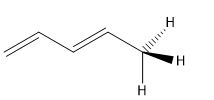
there is no acidic protons at all. You can argue that the shown H will have an enhanced acidity because bringing negative charge there will induce resonance in the species. But, the pKa of that proton is not so low, that it can be abstracted by a base of average strength like EtO-. So there eill be no acid base reaction.
There will be nucleophilic attack by EtO- also, since diene is an e- rich system and nucleophilic attack on e- rich system is ot feasible.
Add Answer to:
Why
doesn’t a reaction take place between trans-1,3-pentadiene and
Na+EtOH- in EtOH?
Cyclopentadiene is a better diene for a Diels-Alder reaction that a non-cyclic diene like 1,3-pentadiene. However,...
 Cyclopentadiene is a better diene for a Diels-Alder reaction that a non-cyclic diene like 1,3-pentadiene. However, this increased reactivity also causes cyclopentadiene to dimerize much more easily. Explain the why cyclopentadiene is more reactive than 1,3-pentadiene.
Estimate the stabilization energy for 1,3-pentadiene using the heats of hydrogenation in Table 1. Table 1....
 Estimate the stabilization energy for 1,3-pentadiene using the heats of hydrogenation in Table 1. Table 1. Heats of Hydrogenation for Selected Compounds Compound Moles H2 A H(kJ mol-?) 1-Butene 1 - 127 1-Pentene 1 -126 trans-2-pentene 1 -115 1,3-Butadiene 2 -239 trans-1,3-Pentadiene 2 -226 X 112 kJ mol-1 O 13 k) mol-1 239 kJ mol-1 15 kJ mol-1 28 kJ mol-1 Which of these dienes can undergo a Diels-Alder reaction? I II III IV V I and V I, II...
Draw the endo and exo products for the reaction of 1,3(E)-pentadiene with maleic anhydride. Which is...
Draw the endo and exo products for the reaction of 1,3(E)-pentadiene with maleic anhydride. Which is the major product?
Why is trans trans 1,4-Diphenyl-1,3-Butadiene thermodynamically more stable than cis trans 1,4-Diphenyl-1,3-Butadiene?
Why is trans trans 1,4-Diphenyl-1,3-Butadiene thermodynamically more stable than cis trans 1,4-Diphenyl-1,3-Butadiene?
Please show your work The reaction of 1,3-pentadiene with hydrogen chloride (HCI) gives the product shown...
 Please show your work
The reaction of 1,3-pentadiene with hydrogen chloride (HCI) gives the product shown below (as a racemate). However, the reaction with deuterium chloride (DCI) produces two products, A and B (also as racemates), and the ratio of these is temperature dependent. Which product, A or B is favored at low temperatures (0°C) and What happens to the ratio at higher temperatures (40°C)? Explain these in terms of kinetic vs thermodynamic control. (20 points d. How might you...
Please show your work
The reaction of 1,3-pentadiene with hydrogen chloride (HCI) gives the product shown below (as a racemate). However, the reaction with deuterium chloride (DCI) produces two products, A and B (also as racemates), and the ratio of these is temperature dependent. Which product, A or B is favored at low temperatures (0°C) and What happens to the ratio at higher temperatures (40°C)? Explain these in terms of kinetic vs thermodynamic control. (20 points d. How might you...
The major elimination product of this reaction is: Na OE EtOH OA. La
 The major elimination product of this reaction is: Na OE EtOH OA. La
Questions 1. Why does the trans conformation of a diene, in reaction with a dienophile, not lead to a Diels-Alder r...
 Questions 1. Why does the trans conformation of a diene, in reaction with a dienophile, not lead to a Diels-Alder reaction product? 2. Complete the following Diels-Alder reactions. Provide the major endo-product(s). Dienophile Product(s) 3. How many i electrons are there in a molecule of 1,3-butadiene?
p. 468) found the energy difference between cis- and trans-1,3-di-terth butylcyclohexane to be 5.9 kcal/mol, and...
 p. 468) found the energy difference between cis- and trans-1,3-di-terth butylcyclohexane to be 5.9 kcal/mol, and considers that this value represents the enerov difference between the chair and twist-boat forms of cyclohexane. Defend Allinger's position
Please help!! Questions 1. Why does the trans conformation of a diene, in reaction with a...
 Please help!!
Questions 1. Why does the trans conformation of a diene, in reaction with a dienophile, not lead to a Diels-Alder reaction product? 2. Complete the following Diels-Alder reactions. Provide the major endo-product(s). Diene Dienophile Product(s) Domov - 0.0- 3. How many a electrons are there in a molecule of 1.3-butadiene? 106 4. What is the maximum number of electrons that can reside in a molecular orbital? (Hint: It is the same maximum number that can fit into an...
Please help!!
Questions 1. Why does the trans conformation of a diene, in reaction with a dienophile, not lead to a Diels-Alder reaction product? 2. Complete the following Diels-Alder reactions. Provide the major endo-product(s). Diene Dienophile Product(s) Domov - 0.0- 3. How many a electrons are there in a molecule of 1.3-butadiene? 106 4. What is the maximum number of electrons that can reside in a molecular orbital? (Hint: It is the same maximum number that can fit into an...
Draw the product(s) of the Diels–Alder reaction of 1,3-butadiene with trans-1,2-dibromoethene. Use wedge-and-dash bonds to show...
 Draw the product(s) of the Diels–Alder reaction of 1,3-butadiene
with trans-1,2-dibromoethene. Use wedge-and-dash bonds to show the
stereochemistry of the product(s). Include hydrogens at any
chirality centers.
Draw the product(s) of the Diels–Alder reaction of 1,3-butadiene
with trans-1,2-dibromoethene. Use wedge-and-dash bonds to show the
stereochemistry of the product(s). Include hydrogens at any
chirality centers.
 Cyclopentadiene is a better diene for a Diels-Alder reaction that a non-cyclic diene like 1,3-pentadiene. However, this increased reactivity also causes cyclopentadiene to dimerize much more easily. Explain the why cyclopentadiene is more reactive than 1,3-pentadiene.
 Estimate the stabilization energy for 1,3-pentadiene using the heats of hydrogenation in Table 1. Table 1. Heats of Hydrogenation for Selected Compounds Compound Moles H2 A H(kJ mol-?) 1-Butene 1 - 127 1-Pentene 1 -126 trans-2-pentene 1 -115 1,3-Butadiene 2 -239 trans-1,3-Pentadiene 2 -226 X 112 kJ mol-1 O 13 k) mol-1 239 kJ mol-1 15 kJ mol-1 28 kJ mol-1 Which of these dienes can undergo a Diels-Alder reaction? I II III IV V I and V I, II...
 Please show your work
The reaction of 1,3-pentadiene with hydrogen chloride (HCI) gives the product shown below (as a racemate). However, the reaction with deuterium chloride (DCI) produces two products, A and B (also as racemates), and the ratio of these is temperature dependent. Which product, A or B is favored at low temperatures (0°C) and What happens to the ratio at higher temperatures (40°C)? Explain these in terms of kinetic vs thermodynamic control. (20 points d. How might you...
Please show your work
The reaction of 1,3-pentadiene with hydrogen chloride (HCI) gives the product shown below (as a racemate). However, the reaction with deuterium chloride (DCI) produces two products, A and B (also as racemates), and the ratio of these is temperature dependent. Which product, A or B is favored at low temperatures (0°C) and What happens to the ratio at higher temperatures (40°C)? Explain these in terms of kinetic vs thermodynamic control. (20 points d. How might you...
 The major elimination product of this reaction is: Na OE EtOH OA. La
 Questions 1. Why does the trans conformation of a diene, in reaction with a dienophile, not lead to a Diels-Alder reaction product? 2. Complete the following Diels-Alder reactions. Provide the major endo-product(s). Dienophile Product(s) 3. How many i electrons are there in a molecule of 1,3-butadiene?
 p. 468) found the energy difference between cis- and trans-1,3-di-terth butylcyclohexane to be 5.9 kcal/mol, and considers that this value represents the enerov difference between the chair and twist-boat forms of cyclohexane. Defend Allinger's position
 Please help!!
Questions 1. Why does the trans conformation of a diene, in reaction with a dienophile, not lead to a Diels-Alder reaction product? 2. Complete the following Diels-Alder reactions. Provide the major endo-product(s). Diene Dienophile Product(s) Domov - 0.0- 3. How many a electrons are there in a molecule of 1.3-butadiene? 106 4. What is the maximum number of electrons that can reside in a molecular orbital? (Hint: It is the same maximum number that can fit into an...
Please help!!
Questions 1. Why does the trans conformation of a diene, in reaction with a dienophile, not lead to a Diels-Alder reaction product? 2. Complete the following Diels-Alder reactions. Provide the major endo-product(s). Diene Dienophile Product(s) Domov - 0.0- 3. How many a electrons are there in a molecule of 1.3-butadiene? 106 4. What is the maximum number of electrons that can reside in a molecular orbital? (Hint: It is the same maximum number that can fit into an...
 Draw the product(s) of the Diels–Alder reaction of 1,3-butadiene
with trans-1,2-dibromoethene. Use wedge-and-dash bonds to show the
stereochemistry of the product(s). Include hydrogens at any
chirality centers.
Draw the product(s) of the Diels–Alder reaction of 1,3-butadiene
with trans-1,2-dibromoethene. Use wedge-and-dash bonds to show the
stereochemistry of the product(s). Include hydrogens at any
chirality centers.
Most questions answered within 3 hours.
-
Where is the error in this code sequence?
String s1 = "Hello";
String s2 = "ello";...
asked 10 months ago -
Financial data for Joel de Paris, Inc., for last year
follow:
Joel de Paris, Inc.
Balance...
asked 10 months ago -
Consider this reaction:
Al2(SO4)3 (aq)+ BaCl3
(aq) Al2Cl6 (aq)- +
3BaSO4(s) . What is the...
asked 10 months ago -
Suppose that Savneet is considering increasing her
recent random sample from 20 car rentals to 40...
asked 10 months ago -
Trucks arrive at an unloading terminal at an average rate of 120
per hour.
Trucks arrive...
asked 10 months ago -
Why are methanol and ethanol completely soluble in water while
octanol is not very little soluble....
asked 10 months ago -
A facilities manager at a university reads in a research report
that the mean amount of...
asked 10 months ago -
When the CuSO4 is rehydrated by adding water to the anhydrous
compound, is this an endothermic...
asked 10 months ago -
A ray of sunlight is passing from diamond into crown glass; the
angle of incidence is...
asked 10 months ago -
A block of mass 0.249 kg is placed on top of a light, vertical
spring of...
asked 10 months ago -
how do the kidneys compensate in the presences of acidosis
a) trigger hyperventilate
b) reserve acid...
asked 10 months ago -
Question 501 pts
The rental rate of capital to the firm increases. Which of the
following...
asked 10 months ago