Describe the purpose of the eTC and how it works using both NADH and FADH2 as...
Describe the purpose of the eTC and how it works using both NADH and FADH2 as examples, and
how it maintains the proton gradient. Then explain how ATP synthase utilizes the gradient in order to
make ATP, and approximately how many ATP are produced by ATP synthase per glucose molecule.
Homework Answers
Electron transport chain is the last process of cellular respiration. In this process, electrons are transported from one electron Carriers to the other.
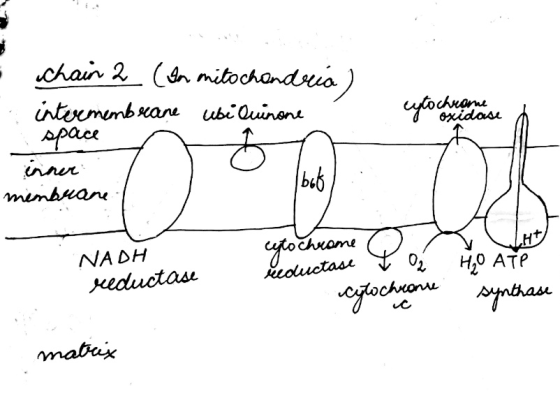
It takes place in the inner mitochondrial membrane where all the electron Carriers are embedded and arranged according to their redox potential. The electron carrier with lower redox potential comes first and the one with higher redox potential comes in the end. The one with lower redox potential has lower affinity for electrons and transfer the electrons to the one with higher redox potential which has higher affinity for electrons.
The electron donors are high energy electron Carriers, NADH and FADH2 which are synthesized in glycolysis, pyruvate oxidation and tricarboxylic acid cycle. They donate their electrons to the first Complex of electron transport chain which then passes the electrons to the subsequent electron carriers.
When electrons are passed on from one electron carrier to the other, each electron carrier pumps protons from mitochondrial Matrix to the intermembrane space. It creates a high Proton gradient or low pH in the intermembrane space. The protons are pumped back into the mitochondrial matrix by ATP synthase enzyme. This creates a Proton gradient across the inner mitochondrial membrane. This Proton gradient is responsible for the spinning of ATP synthesis enzyme which than drives ATP synthesis by phosphorylating ADP with inorganic phosphate.
The process of formation of ATP by ATP synthase enzyme in the presence of oxygen using energy derived from Proton gradient is called as oxidative phosphorylation.
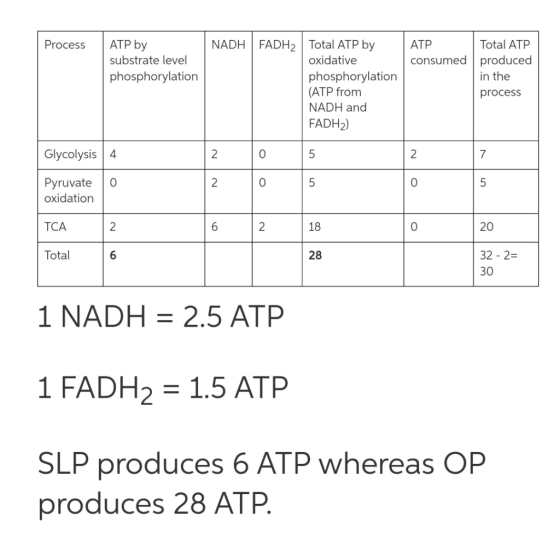
In aerobic respiration, one molecule of glucose is oxidised to carbon dioxide and water to produce molecules of ATP.
Below is the balance sheet for respiration -
Please rate.
Add Answer to:
Describe the purpose of the eTC and how it works using both NADH
and FADH2 as...
1. Which one of the following shows the correct sequence of energy transitions during chemiosmosis? A. NADH → electron acceptors → proton gradient → ATP synthase → ATP B. NADH → NAD+ → FADH2 → electro...
1. Which one of the following shows the correct sequence of energy transitions during chemiosmosis? A. NADH → electron acceptors → proton gradient → ATP synthase → ATP B. NADH → NAD+ → FADH2 → electron acceptors → ATP C. carbohydrates → acetyl CoA → CO2 → proton gradient → ATP D. NAD+ → NADH → protons → ADP → ATP E. glucose → pyruvate → acetyl CoA → NADH → ATP 2. Facultative anaerobes: A. prefer carbon dioxide. B....
How many MOLES of ATP are produced from NADH and FADH2 in the ETC? Please show...
How many MOLES of ATP are produced from NADH and FADH2 in the ETC? Please show steps of how you figured this out. Thank you.
also the # of molecules produced of ATP, NADH, and CO2 FADH2 3. (a) If you...
 also the # of molecules produced of ATP, NADH, and CO2
FADH2 3. (a) If you were to add an inhibitor that specifically GTP blocked the activity of pyruvate kinase, how many molecules per glucose molecule of each of the products listed would you expect to be produced in the presence of the inhibitor. (b) Which intermediate would you expect to build- up? B) PEP will build up from the guese. 4. (a) If you were to add an inhibitor...
also the # of molecules produced of ATP, NADH, and CO2
FADH2 3. (a) If you were to add an inhibitor that specifically GTP blocked the activity of pyruvate kinase, how many molecules per glucose molecule of each of the products listed would you expect to be produced in the presence of the inhibitor. (b) Which intermediate would you expect to build- up? B) PEP will build up from the guese. 4. (a) If you were to add an inhibitor...
QUESTION 1 What is the purpose of the proton motive force? A Powers the phosphorylation of...
 QUESTION 1 What is the purpose of the proton motive force? A Powers the phosphorylation of ATP to ADP. B. Powers the phosphorylation of ADP to ATP. C. Powers the production of high energy electron carriers. D. Powers the ability to generate more redox reactions. QUESTION 2 What is the main mechanism of action for oxidative phosphorylation? A uses the free energy of the proton gradient generated as a result of transferring electrons from NADH or FADH2 to O2 by...
Regarding the electron transport chain (ETC)...How many ATPs are produced from one NADH? From one FADH2?...
Regarding the electron transport chain (ETC)...How many ATPs are produced from one NADH? From one FADH2? Where in the ETC (i.e. to which electron carrier) does each of these molecules donate its electrons?
1. 2,4-Dinitrophenol (DNP) is a molecule that can shuttle protons across cellular membranes and was used...
1. 2,4-Dinitrophenol (DNP) is a molecule that can shuttle protons across cellular membranes and was used in diet pills in the 1930s (but was quickly discontinued for its lethality). Explain how this molecule might induce weight loss, and why its consumption is often fatal. 2. Biosynthesis and breakdown of glucose share many common enzymes and reactions, but this is not the case in the metabolism of fatty acids. Compare and contrast fatty acid biosynthesis vs. beta-oxidation (location, acyl group carriers,...
#12&13 12. Describe chemiosmosis. How is this related to the ATP synthase (ATPase)? How much ATP...
 #12&13
12. Describe chemiosmosis. How is this related to the ATP synthase (ATPase)? How much ATP is made per glucose molecule via chmiosmosis?(C) 13. Define fermentation. (C and D) How much Fill in the following sentence: Fermentation is a metabolic pathway that oxidizes produce a little ATP for the cell in the absence of oxygen but they both require regeneration of Sback to because both and the can
#12&13
12. Describe chemiosmosis. How is this related to the ATP synthase (ATPase)? How much ATP is made per glucose molecule via chmiosmosis?(C) 13. Define fermentation. (C and D) How much Fill in the following sentence: Fermentation is a metabolic pathway that oxidizes produce a little ATP for the cell in the absence of oxygen but they both require regeneration of Sback to because both and the can
YOU MUST ANSWER THE FOLLOWING QUESTIONS ON YOUR OWN PRIOR TO CLASS REVIEW! 1. Label the...
 YOU MUST ANSWER THE FOLLOWING QUESTIONS ON YOUR OWN PRIOR TO CLASS REVIEW! 1. Label the path of electrons through the light reactions of photosynthesis using the illustration below. A. Include PSII and PSI and label all the complexes involved i. Which complex pushes H* across the membrane? ii. Where do these electrons end up? iii. What is the purpose of splitting H2O? iv. Where do the light reactions take place? 2H2D Ot ENR NAOD ADP photolyetemi photosyetemi wlochtone be-...
Ignore question 4. 1. Calculate the number of ATP produced per carbon atom for a molecule...
 Ignore question 4.
1. Calculate the number of ATP produced per carbon atom for a molecule of glucose under oxidative phosphorylation (remember we use as a rule of thumb 2.5ATP per NADH and 1.5ATP per FADH2 based on the number of protons pumped in the ETC). 2. Calculate the number of ATP produced per carbon atom for a saturated fatty acid between 12 and 18 carbons long (make sure you clearly indicate the length of fatty acid you choose, e.g...
Ignore question 4.
1. Calculate the number of ATP produced per carbon atom for a molecule of glucose under oxidative phosphorylation (remember we use as a rule of thumb 2.5ATP per NADH and 1.5ATP per FADH2 based on the number of protons pumped in the ETC). 2. Calculate the number of ATP produced per carbon atom for a saturated fatty acid between 12 and 18 carbons long (make sure you clearly indicate the length of fatty acid you choose, e.g...
With all these H+ ions built up in the periplasmic space we make our way to...
With all these H+ ions built up in the periplasmic space we make our way to a large protein complex just ahead in the membrane. As we get closer we can see that H+ ions are following through this complex and causing it to spin. The energy produce by this spinning is enough to add an inorganic phosphate group to ADP molecule. Some decides to start counting the H+ ions and notices that for every 10 that flow through this...
 also the # of molecules produced of ATP, NADH, and CO2
FADH2 3. (a) If you were to add an inhibitor that specifically GTP blocked the activity of pyruvate kinase, how many molecules per glucose molecule of each of the products listed would you expect to be produced in the presence of the inhibitor. (b) Which intermediate would you expect to build- up? B) PEP will build up from the guese. 4. (a) If you were to add an inhibitor...
also the # of molecules produced of ATP, NADH, and CO2
FADH2 3. (a) If you were to add an inhibitor that specifically GTP blocked the activity of pyruvate kinase, how many molecules per glucose molecule of each of the products listed would you expect to be produced in the presence of the inhibitor. (b) Which intermediate would you expect to build- up? B) PEP will build up from the guese. 4. (a) If you were to add an inhibitor...
 QUESTION 1 What is the purpose of the proton motive force? A Powers the phosphorylation of ATP to ADP. B. Powers the phosphorylation of ADP to ATP. C. Powers the production of high energy electron carriers. D. Powers the ability to generate more redox reactions. QUESTION 2 What is the main mechanism of action for oxidative phosphorylation? A uses the free energy of the proton gradient generated as a result of transferring electrons from NADH or FADH2 to O2 by...
 #12&13
12. Describe chemiosmosis. How is this related to the ATP synthase (ATPase)? How much ATP is made per glucose molecule via chmiosmosis?(C) 13. Define fermentation. (C and D) How much Fill in the following sentence: Fermentation is a metabolic pathway that oxidizes produce a little ATP for the cell in the absence of oxygen but they both require regeneration of Sback to because both and the can
#12&13
12. Describe chemiosmosis. How is this related to the ATP synthase (ATPase)? How much ATP is made per glucose molecule via chmiosmosis?(C) 13. Define fermentation. (C and D) How much Fill in the following sentence: Fermentation is a metabolic pathway that oxidizes produce a little ATP for the cell in the absence of oxygen but they both require regeneration of Sback to because both and the can
 YOU MUST ANSWER THE FOLLOWING QUESTIONS ON YOUR OWN PRIOR TO CLASS REVIEW! 1. Label the path of electrons through the light reactions of photosynthesis using the illustration below. A. Include PSII and PSI and label all the complexes involved i. Which complex pushes H* across the membrane? ii. Where do these electrons end up? iii. What is the purpose of splitting H2O? iv. Where do the light reactions take place? 2H2D Ot ENR NAOD ADP photolyetemi photosyetemi wlochtone be-...
 Ignore question 4.
1. Calculate the number of ATP produced per carbon atom for a molecule of glucose under oxidative phosphorylation (remember we use as a rule of thumb 2.5ATP per NADH and 1.5ATP per FADH2 based on the number of protons pumped in the ETC). 2. Calculate the number of ATP produced per carbon atom for a saturated fatty acid between 12 and 18 carbons long (make sure you clearly indicate the length of fatty acid you choose, e.g...
Ignore question 4.
1. Calculate the number of ATP produced per carbon atom for a molecule of glucose under oxidative phosphorylation (remember we use as a rule of thumb 2.5ATP per NADH and 1.5ATP per FADH2 based on the number of protons pumped in the ETC). 2. Calculate the number of ATP produced per carbon atom for a saturated fatty acid between 12 and 18 carbons long (make sure you clearly indicate the length of fatty acid you choose, e.g...
Most questions answered within 3 hours.
-
Where is the error in this code sequence?
String s1 = "Hello";
String s2 = "ello";...
asked 11 months ago -
Financial data for Joel de Paris, Inc., for last year
follow:
Joel de Paris, Inc.
Balance...
asked 11 months ago -
Consider this reaction:
Al2(SO4)3 (aq)+ BaCl3
(aq) Al2Cl6 (aq)- +
3BaSO4(s) . What is the...
asked 11 months ago -
Suppose that Savneet is considering increasing her
recent random sample from 20 car rentals to 40...
asked 11 months ago -
Trucks arrive at an unloading terminal at an average rate of 120
per hour.
Trucks arrive...
asked 11 months ago -
Why are methanol and ethanol completely soluble in water while
octanol is not very little soluble....
asked 11 months ago -
A facilities manager at a university reads in a research report
that the mean amount of...
asked 11 months ago -
When the CuSO4 is rehydrated by adding water to the anhydrous
compound, is this an endothermic...
asked 11 months ago -
A ray of sunlight is passing from diamond into crown glass; the
angle of incidence is...
asked 11 months ago -
A block of mass 0.249 kg is placed on top of a light, vertical
spring of...
asked 11 months ago -
how do the kidneys compensate in the presences of acidosis
a) trigger hyperventilate
b) reserve acid...
asked 11 months ago -
Question 501 pts
The rental rate of capital to the firm increases. Which of the
following...
asked 11 months ago