A 62.8 kg woman stands on a horizontal surface. A) What is the volume of the...
A 62.8 kg woman stands on a horizontal surface.
A) What is the volume of the woman's body (in m3) if her average density is 983 kg/m3?
I know the answer for this is 0.064 m^3.
B) What average pressure (in Pa) from her weight is exerted on the horizontal surface if her two feet have a combined area of 3.64 ✕ 10−2 m2?
______pa?
I cant figure out part b someone please help.
Homework Answers
Part A. (Already Solved)
Volume = mass/density
Volume = 62.8/983 = 0.064 m^3
Part B.
We know that
Pressure = Force exerted/Area
Force exerted on ground = Weight of woman = m*g
Area = Combined area of feet = 3.64*10^-2 m^2
So,
Pressure = m*g/A
P = 62.8*9.81/(3.64*10^-2)
P = 16924.95 Pa
P = 1.69*10^4 Pa = Average Pressure exerted on ground
Please Upvote.
Add Answer to:
A 62.8 kg woman stands on a horizontal surface.
A) What is the volume of the...
A 74.5 kg man stands on a horizontal surface. (a) What is the volume of the...
A 74.5 kg man stands on a horizontal surface. (a) What is the volume of the man's body (in m^3) if his average density is 981 kg/m^3? (b) What average pressure (in Pa) from his weight is exerted on the horizontal surface if his two feet have a combined area of 4.75 ✕ 10−2 m^2?
A 56.0-kg woman stands at the western rim of a horizontal turntable having a moment of...
A 56.0-kg woman stands at the western rim of a horizontal turntable having a moment of inertia of 520 kg · m2 and a radius of 2.00 m. The turntable is initially at rest and is free to rotate about a frictionless, vertical axle through its center. The woman then starts walking around the rim counterclockwise (as viewed from above the system) at a constant speed of 1.50 m/s relative to the Earth. Consider the woman–turntable system as motion begins....
A 64.0-kg woman stands at the western rim of a horizontal turntable having a moment of...
 A 64.0-kg woman stands at the western rim of a horizontal turntable having a moment of inertia of 495 kg .m2 and a radius of 2.00 m. The turntable is initially at rest and is free to rotate about a frictionless, vertical axle through its center. The woman then starts walking around the rim clockwise (as viewed from above the system) at a constant speed of 1.50 m/s relative to the Earth. Consider the woman-turntable system as motion begins. (a)...
refer to picture. A 57.0 kg woman stands halfway up a 10.0 kg ladder, which makes...
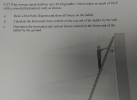 refer to picture.
A 57.0 kg woman stands halfway up a 10.0 kg ladder, which makes an angle of 24.0° with a smooth (frictionless) wall, as shown. Draw a free-body diagram and show all forces on the ladder. Calculate the horizontal force exerted on the top end of the ladder by the wall. Determine the horizontal and vertical forces exerted on the lower end of the ladder by the ground.
refer to picture.
A 57.0 kg woman stands halfway up a 10.0 kg ladder, which makes an angle of 24.0° with a smooth (frictionless) wall, as shown. Draw a free-body diagram and show all forces on the ladder. Calculate the horizontal force exerted on the top end of the ladder by the wall. Determine the horizontal and vertical forces exerted on the lower end of the ladder by the ground.
A 65.0-kg woman stands at the rim of a horizontal turntable having a moment of inertia...
A 65.0-kg woman stands at the rim of a horizontal turntable having a moment of inertia of 460 kg · m2 and a radius of 2.00 m. The turntable is initially at rest and is free to rotate about a frictionless vertical axle through its center. The woman then starts walking around the rim clockwise (as viewed from above the system) at a constant speed of 1.50 m/s relative to the Earth. (a) With what angular speed does the turntable...
A 55.0-kg woman stands at the rim of a horizontal turntable having a moment of inertia of 540 kg · m2 and a radius of...
A 55.0-kg woman stands at the rim of a horizontal turntable having a moment of inertia of 540 kg · m2 and a radius of 2.00 m. The turntable is initially at rest and is free to rotate about a frictionless vertical axle through its center. The woman then starts walking around the rim clockwise (as viewed from above the system) at a constant speed of 1.50 m/s relative to the Earth. (a) In what direction does the turntable rotate?...
*Does air affect what a scale reads? A 60-kg woman with a density of 980 kg>m3...
*Does air affect what a scale reads? A 60-kg woman with a density of 980 kg>m3 stands on a bathroom scale. Determine the reduction of the scale reading due to air. I need an explanation
on a frictionless table collides with a stationary 7. A 10 kg ball moving at a...
 on a frictionless table collides with a stationary 7. A 10 kg ball moving at a velocity of 2 m/s 5 kg ball. Find the final velocity of each ball if the collision is inelastic? If the collision is elastic and the 10 kg ball comes to a complete stop, what is the final velocity of the second ball? 8. A woman stands at the center of a platform. She is holding a dumb-bell in each hand, and outstretched. The...
1. A submarine dives from the surface of the ocean to a depth of 3500 feet...
1. A submarine dives from the surface of the ocean to a depth of 3500 feet ( 1foot= 0.305 meters) . a) what pressure increase does the submarine experience? b) at this depth of 3500 feet, what is the force (in units of N) on the hatch which has an area of 0.6 m2 ? Take the density of sea water to be 1030 kg/m3 ( It is a good assumption to presume that sea water has essentially constant density,...
Question 3 [20 marks] Water (density p1000 kg/m2; dynamic viscosity 0.001 Pa-s) flows steadily through a horizontal, st...
 Question 3 [20 marks] Water (density p1000 kg/m2; dynamic viscosity 0.001 Pa-s) flows steadily through a horizontal, straight pipe with circular cross section of diameter D=0.2 m. The volumetric flow rate is 0.01 m°/s. Argue that this is turbulent flow. [4 marksl а. Pressure drop in the pipe is due to friction. The pressure drop per unit length can be written as Др 4f L with U the average velocity in the pipe and fthe friction factor. Given the pipe...
 A 64.0-kg woman stands at the western rim of a horizontal turntable having a moment of inertia of 495 kg .m2 and a radius of 2.00 m. The turntable is initially at rest and is free to rotate about a frictionless, vertical axle through its center. The woman then starts walking around the rim clockwise (as viewed from above the system) at a constant speed of 1.50 m/s relative to the Earth. Consider the woman-turntable system as motion begins. (a)...
 refer to picture.
A 57.0 kg woman stands halfway up a 10.0 kg ladder, which makes an angle of 24.0° with a smooth (frictionless) wall, as shown. Draw a free-body diagram and show all forces on the ladder. Calculate the horizontal force exerted on the top end of the ladder by the wall. Determine the horizontal and vertical forces exerted on the lower end of the ladder by the ground.
refer to picture.
A 57.0 kg woman stands halfway up a 10.0 kg ladder, which makes an angle of 24.0° with a smooth (frictionless) wall, as shown. Draw a free-body diagram and show all forces on the ladder. Calculate the horizontal force exerted on the top end of the ladder by the wall. Determine the horizontal and vertical forces exerted on the lower end of the ladder by the ground.
 on a frictionless table collides with a stationary 7. A 10 kg ball moving at a velocity of 2 m/s 5 kg ball. Find the final velocity of each ball if the collision is inelastic? If the collision is elastic and the 10 kg ball comes to a complete stop, what is the final velocity of the second ball? 8. A woman stands at the center of a platform. She is holding a dumb-bell in each hand, and outstretched. The...
 Question 3 [20 marks] Water (density p1000 kg/m2; dynamic viscosity 0.001 Pa-s) flows steadily through a horizontal, straight pipe with circular cross section of diameter D=0.2 m. The volumetric flow rate is 0.01 m°/s. Argue that this is turbulent flow. [4 marksl а. Pressure drop in the pipe is due to friction. The pressure drop per unit length can be written as Др 4f L with U the average velocity in the pipe and fthe friction factor. Given the pipe...
Most questions answered within 3 hours.
-
Where is the error in this code sequence?
String s1 = "Hello";
String s2 = "ello";...
asked 11 months ago -
Financial data for Joel de Paris, Inc., for last year
follow:
Joel de Paris, Inc.
Balance...
asked 11 months ago -
Consider this reaction:
Al2(SO4)3 (aq)+ BaCl3
(aq) Al2Cl6 (aq)- +
3BaSO4(s) . What is the...
asked 11 months ago -
Suppose that Savneet is considering increasing her
recent random sample from 20 car rentals to 40...
asked 11 months ago -
Trucks arrive at an unloading terminal at an average rate of 120
per hour.
Trucks arrive...
asked 11 months ago -
Why are methanol and ethanol completely soluble in water while
octanol is not very little soluble....
asked 11 months ago -
A facilities manager at a university reads in a research report
that the mean amount of...
asked 11 months ago -
When the CuSO4 is rehydrated by adding water to the anhydrous
compound, is this an endothermic...
asked 11 months ago -
A ray of sunlight is passing from diamond into crown glass; the
angle of incidence is...
asked 11 months ago -
A block of mass 0.249 kg is placed on top of a light, vertical
spring of...
asked 11 months ago -
how do the kidneys compensate in the presences of acidosis
a) trigger hyperventilate
b) reserve acid...
asked 11 months ago -
Question 501 pts
The rental rate of capital to the firm increases. Which of the
following...
asked 11 months ago