A 74.5 kg man stands on a horizontal surface. (a) What is the volume of the...
A 74.5 kg man stands on a horizontal surface.
(a) What is the volume of the man's body (in m^3) if his average density is 981 kg/m^3?
(b) What average pressure (in Pa) from his weight is exerted on the horizontal surface if his two feet have a combined area of 4.75 ✕ 10−2 m^2?
Homework Answers

Add Answer to:
A 74.5 kg man stands on a horizontal surface.
(a) What is the volume of the...
A 62.8 kg woman stands on a horizontal surface. A) What is the volume of the...
A 62.8 kg woman stands on a horizontal surface. A) What is the volume of the woman's body (in m3) if her average density is 983 kg/m3? I know the answer for this is 0.064 m^3. B) What average pressure (in Pa) from her weight is exerted on the horizontal surface if her two feet have a combined area of 3.64 ✕ 10−2 m2? ______pa? I cant figure out part b someone please help.
A 1,650-kg car stands on a square platform, and a 75-kg man simply stands on another...
A 1,650-kg car stands on a square platform, and a 75-kg man simply stands on another square platform. These platforms are in fact two caps of a large oil-filled container. What must be the relation between the areas of the two platforms (that under the car and that under the man), for the man to be able to barely lift the car just by standing on his platform, without applying additional forces with his muscles? -The area of the car's...
A man jumps out from an aeroplane. As the man falls, he opens his parachute. What...
A man jumps out from an aeroplane. As the man falls, he opens his parachute. What is the man’s terminal velocity if his drag coefficient with his parachute is 0.55, the combined mass of the man-parachute system is 80 kg, the surface area of the man and his parachute is 10 m^2 , and air density is 1.225 kg/m^3 . If a human can survive up to 13 m/s impact speed on a hard floor, can the parachuting man survive...
The 75-kg man pushes on the 150-kg crate with a horizontal force F. The coefficients of...
The 75-kg man pushes on the 150-kg crate with a horizontal force F. The coefficients of static and kinetic friction between the crate and the surface are μs = 0.3 and μk = 0.1, and the coefficient of static friction between the man's shoes and the surface is μ′s = 0.8. What is the greatest acceleration the man can give the crate if the man's acceleration is zero at this instant? I keep getting 1.96 but it says answer is...
4 4. An 80-kg man stands in an elevator. What is his apparent weight when 1)...
 4
4. An 80-kg man stands in an elevator. What is his apparent weight when 1) the elevators stationary, IT) the elevator accelerates up at 2 m/s?. III) the elevator accelerates down at 2 m/s IV) the elevator cruises up at constant velocity of 1 m/s. A) Draw a free body diagram of the man labeling the two forces (n and weight) acting on him. B) Write Newton's 2nd law, just including the vertical components. C) Put the forces n...
4
4. An 80-kg man stands in an elevator. What is his apparent weight when 1) the elevators stationary, IT) the elevator accelerates up at 2 m/s?. III) the elevator accelerates down at 2 m/s IV) the elevator cruises up at constant velocity of 1 m/s. A) Draw a free body diagram of the man labeling the two forces (n and weight) acting on him. B) Write Newton's 2nd law, just including the vertical components. C) Put the forces n...
A man with a mass of 75.5 kg stands on one foot. His femur has a...
A man with a mass of 75.5 kg stands on one foot. His femur has a cross-sectional area of 8.00 cm2 and an uncompressed length 50.9 cm. Young’s modulus for compression of the human femur is 9.40 × 10⁹ N/m2. How much shorter is the femur when the man stands on one foot? What is the fractional length change of the femur when the person moves from standing on two feet to standing on one foot?
The 75-kg man pushes on the 150 kg crate with a horizontal force F The coefficients of static and kinetic friction...
 The 75-kg man pushes on the 150 kg crate with a horizontal force F The coefficients of static and kinetic friction between the crate and the surface are us=0.3 and uk = 0.18, and the coefficient of static friction between the man's shoes and the surface is u's=0.8. (Figure 1) What is the greatest acceleration the man can give the crate if the man's acceleration is zero at this instant? (Ctri)
If a man weighs 220 lb with a body fat percentage of 28%: (a) What is...
If a man weighs 220 lb with a body fat percentage of 28%: (a) What is the density of this person's body in kg/m^3? (b) What is the volume of the person's body? (c) Find the apparent weight of this person when completely submerged in water. Assume fat has a density of 900 kg/m^3 and fat-free body mass has a density of 1100 kg/m^3.
2 out of 3 attempts A man is trying to lift 67.2 kg off the floor...
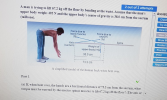 2 out of 3 attempts A man is trying to lift 67.2 kg off the floor by bending at the waist. Assume that the man's Assist upper body weighs 495 N and the upper body's center of gravity is 38.0 cm from the sacrum (tailbone) Checi Try An View H View Q Show M Guided Practice Force due to back muscles Force due to sacrum (Fs) Spine Axis (sacrum) Weight of upper body (mg Print 38.0 cm 73.3 cm A...
An 80 kg man stands in a very strong wind moving at 17 m/s at torso...
An 80 kg man stands in a very strong wind moving at 17 m/s at torso height. As you know, he will need to lean in to the wind, and we can model the situation to see why. Assume that the man has a mass of 80 kg, with a center of gravity 1.0 m above the ground. The action of the wind on his torso, which we approximate as a cylinder 50 cm wide and 90 cm long centered...
 4
4. An 80-kg man stands in an elevator. What is his apparent weight when 1) the elevators stationary, IT) the elevator accelerates up at 2 m/s?. III) the elevator accelerates down at 2 m/s IV) the elevator cruises up at constant velocity of 1 m/s. A) Draw a free body diagram of the man labeling the two forces (n and weight) acting on him. B) Write Newton's 2nd law, just including the vertical components. C) Put the forces n...
4
4. An 80-kg man stands in an elevator. What is his apparent weight when 1) the elevators stationary, IT) the elevator accelerates up at 2 m/s?. III) the elevator accelerates down at 2 m/s IV) the elevator cruises up at constant velocity of 1 m/s. A) Draw a free body diagram of the man labeling the two forces (n and weight) acting on him. B) Write Newton's 2nd law, just including the vertical components. C) Put the forces n...
 The 75-kg man pushes on the 150 kg crate with a horizontal force F The coefficients of static and kinetic friction between the crate and the surface are us=0.3 and uk = 0.18, and the coefficient of static friction between the man's shoes and the surface is u's=0.8. (Figure 1) What is the greatest acceleration the man can give the crate if the man's acceleration is zero at this instant? (Ctri)
 2 out of 3 attempts A man is trying to lift 67.2 kg off the floor by bending at the waist. Assume that the man's Assist upper body weighs 495 N and the upper body's center of gravity is 38.0 cm from the sacrum (tailbone) Checi Try An View H View Q Show M Guided Practice Force due to back muscles Force due to sacrum (Fs) Spine Axis (sacrum) Weight of upper body (mg Print 38.0 cm 73.3 cm A...
Most questions answered within 3 hours.
-
Where is the error in this code sequence?
String s1 = "Hello";
String s2 = "ello";...
asked 10 months ago -
Financial data for Joel de Paris, Inc., for last year
follow:
Joel de Paris, Inc.
Balance...
asked 10 months ago -
Consider this reaction:
Al2(SO4)3 (aq)+ BaCl3
(aq) Al2Cl6 (aq)- +
3BaSO4(s) . What is the...
asked 10 months ago -
Suppose that Savneet is considering increasing her
recent random sample from 20 car rentals to 40...
asked 10 months ago -
Trucks arrive at an unloading terminal at an average rate of 120
per hour.
Trucks arrive...
asked 10 months ago -
Why are methanol and ethanol completely soluble in water while
octanol is not very little soluble....
asked 10 months ago -
A facilities manager at a university reads in a research report
that the mean amount of...
asked 10 months ago -
When the CuSO4 is rehydrated by adding water to the anhydrous
compound, is this an endothermic...
asked 10 months ago -
A ray of sunlight is passing from diamond into crown glass; the
angle of incidence is...
asked 10 months ago -
A block of mass 0.249 kg is placed on top of a light, vertical
spring of...
asked 10 months ago -
how do the kidneys compensate in the presences of acidosis
a) trigger hyperventilate
b) reserve acid...
asked 10 months ago -
Question 501 pts
The rental rate of capital to the firm increases. Which of the
following...
asked 10 months ago