5. Imagine we have only computer and wheat in the economy. The PPF of this economy...
5. Imagine we have only computer and wheat in the economy. The
PPF of this economy is not
linear. Draw a possible PPF for this economy using your imagination
and briefly explain what
this non-linearity shows
Homework Answers


Add Answer to:
5. Imagine we have only computer and wheat in the economy. The
PPF of this economy...
Consider an economy with only one good, wheat, and no money. Wheat can be planted in...
Consider an economy with only one good, wheat, and no money. Wheat can be planted in one period in order to produce more wheat in the next period. You want to grow some wheat but you have none, so you need to borrow some to get started. The quantity of wheat that you will produce in the next period (output) as a function of the quantity that you plant this period (investment) is as follows. Investment Output 1 3 2 ...
GRAPHING 31. Draw a PPF for an economy that, when exhausting all given resources, can produce...
 GRAPHING 31. Draw a PPF for an economy that, when exhausting all given resources, can produce either 65 tons of steel or 90 tons of cheese. Label three points showing A. maximum productive efficiency, B. improper resource allocation/inefficient production, and C. unattainable levels of output. (7 pts) 32. What does the slope of the PPF represent conceptually? How (mathematically)? Be brief and to the point. Explain using your PPF above. (5 pts)
6. The following table shows how many hours it would take to produce one meter of...
 6. The following table shows how many hours it would take to produce one meter of cloth or one kilogram of wheat for country A and country B._? Cloth wheat Country A 1 hour/per meter 3 hours/per kg Country B 2 hours / per meter 4 hours/per kg According to the absolute advantage theory, is there a basis for trade between country A and country B? Explain. Which country has the comparative advantage in wheat production? Explain your answer. Now...
1. Suppose that a simple economy produced only three goods: wheat, automobiles, and chairs. The table...
 1. Suppose that a simple economy produced only three goods: wheat, automobiles, and chairs. The table below lists the quantity and prices for each of the goods for year 2000 and 2010. Based on table, answer the following questions (7.8 total points): Price in 2000 Wheat Automobiles Chairs Quantity produced in 2000 100 200 400 $5 $40,000 $10 a) Calculate nominal GDP in year 2000. 5 points) b) Suppose prices doubled by 2010 but production stayed the same. Calculate the...
A6-9. Imagine an economy with an average level of human capital (H) equal to 5, an...
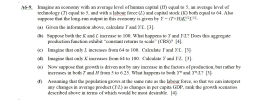 A6-9. Imagine an economy with an average level of human capital (H) equal to 5, an average level of technology (T) equal to 5, and with a labour force (L) and capital stock (K) both equal to 64. Also suppose that the long-run output in this economy is given by Y = (T+H)K12L1/2, (a) Given the information above, calculate Y and Y/L. [3]. (b) Suppose both the K and L increase to 100. What happens to Y and Y/L? Does...
We have discussed stagflation in this course. Explain how stagflation can be caused in an economy....
We have discussed stagflation in this course. Explain how stagflation can be caused in an economy. Include an explanation of the shift in the AD-AS diagram that could cause stagflation, and possible reasons for such a shift. Please do not draw graphs - a written explanation is all that is required. (b) Recall our class discussion on the money market, money demand and money supply. Suppose you are studying the money market in an open economy. You now see that...
Imagine that you have been appointed as a project manager for an important IT project in...
Imagine that you have been appointed as a project manager for an important IT project in a large firm. Answer the following questions: Briefly outline which category of employee (top managers, business analysts, designers, developers, testers, system administrators, end-users) you will have frequent interaction with during the seven phases of the Systems Development Life Cycle and briefly explain why your interaction with these categories of employees will be frequent. What project management tools would you draw on over the course of...
2. There is an economy consisting of only two people, Fred and Robin, who produce and...
 2. There is an economy consisting of only two people, Fred and Robin, who produce and consume two goods: gallons of juice and gallons of beer. In 1 week, Robin can produce 25 gallons of juice or 5 gallons of beer. Fred can produce 12 gallons of juice or 4 gallons of beer. Assume both goods can be produced in continuous quantities. a) Determine who has the comparative advantage in each good. Show the numbers that led to this conclusion....
5. Imagine there is an economy with pure exchange with two individuals (1 and 2). A,...
5. Imagine there is an economy with pure exchange with two individuals (1 and 2). A, B and C are three points that belong to the utility possibility frontier (UPF) of the two individuals. Points U1 U2 A 2 7 B 5 5 C 7 2 According to the information of the previous table, is the following statement true or false: "The point D (2,5) belong to the UPF" Question: True or False A. true B False Explain your answer...
Question 01. Suppose that both the U.S. and Japan can produce computers and bushels of wheat...
Question 01. Suppose that both the U.S. and Japan can produce computers and bushels of wheat using only labor (i.e., two countries, two goods, one factor Ricardian model). One U.S. worker can produce 3 computers or 10 bushels of wheat. One Japanese worker can produce 2 computers or 5 bushels of wheat. Given that the U.S. has 100 workers and Japan has 180 workers, answer each of the following parts. Show your work for credit. A. Which country has the...
 GRAPHING 31. Draw a PPF for an economy that, when exhausting all given resources, can produce either 65 tons of steel or 90 tons of cheese. Label three points showing A. maximum productive efficiency, B. improper resource allocation/inefficient production, and C. unattainable levels of output. (7 pts) 32. What does the slope of the PPF represent conceptually? How (mathematically)? Be brief and to the point. Explain using your PPF above. (5 pts)
 6. The following table shows how many hours it would take to produce one meter of cloth or one kilogram of wheat for country A and country B._? Cloth wheat Country A 1 hour/per meter 3 hours/per kg Country B 2 hours / per meter 4 hours/per kg According to the absolute advantage theory, is there a basis for trade between country A and country B? Explain. Which country has the comparative advantage in wheat production? Explain your answer. Now...
 1. Suppose that a simple economy produced only three goods: wheat, automobiles, and chairs. The table below lists the quantity and prices for each of the goods for year 2000 and 2010. Based on table, answer the following questions (7.8 total points): Price in 2000 Wheat Automobiles Chairs Quantity produced in 2000 100 200 400 $5 $40,000 $10 a) Calculate nominal GDP in year 2000. 5 points) b) Suppose prices doubled by 2010 but production stayed the same. Calculate the...
 A6-9. Imagine an economy with an average level of human capital (H) equal to 5, an average level of technology (T) equal to 5, and with a labour force (L) and capital stock (K) both equal to 64. Also suppose that the long-run output in this economy is given by Y = (T+H)K12L1/2, (a) Given the information above, calculate Y and Y/L. [3]. (b) Suppose both the K and L increase to 100. What happens to Y and Y/L? Does...
 2. There is an economy consisting of only two people, Fred and Robin, who produce and consume two goods: gallons of juice and gallons of beer. In 1 week, Robin can produce 25 gallons of juice or 5 gallons of beer. Fred can produce 12 gallons of juice or 4 gallons of beer. Assume both goods can be produced in continuous quantities. a) Determine who has the comparative advantage in each good. Show the numbers that led to this conclusion....
Most questions answered within 3 hours.
-
Where is the error in this code sequence?
String s1 = "Hello";
String s2 = "ello";...
asked 10 months ago -
Financial data for Joel de Paris, Inc., for last year
follow:
Joel de Paris, Inc.
Balance...
asked 10 months ago -
Consider this reaction:
Al2(SO4)3 (aq)+ BaCl3
(aq) Al2Cl6 (aq)- +
3BaSO4(s) . What is the...
asked 10 months ago -
Suppose that Savneet is considering increasing her
recent random sample from 20 car rentals to 40...
asked 10 months ago -
Trucks arrive at an unloading terminal at an average rate of 120
per hour.
Trucks arrive...
asked 10 months ago -
Why are methanol and ethanol completely soluble in water while
octanol is not very little soluble....
asked 10 months ago -
A facilities manager at a university reads in a research report
that the mean amount of...
asked 10 months ago -
When the CuSO4 is rehydrated by adding water to the anhydrous
compound, is this an endothermic...
asked 10 months ago -
A ray of sunlight is passing from diamond into crown glass; the
angle of incidence is...
asked 10 months ago -
A block of mass 0.249 kg is placed on top of a light, vertical
spring of...
asked 10 months ago -
how do the kidneys compensate in the presences of acidosis
a) trigger hyperventilate
b) reserve acid...
asked 10 months ago -
Question 501 pts
The rental rate of capital to the firm increases. Which of the
following...
asked 10 months ago