The formula for the nth Tetranacci number ?? is defined as follows: ?0 = 0 ?1...
The formula for the nth Tetranacci number ?? is defined as follows: ?0 = 0 ?1 = 1 ?2 = 1 ?3 = 2 ?? = ??−1 + ??−2 + ??−3 + ??−4 Your task is to implement a recursive function which accepts an integer n (you may assume that n >= 0), and computes the n-th Tetranacci number (don’t worry about efficiency, only about making the definition as simple as possible).
Homework Answers
`Hey,
Note: If you have any queries related the answer please do comment. I would be very happy to resolve all your queries.
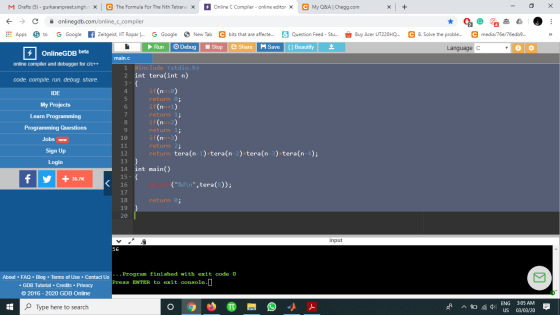
#include <stdio.h>
int tera(int n)
{
if(n==0)
return 0;
if(n==1)
return 1;
if(n==2)
return 1;
if(n==3)
return 2;
return tera(n-1)+tera(n-2)+tera(n-3)+tera(n-4);
}
int main()
{
printf("%d\n",tera(8));
return 0;
}
Kindly revert for any queries
Thanks.
Add Answer to:
The formula for the nth Tetranacci number ?? is defined as
follows: ?0 = 0 ?1...
In mathematics, the Nth harmonic number is defined to be 1 1/2 1/3+ 141/N. So, the...
 In mathematics, the Nth harmonic number is defined to be 1 1/2 1/3+ 141/N. So, the first harmonic number is 1 second is 1.5, the third is 1.83333... and so on. Assume that n is an integer variable whose value is some also that hn is a double variable whose value is the Nth harmonic number. Write an expression whose value is the (N+-1)th , the harmonic number.
Suppose that a Tibonacci sequence is defined as follows: Tibo(0) = 1, Tibo(1) = 2, Tibo(2)...
Suppose that a Tibonacci sequence is defined as follows: Tibo(0) = 1, Tibo(1) = 2, Tibo(2) = 3 Tibo(n) = Tibo(n-1) + Tibo(n-3), when n ≥ 3 Write a recursive method Tibo, that takes some integer n as a parameter and returns the n-th Tibonacci number. You DO NOT need to write the main function.
Consider Fibonacci number F(N), where N is a positive integer, defined as follows. F(1) = 1...
Consider Fibonacci number F(N), where N is a positive integer, defined as follows. F(1) = 1 F(2) = 1 F(N) = F(N-1) + F(N-2) for N > 2 a) Write a recursive function that computes Fibonacci number for a given integer N≥ 1. b) Prove the following theorem using induction: F(N) < ΦN for integer N≥ 1, where Φ = (1+√5)/2.
IN JAVA A Fibonacci Word is a string of 0's and 1's defined recursively as follows:...
 IN JAVA
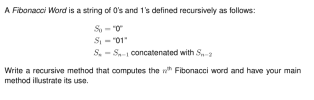
A Fibonacci Word is a string of 0's and 1's defined recursively as follows: So ) = "0" S1 = "01" Sn Sn-1 Concatenated with Sn-2 Write a recursive method that computes the nth Fibonacci word and have your main method illustrate its use
IN JAVA
A Fibonacci Word is a string of 0's and 1's defined recursively as follows: So ) = "0" S1 = "01" Sn Sn-1 Concatenated with Sn-2 Write a recursive method that computes the nth Fibonacci word and have your main method illustrate its use
Write a program in MIPs Assembly Language to compute nth number of a fibonacci number sequence....
Write a program in MIPs Assembly Language to compute nth number of a fibonacci number sequence. Your program should prompt for an integer input n from the user. The program should call a recursive function to compute the nth fibonacci number. Your program must follow programming convention. You should submit program and screenshot of output in a single word/pdf file. You should use following recursive definition of fibonacci function: fib(0) = 0 fib(1) = 1 fib(n) = fib(n-1) +fib(n-2)
F# ONLY SOMEONE SOLVED IN PYTHON JUST NOW. I NEED F SHARP PROGRAMMING THANKS A more...
F# ONLY SOMEONE SOLVED IN PYTHON JUST NOW. I NEED F SHARP PROGRAMMING THANKS A more efficient version of the function for computing Tetranacci numbers can be defined by following three steps: Implement a function which takes a list of integers and adds the sum of the top four elements to the head of the list (e.g., in F#, 1::1::1::1::[] should become 4::1::1::1::1::[]). Implement a recursive function which accepts an integer n as input (again, assume n >= 0), and...
1. The famous Fibonacci sequence f1, f2, f3, . . . is defined as f1 =...
1. The famous Fibonacci sequence f1, f2, f3, . . . is defined as f1 = 1, f2 = 1 fn = fn−1 + fn−2, for n > 2 So the sequence begins as 1, 1, 2, 3, 5, 8, 13, 21, 34, . . .. Define a recursive function int fibonacci(int n) which returns the n-th Fibonacci number 2. Define recursive function my_sequence(n) which returns the n-th member of the sequence a1 = 3, a2 = 5, a3 =...
Using java programming. Question 1. Write a recursive function fibo(n) that returns the nth Fibonacci number...
Using java programming. Question 1. Write a recursive function fibo(n) that returns the nth Fibonacci number which is defined as follows: fibo(0) = 0 fibo(1) = 1 fibo(n) = fibo(n-1) + fibo(n-2) for n >= 2 Question 2. Write a recursive function that calculates the sum of quintics: 1power of5 + 2power of5 + 3power of5 + … + n5 Question 3. Write a program to find a route from one given position to another given position for the knight...
1. Write an iterative C++ function that inputs a nonnegative integer n and returns the nth...
1. Write an iterative C++ function that inputs a nonnegative integer n and returns the nth Fibonacci number. 2. Write a recursive C++ function that inputs a nonnegative integer n and returns the nth Fibonacci number.
The factorial of a nonnegative n written as n! is defined as follows: n!= n*(n-1)*(n-2) *...
The factorial of a nonnegative n written as n! is defined as follows: n!= n*(n-1)*(n-2) * .... *1 (for all values of n greater than 0) and 0! =1. For example 5! = 5*4*3*2*1 which is 120. (can also be 1*2*3*4*5) Write a C++ program that reads a nonnegative integer and computes and prints its factorial.
 In mathematics, the Nth harmonic number is defined to be 1 1/2 1/3+ 141/N. So, the first harmonic number is 1 second is 1.5, the third is 1.83333... and so on. Assume that n is an integer variable whose value is some also that hn is a double variable whose value is the Nth harmonic number. Write an expression whose value is the (N+-1)th , the harmonic number.
 IN JAVA
A Fibonacci Word is a string of 0's and 1's defined recursively as follows: So ) = "0" S1 = "01" Sn Sn-1 Concatenated with Sn-2 Write a recursive method that computes the nth Fibonacci word and have your main method illustrate its use
IN JAVA
A Fibonacci Word is a string of 0's and 1's defined recursively as follows: So ) = "0" S1 = "01" Sn Sn-1 Concatenated with Sn-2 Write a recursive method that computes the nth Fibonacci word and have your main method illustrate its use
Most questions answered within 3 hours.
-
Where is the error in this code sequence?
String s1 = "Hello";
String s2 = "ello";...
asked 10 months ago -
Financial data for Joel de Paris, Inc., for last year
follow:
Joel de Paris, Inc.
Balance...
asked 10 months ago -
Consider this reaction:
Al2(SO4)3 (aq)+ BaCl3
(aq) Al2Cl6 (aq)- +
3BaSO4(s) . What is the...
asked 10 months ago -
Suppose that Savneet is considering increasing her
recent random sample from 20 car rentals to 40...
asked 10 months ago -
Trucks arrive at an unloading terminal at an average rate of 120
per hour.
Trucks arrive...
asked 10 months ago -
Why are methanol and ethanol completely soluble in water while
octanol is not very little soluble....
asked 10 months ago -
A facilities manager at a university reads in a research report
that the mean amount of...
asked 10 months ago -
When the CuSO4 is rehydrated by adding water to the anhydrous
compound, is this an endothermic...
asked 10 months ago -
A ray of sunlight is passing from diamond into crown glass; the
angle of incidence is...
asked 10 months ago -
A block of mass 0.249 kg is placed on top of a light, vertical
spring of...
asked 10 months ago -
how do the kidneys compensate in the presences of acidosis
a) trigger hyperventilate
b) reserve acid...
asked 10 months ago -
Question 501 pts
The rental rate of capital to the firm increases. Which of the
following...
asked 10 months ago