17. Describe the structure of a neuron and how it transmits a nerve impulse within the...
17. Describe the structure of a neuron and how it transmits a nerve impulse within the neuron and between neurons (at the synapse).
Homework Answers
Answer - are cells that make up our nervous system. A neuron is made up of three parts basically which includes dendrites, soma & the axon.
Dendrites - these are branch-like structures that receive a signal from the other connected neuron.
Soma - also known as cell body which has all the neuron cell organelles.
Axon - It is a structure that is wrapped by fatty myelin.
The dendrites receive signals from other neurons via neurotransmitters which when binds to the receptors on the dendrites act as a chemical signal. That binding opens ion channels that allow charged ions to flow in and out of the neurons converting the chemical signal into an electrical signal. Since multiple dendrites receive neurotransmitters, which results in the change of the charge signals inside the neuron ultimately give rise to an action potential. This action potential is an electrical signal that passes through the axon triggering the release of neurotransmitters on the other end of the neuron which is passed onto the next neuron and so on further. Neurotransmitters are used by a neuron to communicate with each other. The action potential in the axon is usually carried out to propagate signals within the cell.
Add Answer to:
17. Describe the structure of a neuron and how it transmits a
nerve impulse within the...
Question 4: Impulse Transmission Between Neurons Nerve impulses travel from neuron to neuron. Describe this mode...
Question 4: Impulse Transmission Between Neurons Nerve impulses travel from neuron to neuron. Describe this mode of propagation, and draw a model to supplement your description. Explain how it differs from the mode of propagation along the neuron.
1. The main receptive surface of neuron at a synapse for nerve Impulse transmission is: a....
 1. The main receptive surface of neuron at a synapse for nerve Impulse transmission is: a. Axon neurotransmitter receptors b. Dendrite neurotransmitter receptors C. Nissl bodies receptors d. Axon terminal receptors 2. Two types of cells in nervous system are: a. Axons & dendrites b. Motor and sensory neurons c. Neurons & neuroglia d. Schwann cells & microglia 3. Myelin is rich in : a. Lipids b. Carbohydrates c. Nucleic acids d. Salts 4. Synaptic knobs are at end of:...
18. What is the difference between a nerve and a neuron? a. A nerve includes parts...
 18. What is the difference between a nerve and a neuron? a. A nerve includes parts of multiple neurons. b. A neuron is only the soma, or body, of a nerve. c. Nerves carry information away from the brain, whereas neurons carry information to the brain. d: Nerves are cells that nourish and support the neurons. e. None of the above; there is no difference between these terms.
Label the parts of a neuron in Figure 13.2 Exercise 1: Neuron Structure AXON Node of...
 Label the parts of a neuron in Figure 13.2 Exercise 1: Neuron Structure AXON Node of Ranvier Dendites -2 Niss/ bodies RAxo dendritic -Blinapon sapete Gunction) - Axonic Angrening mydin hilock schwann.cell Yxonic timmar Figure 13.2: Neuron model. Neurons may be classified according to their differences in structure or in function. Functionally, there are three types of neurons. A change in the environment, such as a change in temperature or pressure against the skin, is detected by receptors associated with...
Complete the following sentences regarding impulse processing. nuclei presynaptic neuron divergence postsynaptic neurons action potential convergence...
Complete the following sentences regarding impulse processing. nuclei presynaptic neuron divergence postsynaptic neurons action potential convergence neuronal pools facilitation 1. Neurons are organized into ____________ which can make multiple synaptic connections to receive and transmit information in the brain. 2. For example, any single neuron in the group may receive information from more than one ____________ . 3. This is called ____________ and makes it possible for impulses to have an additive effect or to collect a variety of sensory information. 4. An impulse from...
3. Describe the general morphological structure of a typical neuron and describe each structure in terms...
 3. Describe the general morphological structure of a typical neuron and describe each structure in terms of location within the cell and its function to the cell. (5 points)
1. Using nerve impulse transmission as an example, describe the importance and mechanism of the following...
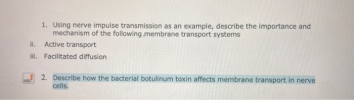 1. Using nerve impulse transmission as an example, describe the importance and mechanism of the following membrane transport systems ii. Active transport iii. Facilitated diffusion ABC 2. Describe how the bacterial botulinum toxin affects membrane transport in nerve cells.
Very broadly speaking, how many presynaptic neurons synapse on a postsynaptic neuron? (one, a few or...
Very broadly speaking, how many presynaptic neurons synapse on a postsynaptic neuron? (one, a few or many)
Very broadly speaking, how many presynaptic neurons synapse on a postsynaptic neuron? (one, a few or...
Very broadly speaking, how many presynaptic neurons synapse on a postsynaptic neuron? (one, a few or many)
Describe the process of neuronal communication, beginning with the generation of a nerve impulse and ending...
Describe the process of neuronal communication, beginning with the generation of a nerve impulse and ending with reuptake.
 1. The main receptive surface of neuron at a synapse for nerve Impulse transmission is: a. Axon neurotransmitter receptors b. Dendrite neurotransmitter receptors C. Nissl bodies receptors d. Axon terminal receptors 2. Two types of cells in nervous system are: a. Axons & dendrites b. Motor and sensory neurons c. Neurons & neuroglia d. Schwann cells & microglia 3. Myelin is rich in : a. Lipids b. Carbohydrates c. Nucleic acids d. Salts 4. Synaptic knobs are at end of:...
 18. What is the difference between a nerve and a neuron? a. A nerve includes parts of multiple neurons. b. A neuron is only the soma, or body, of a nerve. c. Nerves carry information away from the brain, whereas neurons carry information to the brain. d: Nerves are cells that nourish and support the neurons. e. None of the above; there is no difference between these terms.
 Label the parts of a neuron in Figure 13.2 Exercise 1: Neuron Structure AXON Node of Ranvier Dendites -2 Niss/ bodies RAxo dendritic -Blinapon sapete Gunction) - Axonic Angrening mydin hilock schwann.cell Yxonic timmar Figure 13.2: Neuron model. Neurons may be classified according to their differences in structure or in function. Functionally, there are three types of neurons. A change in the environment, such as a change in temperature or pressure against the skin, is detected by receptors associated with...
 3. Describe the general morphological structure of a typical neuron and describe each structure in terms of location within the cell and its function to the cell. (5 points)
 1. Using nerve impulse transmission as an example, describe the importance and mechanism of the following membrane transport systems ii. Active transport iii. Facilitated diffusion ABC 2. Describe how the bacterial botulinum toxin affects membrane transport in nerve cells.
Most questions answered within 3 hours.
-
Where is the error in this code sequence?
String s1 = "Hello";
String s2 = "ello";...
asked 11 months ago -
Financial data for Joel de Paris, Inc., for last year
follow:
Joel de Paris, Inc.
Balance...
asked 11 months ago -
Consider this reaction:
Al2(SO4)3 (aq)+ BaCl3
(aq) Al2Cl6 (aq)- +
3BaSO4(s) . What is the...
asked 11 months ago -
Suppose that Savneet is considering increasing her
recent random sample from 20 car rentals to 40...
asked 11 months ago -
Trucks arrive at an unloading terminal at an average rate of 120
per hour.
Trucks arrive...
asked 11 months ago -
Why are methanol and ethanol completely soluble in water while
octanol is not very little soluble....
asked 11 months ago -
A facilities manager at a university reads in a research report
that the mean amount of...
asked 11 months ago -
When the CuSO4 is rehydrated by adding water to the anhydrous
compound, is this an endothermic...
asked 11 months ago -
A ray of sunlight is passing from diamond into crown glass; the
angle of incidence is...
asked 11 months ago -
A block of mass 0.249 kg is placed on top of a light, vertical
spring of...
asked 11 months ago -
how do the kidneys compensate in the presences of acidosis
a) trigger hyperventilate
b) reserve acid...
asked 11 months ago -
Question 501 pts
The rental rate of capital to the firm increases. Which of the
following...
asked 11 months ago