
Homework Answers
Neuron is the basic unit of central and peripheral nervous system. It is a specialised cells that transfer chemical and electrical signal between surrounding neurons and muscles cells.
Sturcture of a neuron:
The neuron is atypical to a normal cells, having few processes. In addition to all the cell component of a cell like nucleus and mitochondria and ribosome, it conatins few unique structure for transferring electrical and chemical signals.
1. Cell body:
It is the central portaion of the cell containing all the organelles like endoplasmic reticulum, Golgi body, mitochondria and nucleus and is round shaped.
2. Dendrites:
these are the branch like structures projections from the cell body. There is absence of any kind of covering on the dendrite and a main dentrite can branch away into few, which are known as dendritic spine. The main function of dendrites is to receive the electrical signal and transfer the same to the cell body.
3. Axon:
It is a single tube like structure projecting from the cell body
opposite to the surface of origin of dendrites. It carries the
signal from cell body to the dendrites of next neuron or to the
muscle cells. There are branching at the terminal of an axon along
with nobs, which store the neurotransmitter.
the junction of cell body and axon is known as axon hillock. There
are presence of Nissl granules in the axon hillock which are
actually rough endoplasmic reticulum.
4. Myelin sheath:
some axons are covered by a lipid rich substance to insulate them. This is known as myelin sheath. The myelin helps in rapid transfer of electrical potential along the axon of neuron. It is actually formed by glial cells, which are non-neuronal in origin.
5. Nodes of Ranvier:
there are periodic gaps in myelin sheath where the electrical signal is actually "jumps" to get transferred to the end of the axon.
6. Schwann cell:
It is also called neurilemma cell and any of the cells in the
peripheral nervous system that produce the myelin sheath around
neuronal axons.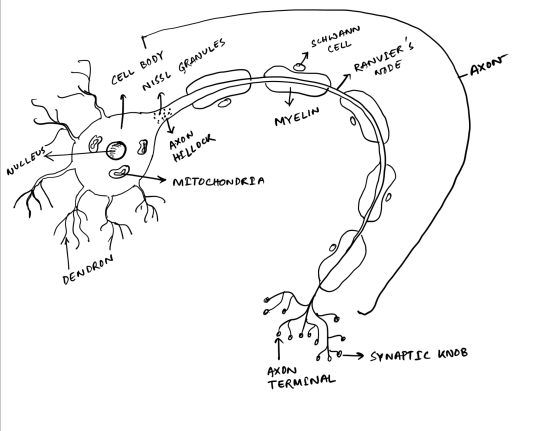
Add Answer to:
3. Describe the general morphological structure of a typical neuron and describe each structure in terms...
5. List the 6 Neuroglia cells located in the nervous system and describe their general structure,...
 5. List the 6 Neuroglia cells located in the nervous system and describe their general structure, function, and location. (10 points) 6. Describe the Myelin sheath and tell me why it is important? (3 points)
Describe the morphological and anatomical differences between sporophytes of Marchantia and a typical moss and discuss...
Describe the morphological and anatomical differences between sporophytes of Marchantia and a typical moss and discuss the evolutionary trends shown by these structures. Answer should be between 2 to 5 sentences
17. Describe the structure of a neuron and how it transmits a nerve impulse within the...
17. Describe the structure of a neuron and how it transmits a nerve impulse within the neuron and between neurons (at the synapse).
1. The chemical reasons for the value of the resting membrane potential for a typical neuron...
1. The chemical reasons for the value of the resting membrane potential for a typical neuron (-70mV) and the electrochemical forces that act on sodium and potassium. Know the role of the Na+/K+ pump. What is a K+ leak channel? 2. Describe the events at a synapse during neurotransmission including how a neurotransmitter is released from the presynaptic cell (calcium triggers exocytosis), and what determines the effect that a neurotransmitter will have on the postsynaptic cell. 3. A function of:...
Chapter Fourteen New s 369 Can You Apply What You've learned? 21. Describe the structure, function...
 Chapter Fourteen New s 369 Can You Apply What You've learned? 21. Describe the structure, function and specific location of the cells 22. Describe the structure and function of microgla 23. Give the location where each of the neuron types listed is found a. anterior horn cell b. Purkinje cell c. pyramidal cell 24. Compare and contrast the structure, location, and function of neglennocytes and oligodendrocytes 25. Is it more common for brain tumors to rise from neurons or from...
Label the parts of a neuron in Figure 13.2 Exercise 1: Neuron Structure AXON Node of...
 Label the parts of a neuron in Figure 13.2 Exercise 1: Neuron Structure AXON Node of Ranvier Dendites -2 Niss/ bodies RAxo dendritic -Blinapon sapete Gunction) - Axonic Angrening mydin hilock schwann.cell Yxonic timmar Figure 13.2: Neuron model. Neurons may be classified according to their differences in structure or in function. Functionally, there are three types of neurons. A change in the environment, such as a change in temperature or pressure against the skin, is detected by receptors associated with...
1. What are 4 standard terms used to describe morphological characteristics of colonies growing on an...
1. What are 4 standard terms used to describe morphological characteristics of colonies growing on an agar plate? 2. Describe the T-streak method 3. Describe which inoculation tool is the most approproiate to use when transfering bacteria from an agar plate to a stab tube. 4. Why is a buffer added to agar? Explain your answer. 5. Look up a growth curve for bacteria growing on an agar plate. Describe why the lag phase occurs.
In the table below, describe the composition and macromolecule structure for each of the extracellular or...
 In the table below, describe the composition
and macromolecule structure for each of the
extracellular or cell interaction components. Do not include
specific amino acids or monosaccharides. Also, describe the
function(s) of each cell component.
Computer typed, please.
CATEGORY WHAT ARE THE GENERAL COMPOSITIONS AND STRUCTURES? WHAT ARE THE FUNCTIONS? Bacterial cell walls Plant cell walls Extracellular matrix Structural proteins Structural polysaccharides Adhesion proteins No composition needed here. Describe structure only. Integrins
In the table below, describe the composition
and macromolecule structure for each of the
extracellular or cell interaction components. Do not include
specific amino acids or monosaccharides. Also, describe the
function(s) of each cell component.
Computer typed, please.
CATEGORY WHAT ARE THE GENERAL COMPOSITIONS AND STRUCTURES? WHAT ARE THE FUNCTIONS? Bacterial cell walls Plant cell walls Extracellular matrix Structural proteins Structural polysaccharides Adhesion proteins No composition needed here. Describe structure only. Integrins
E. Evolve Sites Road to Recovery Body Area Terms Dicas 1. Review the body wrea terms...
 E. Evolve Sites Road to Recovery Body Area Terms Dicas 1. Review the body wrea terms presented in Table 5-2 of your textbook. 2. Access the Evolve site Play the Road to Recovery Game presented in Chapter 5. 4. Record your points on your assignment sheet F. Evolve Site Body Spectrum General Human Cell Body Spectrum directions: 1. Access the Body Spectrum on the Evolve site. 2. If necessary, access the HELP screen for directions on using the Body Spectrum...
Csondier the steps at synaptic trasmission (communication from one neuron to another across the synapse. describe...
Csondier the steps at synaptic trasmission (communication from one neuron to another across the synapse. describe two different ways that drugs can act at various points in the process of synaptic transmission. For each drug, describe 10) at what point in the process of synaptic transmission it acts, and what its effect is, 2 what effect this has on the amount of neurotransmitter available in the synapse, and 3) what effect this has on the post-synaptic cell.
 5. List the 6 Neuroglia cells located in the nervous system and describe their general structure, function, and location. (10 points) 6. Describe the Myelin sheath and tell me why it is important? (3 points)
 Chapter Fourteen New s 369 Can You Apply What You've learned? 21. Describe the structure, function and specific location of the cells 22. Describe the structure and function of microgla 23. Give the location where each of the neuron types listed is found a. anterior horn cell b. Purkinje cell c. pyramidal cell 24. Compare and contrast the structure, location, and function of neglennocytes and oligodendrocytes 25. Is it more common for brain tumors to rise from neurons or from...
 Label the parts of a neuron in Figure 13.2 Exercise 1: Neuron Structure AXON Node of Ranvier Dendites -2 Niss/ bodies RAxo dendritic -Blinapon sapete Gunction) - Axonic Angrening mydin hilock schwann.cell Yxonic timmar Figure 13.2: Neuron model. Neurons may be classified according to their differences in structure or in function. Functionally, there are three types of neurons. A change in the environment, such as a change in temperature or pressure against the skin, is detected by receptors associated with...
 In the table below, describe the composition
and macromolecule structure for each of the
extracellular or cell interaction components. Do not include
specific amino acids or monosaccharides. Also, describe the
function(s) of each cell component.
Computer typed, please.
CATEGORY WHAT ARE THE GENERAL COMPOSITIONS AND STRUCTURES? WHAT ARE THE FUNCTIONS? Bacterial cell walls Plant cell walls Extracellular matrix Structural proteins Structural polysaccharides Adhesion proteins No composition needed here. Describe structure only. Integrins
In the table below, describe the composition
and macromolecule structure for each of the
extracellular or cell interaction components. Do not include
specific amino acids or monosaccharides. Also, describe the
function(s) of each cell component.
Computer typed, please.
CATEGORY WHAT ARE THE GENERAL COMPOSITIONS AND STRUCTURES? WHAT ARE THE FUNCTIONS? Bacterial cell walls Plant cell walls Extracellular matrix Structural proteins Structural polysaccharides Adhesion proteins No composition needed here. Describe structure only. Integrins
 E. Evolve Sites Road to Recovery Body Area Terms Dicas 1. Review the body wrea terms presented in Table 5-2 of your textbook. 2. Access the Evolve site Play the Road to Recovery Game presented in Chapter 5. 4. Record your points on your assignment sheet F. Evolve Site Body Spectrum General Human Cell Body Spectrum directions: 1. Access the Body Spectrum on the Evolve site. 2. If necessary, access the HELP screen for directions on using the Body Spectrum...
Most questions answered within 3 hours.
-
Where is the error in this code sequence?
String s1 = "Hello";
String s2 = "ello";...
asked 10 months ago -
Financial data for Joel de Paris, Inc., for last year
follow:
Joel de Paris, Inc.
Balance...
asked 10 months ago -
Consider this reaction:
Al2(SO4)3 (aq)+ BaCl3
(aq) Al2Cl6 (aq)- +
3BaSO4(s) . What is the...
asked 10 months ago -
Suppose that Savneet is considering increasing her
recent random sample from 20 car rentals to 40...
asked 10 months ago -
Trucks arrive at an unloading terminal at an average rate of 120
per hour.
Trucks arrive...
asked 10 months ago -
Why are methanol and ethanol completely soluble in water while
octanol is not very little soluble....
asked 10 months ago -
A facilities manager at a university reads in a research report
that the mean amount of...
asked 10 months ago -
When the CuSO4 is rehydrated by adding water to the anhydrous
compound, is this an endothermic...
asked 10 months ago -
A ray of sunlight is passing from diamond into crown glass; the
angle of incidence is...
asked 10 months ago -
A block of mass 0.249 kg is placed on top of a light, vertical
spring of...
asked 10 months ago -
how do the kidneys compensate in the presences of acidosis
a) trigger hyperventilate
b) reserve acid...
asked 10 months ago -
Question 501 pts
The rental rate of capital to the firm increases. Which of the
following...
asked 10 months ago