briefly describe one of the two major transcription termination methods, with special attention to the mechanism...
briefly describe one of the two major transcription termination methods, with special attention to the mechanism of termination. draw a diagram to aid.
Homework Answers
Termination of transcription in prokaryotes
Sequences call Terminators Trigger the RNA polymerase to dissociate from DNA and release the RNA transcript it has synthesized. This whole action of Terminators is known as termination of transcription.
It occurs by 2 mechanisms
• Rho independent termination by intrinsic terminators and
• Rho dependent termination
1.Most rho-independent terminators have two distinguishing features.
• The first is a region that produces an RNA transcript with self-complementary sequences, permitting the formation of a hairpin structure centered 15 to 20 nucleotides before the projected end of the RNA strand.
• The second feature is a highly conserved string of three A residues in the template strand that are transcribed into U residues near the 3’ end of the hairpin. When a polymerase arrives at a termination site with this structure, it pauses. Formation of the hairpin structure in the RNA disrupts several AUU base pairs in the RNA-DNA hybrid segment and may disrupt important interactions between RNA and the RNA polymerase, facilitating dissociation of the transcript.
2. The rho-dependent terminators have two specificities
• lack the sequence of repeated A residues in the template strand but usually include a CA-rich sequence called a rut (rho utilization) element. These are 40 nucleotides long sequences that do not fold into secondary structure.
• The rho protein does not bind to a transcript being translated i.e., does not bind transcript bound to ribosomes. It typically terminates those transcript which are being translated beyond the end of genes.
The rho protein associates with the RNA at specific binding sites and migrates in the 5’ to 3’ direction until it reaches the transcription complex that is paused at a termination site. Here it contributes to release of the RNA transcript.
The rho protein has an ATP-dependent RNA-DNA helicase activity that promotes translocation of the protein along the RNA, and ATP is hydrolyzed by rho protein during the termination process.
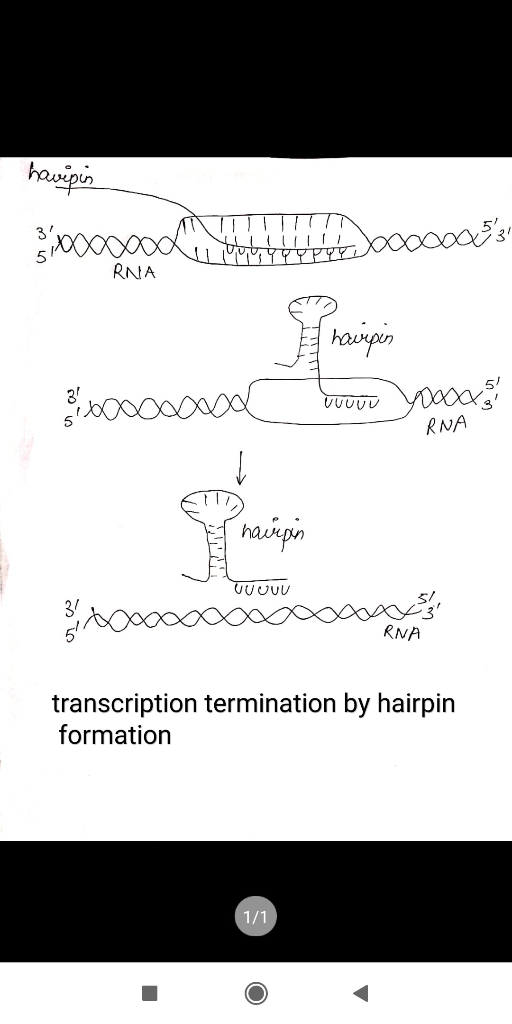
I have given you details for both the types of mechanisms and image for only mechanism.
Please rate.
Add Answer to:
briefly describe one of the two major transcription termination
methods, with special attention to the mechanism...
Describe/draw the three major steps (Initiation, Elongation and Termination) of transcription. In your description be sure...
Describe/draw the three major steps (Initiation, Elongation and Termination) of transcription. In your description be sure to point out significant DNA sequences and proteins involved and describe their role.
Describe the process of Prokaryotic RNA transcription in molecular detail You must be able to describe the process and order of events in initiation, elongation, and termination. You must describe t...
Describe the process of Prokaryotic RNA transcription in molecular detail You must be able to describe the process and order of events in initiation, elongation, and termination. You must describe the catalytic/biological purpose function of the key proteins/elements in elongation -35 and -10 (Pribnow box) Promoters Sigma factors (does not matter which one) RNA Polymerase (including structure and subunits and mechanism) Rho-independent and rho-dependent termination How sequence composition affects promoter function
Gene expression in eukaryotes is regulated at steps beyond transcription. Briefly, describe these steps and give...
Gene expression in eukaryotes is regulated at steps beyond transcription. Briefly, describe these steps and give the mechanism of regulation.
Two RNA sequences that can cause premature transcription termination are the trp leader sequence (trp L)...
Two RNA sequences that can cause premature transcription termination are the trp leader sequence (trp L) in E. coli and the thi riboswitch in B. subtilis. For each of these RNAs, discuss how alternate secondary structures impact termination and describe the conditions that favor each of the alternate secondary structures.
3. Two RNA sequences that can cause premature transcription termination are the trp leader sequence (trp...
 3. Two RNA sequences that can cause premature transcription termination are the trp leader sequence (trp L) in E. coli and the thi riboswitch in B. subtilis. For each of these RNAs, discuss how alternate secondary structures impact termination and describe the conditions that favor each of the alternate secondary structures.
1. Describe the three stages in transcription in prokaryotes and note the functions of the enzymes...
 1. Describe the three stages in transcription in prokaryotes and note the functions of the enzymes that are involved for each. 2. Describe three ways in which transcription in in eukaryotes is different from that of prokaryotes. 3. At what stage of transcription do these alterations take place in? Initiation, Elongation or Termination? 4. Draw a prokaryotic gene with the following features: a. A promoter region with -35 and -10 consensus sequences. b. The start point of transcription with first...
Prepare two diagrams illustrating the tryptophan operon attenuation mechanism. One diagram should be for the condition...
Prepare two diagrams illustrating the tryptophan operon attenuation mechanism. One diagram should be for the condition of low tryptophan concentration and the other for high tryptophan concentration. Write at least two sentences for each of the two diagrams that explains how attenuation allows bacteria to control the level of tryptophan. Provide the following labels on the diagrams to support your explanation: DNA, mRNA, polypeptide, RNA polymerase, ribosome, tryptophan codons, mRNA region #1, mRNA region #2, mRNA region #3, mRNA region...
2. Briefly describe one of the major groups in the Archaea domain
 2. Briefly describe one of the major groups in the Archaea domain
1. Briefly describe the cyclic and non-cyclic photophosphorylation. What are the products of the two processes. 2....
 1. Briefly describe the cyclic and non-cyclic photophosphorylation. What are the products of the two processes. 2. Using annotated diagram, indicate the major differences between fatty acid synthesis and fatty acid degradation 3. What are major physiological functions of fatty acids 4. Describe briefly the futile activities of photorespiration.
1. Briefly describe the cyclic and non-cyclic photophosphorylation. What are the products of the two processes. 2. Using annotated diagram, indicate the major differences between fatty acid synthesis and fatty acid...
1. Briefly describe the cyclic and non-cyclic photophosphorylation. What are the products of the two processes. 2. Using annotated diagram, indicate the major differences between fatty acid synthesis and fatty acid degradation 3. What are major physiological functions of fatty acids 4. Describe briefly the futile activities of photorespiration.
1. Briefly describe the cyclic and non-cyclic photophosphorylation. What are the products of the two processes. 2. Using annotated diagram, indicate the major differences between fatty acid synthesis and fatty acid...
1.With the mixed copolymer experiment, it was determined that AAC specifies one of the three amino...
1.With the mixed copolymer experiment, it was determined that AAC specifies one of the three amino acids: threonine, asparagine, or glutamine. Describe a triplet binding assay experiment that can be used to determine which of the three amino acids is specified by the codon AAC. You will need to include the ingredients that must be added to each tube analyzed in the experiment. Describe the experimental result that would be obtained if AAC specifies asparagine. 2. Briefly describe the difference(s)...
 3. Two RNA sequences that can cause premature transcription termination are the trp leader sequence (trp L) in E. coli and the thi riboswitch in B. subtilis. For each of these RNAs, discuss how alternate secondary structures impact termination and describe the conditions that favor each of the alternate secondary structures.
 1. Describe the three stages in transcription in prokaryotes and note the functions of the enzymes that are involved for each. 2. Describe three ways in which transcription in in eukaryotes is different from that of prokaryotes. 3. At what stage of transcription do these alterations take place in? Initiation, Elongation or Termination? 4. Draw a prokaryotic gene with the following features: a. A promoter region with -35 and -10 consensus sequences. b. The start point of transcription with first...
 2. Briefly describe one of the major groups in the Archaea domain
 1. Briefly describe the cyclic and non-cyclic photophosphorylation. What are the products of the two processes. 2. Using annotated diagram, indicate the major differences between fatty acid synthesis and fatty acid degradation 3. What are major physiological functions of fatty acids 4. Describe briefly the futile activities of photorespiration.
1. Briefly describe the cyclic and non-cyclic photophosphorylation. What are the products of the two processes. 2. Using annotated diagram, indicate the major differences between fatty acid synthesis and fatty acid...
1. Briefly describe the cyclic and non-cyclic photophosphorylation. What are the products of the two processes. 2. Using annotated diagram, indicate the major differences between fatty acid synthesis and fatty acid degradation 3. What are major physiological functions of fatty acids 4. Describe briefly the futile activities of photorespiration.
1. Briefly describe the cyclic and non-cyclic photophosphorylation. What are the products of the two processes. 2. Using annotated diagram, indicate the major differences between fatty acid synthesis and fatty acid...
Most questions answered within 3 hours.
-
Where is the error in this code sequence?
String s1 = "Hello";
String s2 = "ello";...
asked 11 months ago -
Financial data for Joel de Paris, Inc., for last year
follow:
Joel de Paris, Inc.
Balance...
asked 11 months ago -
Consider this reaction:
Al2(SO4)3 (aq)+ BaCl3
(aq) Al2Cl6 (aq)- +
3BaSO4(s) . What is the...
asked 11 months ago -
Suppose that Savneet is considering increasing her
recent random sample from 20 car rentals to 40...
asked 11 months ago -
Trucks arrive at an unloading terminal at an average rate of 120
per hour.
Trucks arrive...
asked 11 months ago -
Why are methanol and ethanol completely soluble in water while
octanol is not very little soluble....
asked 11 months ago -
A facilities manager at a university reads in a research report
that the mean amount of...
asked 11 months ago -
When the CuSO4 is rehydrated by adding water to the anhydrous
compound, is this an endothermic...
asked 11 months ago -
A ray of sunlight is passing from diamond into crown glass; the
angle of incidence is...
asked 11 months ago -
A block of mass 0.249 kg is placed on top of a light, vertical
spring of...
asked 11 months ago -
how do the kidneys compensate in the presences of acidosis
a) trigger hyperventilate
b) reserve acid...
asked 11 months ago -
Question 501 pts
The rental rate of capital to the firm increases. Which of the
following...
asked 11 months ago