What is returned to chlorophyll in cyclic photophosphorylation that is not returned in noncyclic photoreduction?
What is returned to chlorophyll in cyclic photophosphorylation that is not returned in noncyclic photoreduction?
Homework Answers
In cyclic photophosphorylation the electrons which got excited from chlorophyla PS1 will be returned by producing ATP at two sites of the reaction chain i.e at the ferridoxin and cytochrom complex regions of the elecron transport system.But in the case of non cyclic photosphorylation the electrons from the PS2 is not returned instead the loss of electrons is compensated by the photolysis of water.
Add Answer to:
What is returned to chlorophyll in cyclic photophosphorylation
that is not returned in noncyclic photoreduction?
54. Indicate how cyclic photophosphorylation differs from noncyclic photophosphorylation in the following aspects (1 point each):...
 54. Indicate how cyclic photophosphorylation differs from noncyclic photophosphorylation in the following aspects (1 point each): a. Types of photosystems involved: b. Pattern of electrons flow: c. Type of energy produced: d. Type of energy used: e. Water splitting
In noncyclic photophosphorylation, water is used for the hydrolysis of ATP. D. the oxidation of NADPH....
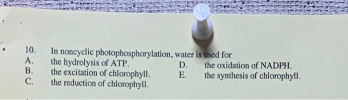 In noncyclic photophosphorylation, water is used for the hydrolysis of ATP. D. the oxidation of NADPH. the excitation of chlorophyll. E. the synthesis of chlorophyll. the reduction of chlorophyll.
1. Briefly describe the cyclic and non-cyclic photophosphorylation. What are the products of the two processes. 2....
 1. Briefly describe the cyclic and non-cyclic photophosphorylation. What are the products of the two processes. 2. Using annotated diagram, indicate the major differences between fatty acid synthesis and fatty acid degradation 3. What are major physiological functions of fatty acids 4. Describe briefly the futile activities of photorespiration.
1. Briefly describe the cyclic and non-cyclic photophosphorylation. What are the products of the two processes. 2. Using annotated diagram, indicate the major differences between fatty acid synthesis and fatty acid...
1. Briefly describe the cyclic and non-cyclic photophosphorylation. What are the products of the two processes. 2. Using annotated diagram, indicate the major differences between fatty acid synthesis and fatty acid degradation 3. What are major physiological functions of fatty acids 4. Describe briefly the futile activities of photorespiration.
1. Briefly describe the cyclic and non-cyclic photophosphorylation. What are the products of the two processes. 2. Using annotated diagram, indicate the major differences between fatty acid synthesis and fatty acid...
place the correct words in each sentence to asses your understanding of the cyclic and noncyclic...
 place the correct words in each sentence to asses your
understanding of the cyclic and noncyclic electron pathways of
photosynthesis
z Chapter 8 G z Chapter 8 https/ Seved ATP synthase Two types of light reactions occur in called noncyclic, because electron flow can be traced from water to a molecule of of the chloroplast. One is The second type is called cyclic because energized electrons are cyclic passed down an electron transport chain and then returned to their source...
place the correct words in each sentence to asses your
understanding of the cyclic and noncyclic electron pathways of
photosynthesis
z Chapter 8 G z Chapter 8 https/ Seved ATP synthase Two types of light reactions occur in called noncyclic, because electron flow can be traced from water to a molecule of of the chloroplast. One is The second type is called cyclic because energized electrons are cyclic passed down an electron transport chain and then returned to their source...
why is photolysis an uncecessary reaction in cyclic photophosphorylation?
why is photolysis an uncecessary reaction in cyclic photophosphorylation?
Under what conditions does cyclic photophosphorylation take place? Question 2 options: with an inactivated photosystem I...
Under what conditions does cyclic photophosphorylation take place? Question 2 options: with an inactivated photosystem I in an acidic stroma none of these answers are correct. with high levels of ATP with high levels of NADH
Construct a concept map with the central theme "Photophosphorylation". Use lines with arrows to connect and...
 Construct a concept map with the central theme
"Photophosphorylation". Use lines with arrows to connect and show
the relationship between connected items. Write a word or
short phrase by each arrow to specify the relationship.
Many arrows can originate or terminate from each concept (if
necessary). Arrows should only go one way, and each arrow
should have a linking phrase attached to it.
Here is a sample photophosphorylation materials list: ATP, Pi,
ADP, Glucose, NAD+, NADH, Energy, Electron carrier, ETC,...
Construct a concept map with the central theme
"Photophosphorylation". Use lines with arrows to connect and show
the relationship between connected items. Write a word or
short phrase by each arrow to specify the relationship.
Many arrows can originate or terminate from each concept (if
necessary). Arrows should only go one way, and each arrow
should have a linking phrase attached to it.
Here is a sample photophosphorylation materials list: ATP, Pi,
ADP, Glucose, NAD+, NADH, Energy, Electron carrier, ETC,...
Which statement about photosystems is FALSE? A. They are embedded in thylakoids. B. They use redox...
Which statement about photosystems is FALSE? A. They are embedded in thylakoids. B. They use redox reactions to store energy in molecules of ATP. C. They are involved in both light-dependent and light-independent reactions. D. They are involved in both cyclic and noncyclic photophosphorylation.
Please answer all... Thank you! 45) Which of the following is true of cyclic photophosphorylation? (1...
 Please answer all... Thank you!
45) Which of the following is true of cyclic photophosphorylation? (1 pts) Water is split to produce oxygen. NADP+ is reduced directly at the end of a liner O-R system. Electrons emitted during radiant excitation of bacteriochlorophylls are retunred through a cyclic O-R system O None of the above are correct. 46) Which of the following is true of the glycolytic pathway? (1 pts) The pathway begins with glucose. The pathway ends with pyruvate. The...
Please answer all... Thank you!
45) Which of the following is true of cyclic photophosphorylation? (1 pts) Water is split to produce oxygen. NADP+ is reduced directly at the end of a liner O-R system. Electrons emitted during radiant excitation of bacteriochlorophylls are retunred through a cyclic O-R system O None of the above are correct. 46) Which of the following is true of the glycolytic pathway? (1 pts) The pathway begins with glucose. The pathway ends with pyruvate. The...
18 Electron flow varies in the light reactions. Categorize each description as characteristic of the cyclic...
 18 Electron flow varies in the light reactions. Categorize each description as characteristic of the cyclic electron pathway, the noncyclic electron pathway, or both Includes a pigment complex Only produces ATP as a product Electrons flow from water to NADP 02-3201 Provides ATP for enzymatic reactions outside photosynthesis Produces a hydrogen gradient Uses photosystem 1 Book Uses two photosystems Produces ATP. NADPH, and oxygen Electrons pass down an electron transport cain, then return to their source Beferences Includes a reaction...
 54. Indicate how cyclic photophosphorylation differs from noncyclic photophosphorylation in the following aspects (1 point each): a. Types of photosystems involved: b. Pattern of electrons flow: c. Type of energy produced: d. Type of energy used: e. Water splitting
 In noncyclic photophosphorylation, water is used for the hydrolysis of ATP. D. the oxidation of NADPH. the excitation of chlorophyll. E. the synthesis of chlorophyll. the reduction of chlorophyll.
 1. Briefly describe the cyclic and non-cyclic photophosphorylation. What are the products of the two processes. 2. Using annotated diagram, indicate the major differences between fatty acid synthesis and fatty acid degradation 3. What are major physiological functions of fatty acids 4. Describe briefly the futile activities of photorespiration.
1. Briefly describe the cyclic and non-cyclic photophosphorylation. What are the products of the two processes. 2. Using annotated diagram, indicate the major differences between fatty acid synthesis and fatty acid...
1. Briefly describe the cyclic and non-cyclic photophosphorylation. What are the products of the two processes. 2. Using annotated diagram, indicate the major differences between fatty acid synthesis and fatty acid degradation 3. What are major physiological functions of fatty acids 4. Describe briefly the futile activities of photorespiration.
1. Briefly describe the cyclic and non-cyclic photophosphorylation. What are the products of the two processes. 2. Using annotated diagram, indicate the major differences between fatty acid synthesis and fatty acid...
 place the correct words in each sentence to asses your
understanding of the cyclic and noncyclic electron pathways of
photosynthesis
z Chapter 8 G z Chapter 8 https/ Seved ATP synthase Two types of light reactions occur in called noncyclic, because electron flow can be traced from water to a molecule of of the chloroplast. One is The second type is called cyclic because energized electrons are cyclic passed down an electron transport chain and then returned to their source...
place the correct words in each sentence to asses your
understanding of the cyclic and noncyclic electron pathways of
photosynthesis
z Chapter 8 G z Chapter 8 https/ Seved ATP synthase Two types of light reactions occur in called noncyclic, because electron flow can be traced from water to a molecule of of the chloroplast. One is The second type is called cyclic because energized electrons are cyclic passed down an electron transport chain and then returned to their source...
 Construct a concept map with the central theme
"Photophosphorylation". Use lines with arrows to connect and show
the relationship between connected items. Write a word or
short phrase by each arrow to specify the relationship.
Many arrows can originate or terminate from each concept (if
necessary). Arrows should only go one way, and each arrow
should have a linking phrase attached to it.
Here is a sample photophosphorylation materials list: ATP, Pi,
ADP, Glucose, NAD+, NADH, Energy, Electron carrier, ETC,...
Construct a concept map with the central theme
"Photophosphorylation". Use lines with arrows to connect and show
the relationship between connected items. Write a word or
short phrase by each arrow to specify the relationship.
Many arrows can originate or terminate from each concept (if
necessary). Arrows should only go one way, and each arrow
should have a linking phrase attached to it.
Here is a sample photophosphorylation materials list: ATP, Pi,
ADP, Glucose, NAD+, NADH, Energy, Electron carrier, ETC,...
 Please answer all... Thank you!
45) Which of the following is true of cyclic photophosphorylation? (1 pts) Water is split to produce oxygen. NADP+ is reduced directly at the end of a liner O-R system. Electrons emitted during radiant excitation of bacteriochlorophylls are retunred through a cyclic O-R system O None of the above are correct. 46) Which of the following is true of the glycolytic pathway? (1 pts) The pathway begins with glucose. The pathway ends with pyruvate. The...
Please answer all... Thank you!
45) Which of the following is true of cyclic photophosphorylation? (1 pts) Water is split to produce oxygen. NADP+ is reduced directly at the end of a liner O-R system. Electrons emitted during radiant excitation of bacteriochlorophylls are retunred through a cyclic O-R system O None of the above are correct. 46) Which of the following is true of the glycolytic pathway? (1 pts) The pathway begins with glucose. The pathway ends with pyruvate. The...
 18 Electron flow varies in the light reactions. Categorize each description as characteristic of the cyclic electron pathway, the noncyclic electron pathway, or both Includes a pigment complex Only produces ATP as a product Electrons flow from water to NADP 02-3201 Provides ATP for enzymatic reactions outside photosynthesis Produces a hydrogen gradient Uses photosystem 1 Book Uses two photosystems Produces ATP. NADPH, and oxygen Electrons pass down an electron transport cain, then return to their source Beferences Includes a reaction...
Most questions answered within 3 hours.
-
Where is the error in this code sequence?
String s1 = "Hello";
String s2 = "ello";...
asked 10 months ago -
Financial data for Joel de Paris, Inc., for last year
follow:
Joel de Paris, Inc.
Balance...
asked 10 months ago -
Consider this reaction:
Al2(SO4)3 (aq)+ BaCl3
(aq) Al2Cl6 (aq)- +
3BaSO4(s) . What is the...
asked 10 months ago -
Suppose that Savneet is considering increasing her
recent random sample from 20 car rentals to 40...
asked 10 months ago -
Trucks arrive at an unloading terminal at an average rate of 120
per hour.
Trucks arrive...
asked 10 months ago -
Why are methanol and ethanol completely soluble in water while
octanol is not very little soluble....
asked 10 months ago -
A facilities manager at a university reads in a research report
that the mean amount of...
asked 10 months ago -
When the CuSO4 is rehydrated by adding water to the anhydrous
compound, is this an endothermic...
asked 10 months ago -
A ray of sunlight is passing from diamond into crown glass; the
angle of incidence is...
asked 10 months ago -
A block of mass 0.249 kg is placed on top of a light, vertical
spring of...
asked 10 months ago -
how do the kidneys compensate in the presences of acidosis
a) trigger hyperventilate
b) reserve acid...
asked 10 months ago -
Question 501 pts
The rental rate of capital to the firm increases. Which of the
following...
asked 10 months ago