For d-metal ions with octahedral coordination, which electronic configurations are Jahn teller active? Consider electronic configurations...
For d-metal ions with octahedral coordination, which electronic configurations are Jahn teller active? Consider electronic configurations from d1 to d10 and both high spin and low spin states.
Homework Answers
Which electronic configuration has electronic symmetry has no
jahn teller distortion or inactive like d10 is symmetrical hence No
jahn teller active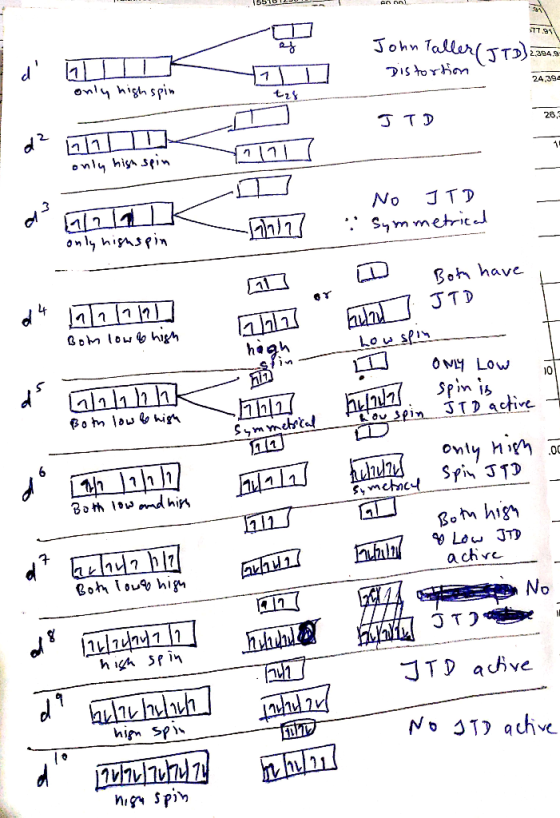
Add Answer to:
For d-metal ions with octahedral coordination, which electronic
configurations are Jahn teller active? Consider electronic
configurations...
(ii) Explain the Jahn-Teller distortion in [Cu(H2O)2 (ii) If a solution with a dissolved octahedral complex...
 (ii) Explain the Jahn-Teller distortion in [Cu(H2O)2 (ii) If a solution with a dissolved octahedral complex appears yellow to the eye, what wavelength of light does it absorb? Is this complex expected to be low spin or high spin?
Sc3+ V2+ 4. A) Consider the transition metal ions: Mn2+ Co2+ Zn2+ For which ions are...
 Sc3+ V2+ 4. A) Consider the transition metal ions: Mn2+ Co2+ Zn2+ For which ions are high spin and low spin octahedral electron configurations observed? Draw high and low spin splitting diagrams for each ion where they are different Label each diagram you draw. Note: if an ion has identical diagrams for high and low spin, it's OK to draw it, but you do not need to draw it. B) Consider the transition metal ions: Sc+ V2 Mn2+ Co2 Zn2+...
a. Predict the structure of [Cr(OH2)6]2+ - I wrote that the complex will undergo Jahn-Teller distortion,...
a. Predict the structure of [Cr(OH2)6]2+ - I wrote that the complex will undergo Jahn-Teller distortion, making the octahedral complex become tetragonal (don't know if that's correct) b. Account for the variation in the lattice enthalpy of Mn (2780 kJ/mol), Fe (2926 kJ/mol), Co (2976 kJ/mol), Ni (3060 kJ/mol), and Zn (2985 kJ/mol) flouride given that the metal center in all of the flourides is surrounded by an octahedral array of F-ions. c. Explain the effect on the d-orbital energies...
Draw the electronic structure (t2g and eg occupancies) of an octahedral Fe2+ complex in both the...
Draw the electronic structure (t2g and eg occupancies) of an octahedral Fe2+ complex in both the high-spin and low-spin configurations. Calculate the LSFE of each configuration if ∆o = 6.4 J/mol.
Which of the following ions CANNOT form both a high spin and low spin octahedral complex...
 Which of the following ions CANNOT form both a high spin and low spin octahedral complex ion? Select one or more: +2 a. Co +3 b. Cr +3 c. Mn +3 d. Fe
Make two d-orbital diagrams for each of the transition metal compounds, that show the low and...
Make two d-orbital diagrams for each of the transition metal compounds, that show the low and high-spin states. Assume the compounds have an octahedral geometry. Determine the value of the spin-only magnetic moment for each of these configurations. Explanation of determining the value of spin-only magnetic moment would help. Ty! tris(acetylacetonato)manganese(III) tris(acetylacetonato)iron(III) tris(acetylacetonato)cobalt(III)
Which of these three octahedral coordination compounds is/are paramagnetic? (Refer to the spectrochemical series below) (1)...
Which of these three octahedral coordination compounds is/are paramagnetic? (Refer to the spectrochemical series below) (1) [Sc(H2O)6] 3+ (2) [FeF6] 4– (3) [Mn(CN)6] 3– The spectrochemical series: Cl– < F– < H2O < NH3 < en < CN– (weak field/high spin) (strong field/low spin) Please explain.
1.- Define what are complex ions 2.- Using NiCl as a reactant look in a book...
 1.- Define what are complex ions 2.- Using NiCl as a reactant look in a book or in the web for a reaction to form a complex ion, indicate which is the Lewis acid and which is the Lewis base. An example of your answer is this: Ag (aq) + 2NH, (aq) - Ag(NH),(aq) Lewis acid Lewis base 3.- Using the rules of nomenclature name the complex you have proposed in question 2 4.- Indicate the coordination number and geometry...
Electron configurations of transition metal ions Zinc is an essential mineral of great biological and health...
Electron configurations of transition metal ions Zinc is an essential mineral of great biological and health importance. In fact, it is the second most abundant transition metal after iron in our body. Most exists as Zn2+ ion in active site of enzymes, and they (more than 300) perform an array of functions. a. What is the electronic configuration of the Zn atom. b. Here comes the irritating part in chemistry. Although the 3d orbitals are placed higher in energy than...
Consider the octahedral complex [Co(NH3)5(NO2)]Cl2 (assume Δ/B = 2.5) Part A: Which Tanabe-Sugano diagram applies to...
Consider the octahedral complex [Co(NH3)5(NO2)]Cl2 (assume Δ/B = 2.5) Part A: Which Tanabe-Sugano diagram applies to complexes of this type? Why? Part B: Use the appropriate Tanabe-Sugano diagram to determine if the complex is high spin or low spin. Justify your answer. Part C: Use the Tanabe Sugano diagram to determine the subcomponent ground term and spin allowed excited states for this octahedral complex.
 (ii) Explain the Jahn-Teller distortion in [Cu(H2O)2 (ii) If a solution with a dissolved octahedral complex appears yellow to the eye, what wavelength of light does it absorb? Is this complex expected to be low spin or high spin?
 Sc3+ V2+ 4. A) Consider the transition metal ions: Mn2+ Co2+ Zn2+ For which ions are high spin and low spin octahedral electron configurations observed? Draw high and low spin splitting diagrams for each ion where they are different Label each diagram you draw. Note: if an ion has identical diagrams for high and low spin, it's OK to draw it, but you do not need to draw it. B) Consider the transition metal ions: Sc+ V2 Mn2+ Co2 Zn2+...
 Which of the following ions CANNOT form both a high spin and low spin octahedral complex ion? Select one or more: +2 a. Co +3 b. Cr +3 c. Mn +3 d. Fe
 1.- Define what are complex ions 2.- Using NiCl as a reactant look in a book or in the web for a reaction to form a complex ion, indicate which is the Lewis acid and which is the Lewis base. An example of your answer is this: Ag (aq) + 2NH, (aq) - Ag(NH),(aq) Lewis acid Lewis base 3.- Using the rules of nomenclature name the complex you have proposed in question 2 4.- Indicate the coordination number and geometry...
Most questions answered within 3 hours.
-
Where is the error in this code sequence?
String s1 = "Hello";
String s2 = "ello";...
asked 10 months ago -
Financial data for Joel de Paris, Inc., for last year
follow:
Joel de Paris, Inc.
Balance...
asked 10 months ago -
Consider this reaction:
Al2(SO4)3 (aq)+ BaCl3
(aq) Al2Cl6 (aq)- +
3BaSO4(s) . What is the...
asked 10 months ago -
Suppose that Savneet is considering increasing her
recent random sample from 20 car rentals to 40...
asked 10 months ago -
Trucks arrive at an unloading terminal at an average rate of 120
per hour.
Trucks arrive...
asked 10 months ago -
Why are methanol and ethanol completely soluble in water while
octanol is not very little soluble....
asked 10 months ago -
A facilities manager at a university reads in a research report
that the mean amount of...
asked 10 months ago -
When the CuSO4 is rehydrated by adding water to the anhydrous
compound, is this an endothermic...
asked 10 months ago -
A ray of sunlight is passing from diamond into crown glass; the
angle of incidence is...
asked 10 months ago -
A block of mass 0.249 kg is placed on top of a light, vertical
spring of...
asked 10 months ago -
how do the kidneys compensate in the presences of acidosis
a) trigger hyperventilate
b) reserve acid...
asked 10 months ago -
Question 501 pts
The rental rate of capital to the firm increases. Which of the
following...
asked 10 months ago