(C++) Suppose you have a certain amount of money is a savings account that earns compound...
(C++) Suppose you have a certain amount of money is a savings account that earns compound monthly interest, and you want to calculate the amount that you will have after a specific number of months. The formula, which is known as the future value formula, is: F = P x (1 + i)t The terms in the formula are as follows:
a. F is the future value of the account after the specified time period
b. P is the present value of the account
c. i is the monthly interest rate
d. t is the number of months
Write a program that prompts the user to enter the account’s present value, monthly interest rate, and the number of months that the money will be left in the account. The program should pass these values to a function named futureValue that returns the future value of the account, after the specified number of months. The program should display the account’s future value.
Homework Answers
PROGRAM:
#include <iostream>
using namespace std;
float futureValue(float P,float i,float t); // Declaring the
Function Prototype
int main()
{
// Declaring the variables
float present_value,monthly_interest,num_months,result;
// Prompt for the user to enter the present value of the
account
cout << "Enter Present Value of the account: ";
// Reading the input from user
cin >> present_value;
// Prompt for the user to enter the monthly interest rate
cout << "Please enter the monthly interest rate: ";
// Reading the input from user
cin >> monthly_interest;
// Prompt for the user to enter the number of months that the money
will be left in account
cout << "Enter the number of months: ";
// Reading the input from user
cin >> num_months;
// Calling futureValue function to calculate the future value of
the account and store it in the result variable
result =
futureValue(present_value,monthly_interest,num_months);
// Displaying the future value of account to the user
cout << "\nAccount's Future Value after " << num_months
<< " months is " << result;
}
// Definition of the function futureValue
float futureValue(float P,float i,float t)
{
float F; // Declaring the result variable
F = (P*(1+i)*t); // Calculating the futureValue
return F; // Returning the futureValue
}
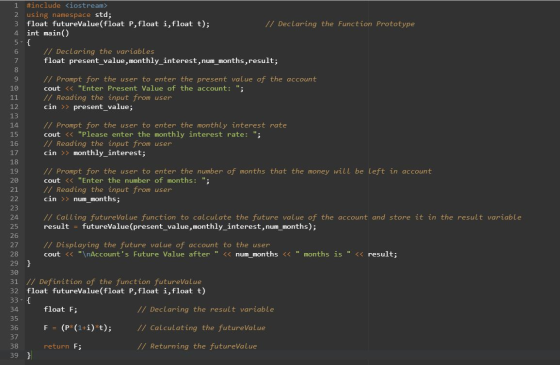
Please refer to the following screenshot of the program for indentation of the code:
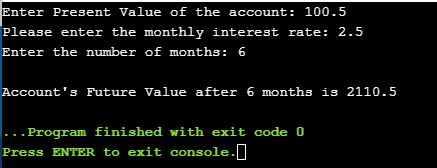
OUTPUT:
Add Answer to:
(C++) Suppose you have a certain amount of money is a savings
account that earns compound...
Suppose you have a certain amount of money in a savings account that earns compound monthly...
Suppose you have a certain amount of money in a savings account that earns compound monthly interest, and you want to calculate the amount that you will have after a specific number of months. The formula is as follows: f = p * (1 + i)^t • f is the future value of the account after the specified time period. • p is the present value of the account. • i is the monthly interest rate. • t is the...
LULUPULUS! WORK AREA Suppose you have a certain amount of money in a savings account that...
 LULUPULUS! WORK AREA Suppose you have a certain amount of money in a savings account that earns compound monthly interest, and you want to calculate the amount that you will have after a specific number of months. The formula is as follows: f=p* (1 + i)^t • fis the future value of the account after the specified time period. •p is the present value of the account. i is the monthly interest rate. .t is the number of months How...
Suppose you want to deposit a certain amount of money into a savings account and then...
Suppose you want to deposit a certain amount of money into a savings account and then leave it alone to draw interest for the next 10 years. At the end of 10 years you would like to have $10,000 in the account. How much do you need to deposit today make that happen? You can use the following formula, which is known as the present value formula, to find out: P = F / (1+ r)^n The terms in...
P5.3 Present Value. Suppose you want to deposit a certain amount of money into a savings...
 P5.3 Present
Value. Suppose you want to deposit a certain amount of
money into a savings account and then leave it alone to draw
interest for the next 10 years. At the end of 10 years you would
like to have $10,000 in the account. How much do you need to
deposit today tomake that happen? You can use the following
formula, which is known as the present value formula, to find
out:
P = F/(1+r)^n
The terms in the...
P5.3 Present
Value. Suppose you want to deposit a certain amount of
money into a savings account and then leave it alone to draw
interest for the next 10 years. At the end of 10 years you would
like to have $10,000 in the account. How much do you need to
deposit today tomake that happen? You can use the following
formula, which is known as the present value formula, to find
out:
P = F/(1+r)^n
The terms in the...
Write a program that calculates the amount of money that you must invest In a savings...
 Write a program that calculates the amount of money that you must invest In a savings account at a given interest rate for a given number of years to have a certain dollar amount at me end of the period Y our program will ask the user for the amount the user wants to have at the end of the term (future value). the number of years the user plans to let the money stay in the account, and the...
Visual C# Create Present Value application Application that lets you deposit a certain amount of money...
Visual C# Create Present Value application Application that lets you deposit a certain amount of money into a savings account and then leave it alone to draw interest for the next 10 years. At the end of 10 years you would like to have $10,000 in the account. How much do you need to deposit today to make that happen? You can use the following present-value formula, to find out. P =F/(1+r)^n P is the present value, or the amount...
14.Compound Interest hank account pays compound interest, it pays interest not only on the principal amount...
 14.Compound Interest hank account pays compound interest, it pays interest not only on the principal amount that was deposited into the account, but also on the interest that has accumulated over time. Suppose you want to deposit some money into a savings account, and let the account earn compound interest for a certain number of years. The formula for calculating the balance of the account afer a specified namber of years is The terms in the formula are A is...
How much money should be deposited today in an account that earns 5% compounded semiannually so...
 How much money should be deposited today in an account that earns 5% compounded semiannually so that it will accumulate to $8000 in three years? The amount of money that should be deposited is $ (Round up to the nearest cent.) You deposit $14,000 in an account that pays 5% interest compounded quarterly A. Find the future value after one year B. Use the future value formula for simple interest to determine the effective annual yield. A. The future value...
An amount of money was invested in an account that earns interest compounded semiannually. From this...
An amount of money was invested in an account that earns interest compounded semiannually. From this investment, the investor could withdraw $2,000 at the start of the first 6-month period and at the start of each of the next nine, 6-month periods (a total of ten, 6-month periods), after which time, the account balance is zero. Interest revenue generated from this arrangement equals: A. The future value of the annuity due B. The future value of the annuity due minus...
JAVA PLEASE! Suppose you save $100 each month into a savings account with the annual interest...
JAVA PLEASE! Suppose you save $100 each month into a savings account with the annual interest rate 5%. So, the monthly interest rate is 0.05/12 = 0.00417. After the first month, the value in the account becomes 100 * (1 + 0.00417) = 100.417 After the second month, the value in the account becomes (100 + 100.417) * (1 + 0.00417) = 201.252 After the third month, the value in the account becomes (100 + 201.252) * (1 + 0.00417)...
 LULUPULUS! WORK AREA Suppose you have a certain amount of money in a savings account that earns compound monthly interest, and you want to calculate the amount that you will have after a specific number of months. The formula is as follows: f=p* (1 + i)^t • fis the future value of the account after the specified time period. •p is the present value of the account. i is the monthly interest rate. .t is the number of months How...
 P5.3 Present
Value. Suppose you want to deposit a certain amount of
money into a savings account and then leave it alone to draw
interest for the next 10 years. At the end of 10 years you would
like to have $10,000 in the account. How much do you need to
deposit today tomake that happen? You can use the following
formula, which is known as the present value formula, to find
out:
P = F/(1+r)^n
The terms in the...
P5.3 Present
Value. Suppose you want to deposit a certain amount of
money into a savings account and then leave it alone to draw
interest for the next 10 years. At the end of 10 years you would
like to have $10,000 in the account. How much do you need to
deposit today tomake that happen? You can use the following
formula, which is known as the present value formula, to find
out:
P = F/(1+r)^n
The terms in the...
 Write a program that calculates the amount of money that you must invest In a savings account at a given interest rate for a given number of years to have a certain dollar amount at me end of the period Y our program will ask the user for the amount the user wants to have at the end of the term (future value). the number of years the user plans to let the money stay in the account, and the...
 14.Compound Interest hank account pays compound interest, it pays interest not only on the principal amount that was deposited into the account, but also on the interest that has accumulated over time. Suppose you want to deposit some money into a savings account, and let the account earn compound interest for a certain number of years. The formula for calculating the balance of the account afer a specified namber of years is The terms in the formula are A is...
 How much money should be deposited today in an account that earns 5% compounded semiannually so that it will accumulate to $8000 in three years? The amount of money that should be deposited is $ (Round up to the nearest cent.) You deposit $14,000 in an account that pays 5% interest compounded quarterly A. Find the future value after one year B. Use the future value formula for simple interest to determine the effective annual yield. A. The future value...
Most questions answered within 3 hours.
-
Where is the error in this code sequence?
String s1 = "Hello";
String s2 = "ello";...
asked 11 months ago -
Financial data for Joel de Paris, Inc., for last year
follow:
Joel de Paris, Inc.
Balance...
asked 11 months ago -
Consider this reaction:
Al2(SO4)3 (aq)+ BaCl3
(aq) Al2Cl6 (aq)- +
3BaSO4(s) . What is the...
asked 11 months ago -
Suppose that Savneet is considering increasing her
recent random sample from 20 car rentals to 40...
asked 11 months ago -
Trucks arrive at an unloading terminal at an average rate of 120
per hour.
Trucks arrive...
asked 11 months ago -
Why are methanol and ethanol completely soluble in water while
octanol is not very little soluble....
asked 11 months ago -
A facilities manager at a university reads in a research report
that the mean amount of...
asked 11 months ago -
When the CuSO4 is rehydrated by adding water to the anhydrous
compound, is this an endothermic...
asked 11 months ago -
A ray of sunlight is passing from diamond into crown glass; the
angle of incidence is...
asked 11 months ago -
A block of mass 0.249 kg is placed on top of a light, vertical
spring of...
asked 11 months ago -
how do the kidneys compensate in the presences of acidosis
a) trigger hyperventilate
b) reserve acid...
asked 11 months ago -
Question 501 pts
The rental rate of capital to the firm increases. Which of the
following...
asked 11 months ago