Suppose you just placed $100 in an interest bearing account paying 7% nominal interest. Inflation is...
Suppose you just placed $100 in an interest bearing account paying 7% nominal interest. Inflation is expected to be 4% per year. After one year, how many dollars will you have in your account? By what percentage will your purchasing power have increased in one year?
Homework Answers
The nominal value of the money place after 1 year will be 100 x (1 + 7%) = 107. Hence, you will have $107 in your account after one year. Purchasing power is measured by real value of money which adjusts nominal value for inflation. Since inflation is 4% next year, the real rate of interest is 7 - 4 = 3%. Hence real value of money or purchasing power is increased by 3%.
Add Answer to:
Suppose you just placed $100 in an interest bearing account
paying 7% nominal interest. Inflation is...
1 Inflation and interest Suppose you deposit $100 in an account that promises 10% nominal interest....
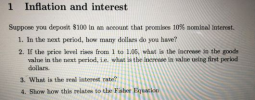 1 Inflation and interest Suppose you deposit $100 in an account that promises 10% nominal interest. 1. In the next period, how many dollars do you have? 2. If the price level rises from 1 to 1.05. what is the increase in the goods value in the next period, i.e. what is the increase in value using first period dollars. 3. What is the real interest rate? 4. Show how this relates to the Fisher Equation
If you lend money at a 12% nominal interest rate, but you expect inflation to be...
 If you lend money at a 12% nominal interest rate, but you expect inflation to be 7% over the life of the loan, then you expect your purchasing power to grow at a rate of [1%. The real interest rate is negative when the nominal interest rate is If the nominal interest rate is 3% and the expected rate of inflation is 1%, then the real interest rate is ▼| the inflation rate. A. 2%. O B. 096. 3%. 1%....
You lent $370 to a friend for one year at a nominal rate of interest of...
You lent $370 to a friend for one year at a nominal rate of interest of 3 percent. Inflation during that year was 2 percent. Did you experience an increase or decrease in the purchasing power of your money? How much did it increase or decrease? (Round answer to 2 decimal places, e.g. 52.75%.) The purchasing power ______(increasing or decreasing) by ____%. If the nominal rate of interest is 4.19 percent and the expected rate of inflation is 1.76 percent,...
Question 4 (8 pts): Suppose that you deposit $12,000 in a savings account that earns 7% in annually. Inflation is 2...
 Question 4 (8 pts): Suppose that you deposit $12,000 in a savings account that earns 7% in annually. Inflation is 2.5%. a) What is the real interest rate? (2 pts) 5) How much money is in your account at the end of the year? (In nominal amount) (3 pt - What is the real purchasing power of that amount? (In real amount) (3 pts)
If inflation is measured at 3% per annum and a savings account is paying interest at...
If inflation is measured at 3% per annum and a savings account is paying interest at 3% per annum, the purchasing power of the savings made will remain unchanged. True or false? Why?
Suppose, instead, Justin deposits 100 into a savings account, paying nominal interest rate i (2) ...
Suppose, instead, Justin deposits 100 into a savings account, paying nominal interest rate i (2) = 2%, at the beginning of each half year for 10 years. The interest earned from this account can be withdrawn at the end of each year and reinvested into another account earning AEIR 4%. Find the accumulated value of his holdings (in both accounts) at the end of 10 years.
5. Interest, inflation, and purchasing power Suppose Yvette is an avid reader and buys only mystery...
 5. Interest, inflation, and purchasing power Suppose Yvette is an avid reader and buys only mystery novels. Yvette deposits $2,000 in a bank account that pays an annual nominal interest rate of 15%. Assume this interest rate is fixed-that is, it won't change over time. At the time of her deposit, a mystery novel is priced at $20.00 Initially, the purchasing power of Yvette's $2,000 deposit ismystery novels. For each of the annual inflation rates given in the following table,...
4. Interest, inflation, and purchasing power Suppose Caroline is an avid reader and buys only mystery...
 4. Interest, inflation, and purchasing power Suppose Caroline is an avid reader and buys only mystery novels. Caroline deposits $4,000 in a bank account that pays an annual nominal interest rate of 5%. Assume this interest rate is fixed—that is, it won't change over time. At the time of her deposit, a mystery novel is priced at $10.00 Initially, the purchasing power of Caroline's $4,000 deposit is mystery novels. For each of the annual inflation rates given in the following...
< Back to Assignment Attempts: Keep the Highest: /3 5. Interest, inflation, and purchasing power Suppose...
 < Back to Assignment Attempts: Keep the Highest: /3 5. Interest, inflation, and purchasing power Suppose Frances is a cinephile and buys only movie tickets. Frances deposits $3,000 in a bank account that pays an annual nominal interest rate of 10%. Assume this interest rate is fixed-that is, it won't change over time. At the time of her deposit, a movie ticket is priced at $15.00. Initially, the purchasing power of Frances's $3,000 deposit is 200 movie tickets. For each...
aplia ch 11 5. Interest, inflation, and purchasing power Suppose Valerie is a sports fan and...
aplia ch 11 5. Interest, inflation, and purchasing power Suppose Valerie is a sports fan and buys only baseball caps. Valerie deposits $3,000 in a bank account that pays an annual nominal interest rate of 5%. Assume this interest rate is fixed�that is, it won't change over time. At the time of her deposit, a baseball cap is priced at $10.00. Initially, the purchasing power of Valerie's $3,000 deposit is baseball caps. For each of the annual inflation rates given...
 1 Inflation and interest Suppose you deposit $100 in an account that promises 10% nominal interest. 1. In the next period, how many dollars do you have? 2. If the price level rises from 1 to 1.05. what is the increase in the goods value in the next period, i.e. what is the increase in value using first period dollars. 3. What is the real interest rate? 4. Show how this relates to the Fisher Equation
 If you lend money at a 12% nominal interest rate, but you expect inflation to be 7% over the life of the loan, then you expect your purchasing power to grow at a rate of [1%. The real interest rate is negative when the nominal interest rate is If the nominal interest rate is 3% and the expected rate of inflation is 1%, then the real interest rate is ▼| the inflation rate. A. 2%. O B. 096. 3%. 1%....
 Question 4 (8 pts): Suppose that you deposit $12,000 in a savings account that earns 7% in annually. Inflation is 2.5%. a) What is the real interest rate? (2 pts) 5) How much money is in your account at the end of the year? (In nominal amount) (3 pt - What is the real purchasing power of that amount? (In real amount) (3 pts)
 5. Interest, inflation, and purchasing power Suppose Yvette is an avid reader and buys only mystery novels. Yvette deposits $2,000 in a bank account that pays an annual nominal interest rate of 15%. Assume this interest rate is fixed-that is, it won't change over time. At the time of her deposit, a mystery novel is priced at $20.00 Initially, the purchasing power of Yvette's $2,000 deposit ismystery novels. For each of the annual inflation rates given in the following table,...
 4. Interest, inflation, and purchasing power Suppose Caroline is an avid reader and buys only mystery novels. Caroline deposits $4,000 in a bank account that pays an annual nominal interest rate of 5%. Assume this interest rate is fixed—that is, it won't change over time. At the time of her deposit, a mystery novel is priced at $10.00 Initially, the purchasing power of Caroline's $4,000 deposit is mystery novels. For each of the annual inflation rates given in the following...
 < Back to Assignment Attempts: Keep the Highest: /3 5. Interest, inflation, and purchasing power Suppose Frances is a cinephile and buys only movie tickets. Frances deposits $3,000 in a bank account that pays an annual nominal interest rate of 10%. Assume this interest rate is fixed-that is, it won't change over time. At the time of her deposit, a movie ticket is priced at $15.00. Initially, the purchasing power of Frances's $3,000 deposit is 200 movie tickets. For each...
Most questions answered within 3 hours.
-
Where is the error in this code sequence?
String s1 = "Hello";
String s2 = "ello";...
asked 10 months ago -
Financial data for Joel de Paris, Inc., for last year
follow:
Joel de Paris, Inc.
Balance...
asked 10 months ago -
Consider this reaction:
Al2(SO4)3 (aq)+ BaCl3
(aq) Al2Cl6 (aq)- +
3BaSO4(s) . What is the...
asked 10 months ago -
Suppose that Savneet is considering increasing her
recent random sample from 20 car rentals to 40...
asked 10 months ago -
Trucks arrive at an unloading terminal at an average rate of 120
per hour.
Trucks arrive...
asked 10 months ago -
Why are methanol and ethanol completely soluble in water while
octanol is not very little soluble....
asked 10 months ago -
A facilities manager at a university reads in a research report
that the mean amount of...
asked 10 months ago -
When the CuSO4 is rehydrated by adding water to the anhydrous
compound, is this an endothermic...
asked 10 months ago -
A ray of sunlight is passing from diamond into crown glass; the
angle of incidence is...
asked 10 months ago -
A block of mass 0.249 kg is placed on top of a light, vertical
spring of...
asked 10 months ago -
how do the kidneys compensate in the presences of acidosis
a) trigger hyperventilate
b) reserve acid...
asked 10 months ago -
Question 501 pts
The rental rate of capital to the firm increases. Which of the
following...
asked 10 months ago