explain selective permeability and how cells achieve it
explain selective permeability and how cells achieve it
Homework Answers
Selective permeability is the property that only certain ions or molecules can pass through the cell membrane ( that is moving in and out of the cell ) this is achieved with using ion channels which allow the movement of particular ions, carriers which allow the movement of particular molecules across the membrane in one particular direction so that no other molecules can move into and out of the cell.
1) Describe how the structure of the bacterial cytoplasmic membrane relates to its function of selective...
 1) Describe how the structure of the bacterial cytoplasmic membrane relates to its function of selective permeability. Ipt 2) Most antibacterial drugs disrupt or destroy bacterial cellular characteristics that are different from those of eukaryotic cells or that may not even be present in eukaryotic cells, an idea termed 'selective toxicity'. List and describe at least two cellular features of bacteria that could be targeted to inhibit or kill a bacterial pathogen lpt
Explain how aquaporin is selective for water and does not allow ions to diffuse through.
Explain how aquaporin is selective for water and does not allow ions to diffuse through.
Figure 1 represents a plasma membrane and molecules present on either side. Figure 1. A...
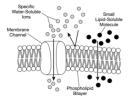 Figure 1 represents a plasma membrane and molecules present on either side.
Figure 1. A model of a plasma membrane demonstrating selective permeability
(a) Describe the biological need for cells to be surrounded by a membrane that is selectively permeable for different materials.
(b) Explain how the model shows selective permeability of the membrane to specific ions.
(c) Describe the characteristics of the phospholipid bilayer that permit small hydrophobic lipid molecules to pass directly across the membrane.
(d)...
Figure 1 represents a plasma membrane and molecules present on either side.
Figure 1. A model of a plasma membrane demonstrating selective permeability
(a) Describe the biological need for cells to be surrounded by a membrane that is selectively permeable for different materials.
(b) Explain how the model shows selective permeability of the membrane to specific ions.
(c) Describe the characteristics of the phospholipid bilayer that permit small hydrophobic lipid molecules to pass directly across the membrane.
(d)...
Special channels called aquaporins allow water to move between cells. These channel proteins are selective- they...
Special channels called aquaporins allow water to move between cells. These channel proteins are selective- they freely let water molecules through the membrane but NOT ions or other molecules- but (like leak channels) are not gated.Based on those facts, state which of the following would be the most likely to determines the direction (and how quickly) water can move across a membrane using aquaporins, and (in a few sentences) explain your answer. how much ATP is present inside the cell...
Explain how hospitals can achieve the same quality levels as highreliability organizations. Explain how hospitals can...
Explain how hospitals can achieve the same quality levels as highreliability organizations. Explain how hospitals can achieve the same quality levels as high reliability organizations
Selective and Differential media used in the laboratory: • Define selective media and use a particular...
Selective and Differential media used in the laboratory: • Define selective media and use a particular medium as the example to explain how it works – Lecture 2 – slides 13, 14 and notes • Define differential media and use a particular medium as the example to explain how it works
Separation of most blood cells is difficult, if not impossible, to achieve because they have similar...
Separation of most blood cells is difficult, if not impossible, to achieve because they have similar properties and/or densities. What procedure is used to separate T-cells of the immune system from the many other different types of white blood cells or spleen cells? What feature of the T-cell facilitates the isolation protocol? Describe how this procedure is performed.
explain the basis for selective formation of the product 6. Explain the basis for the selective...
 explain the basis for selective formation of the
product
6. Explain the basis for the selective formation of the product shown over the alternative product. CH CO2CH3 C150ccEncuzcn1.01 CH,O,CCCH2CH2CH2OH not - CIL o 2.7.1 (b) H C CH3 H3CCH; H:C, CH, RCO3H I versus Versus a yo (88%) (12%) (c) H2B2 Н4С., HC-N ) + BH preferred to V GR- HC" H Hº CH3 CH3 CH3 1 2.7.ga 179 H OH HOH PROBLEM LAIH aZcH₃ ach rather than a a...
explain the basis for selective formation of the
product
6. Explain the basis for the selective formation of the product shown over the alternative product. CH CO2CH3 C150ccEncuzcn1.01 CH,O,CCCH2CH2CH2OH not - CIL o 2.7.1 (b) H C CH3 H3CCH; H:C, CH, RCO3H I versus Versus a yo (88%) (12%) (c) H2B2 Н4С., HC-N ) + BH preferred to V GR- HC" H Hº CH3 CH3 CH3 1 2.7.ga 179 H OH HOH PROBLEM LAIH aZcH₃ ach rather than a a...
C. Explain how microbes are classified on the basis of oxygen requirements D. Name and explain...
C. Explain how microbes are classified on the basis of oxygen requirements D. Name and explain the uses for at least four elements needed for microbial growth E. Describe the formation of biofilms F. Justify the use of each of the following: anaerobic techniques, living host cells, selective and differential media.
Explain how the selective induction of either Phase I (oxidative enzymes - e.g., cytochrome P-450) or...
Explain how the selective induction of either Phase I (oxidative enzymes - e.g., cytochrome P-450) or Phase II (conjugative enzymes - e.g., glutathione transferase) enzymes can increase the toxicity of some chemicals while decreasing the toxicities of others
 1) Describe how the structure of the bacterial cytoplasmic membrane relates to its function of selective permeability. Ipt 2) Most antibacterial drugs disrupt or destroy bacterial cellular characteristics that are different from those of eukaryotic cells or that may not even be present in eukaryotic cells, an idea termed 'selective toxicity'. List and describe at least two cellular features of bacteria that could be targeted to inhibit or kill a bacterial pathogen lpt
 Figure 1 represents a plasma membrane and molecules present on either side.
Figure 1. A model of a plasma membrane demonstrating selective permeability
(a) Describe the biological need for cells to be surrounded by a membrane that is selectively permeable for different materials.
(b) Explain how the model shows selective permeability of the membrane to specific ions.
(c) Describe the characteristics of the phospholipid bilayer that permit small hydrophobic lipid molecules to pass directly across the membrane.
(d)...
Figure 1 represents a plasma membrane and molecules present on either side.
Figure 1. A model of a plasma membrane demonstrating selective permeability
(a) Describe the biological need for cells to be surrounded by a membrane that is selectively permeable for different materials.
(b) Explain how the model shows selective permeability of the membrane to specific ions.
(c) Describe the characteristics of the phospholipid bilayer that permit small hydrophobic lipid molecules to pass directly across the membrane.
(d)...
 explain the basis for selective formation of the
product
6. Explain the basis for the selective formation of the product shown over the alternative product. CH CO2CH3 C150ccEncuzcn1.01 CH,O,CCCH2CH2CH2OH not - CIL o 2.7.1 (b) H C CH3 H3CCH; H:C, CH, RCO3H I versus Versus a yo (88%) (12%) (c) H2B2 Н4С., HC-N ) + BH preferred to V GR- HC" H Hº CH3 CH3 CH3 1 2.7.ga 179 H OH HOH PROBLEM LAIH aZcH₃ ach rather than a a...
explain the basis for selective formation of the
product
6. Explain the basis for the selective formation of the product shown over the alternative product. CH CO2CH3 C150ccEncuzcn1.01 CH,O,CCCH2CH2CH2OH not - CIL o 2.7.1 (b) H C CH3 H3CCH; H:C, CH, RCO3H I versus Versus a yo (88%) (12%) (c) H2B2 Н4С., HC-N ) + BH preferred to V GR- HC" H Hº CH3 CH3 CH3 1 2.7.ga 179 H OH HOH PROBLEM LAIH aZcH₃ ach rather than a a...
Most questions answered within 3 hours.
-
Where is the error in this code sequence?
String s1 = "Hello";
String s2 = "ello";...
asked 10 months ago -
Financial data for Joel de Paris, Inc., for last year
follow:
Joel de Paris, Inc.
Balance...
asked 10 months ago -
Consider this reaction:
Al2(SO4)3 (aq)+ BaCl3
(aq) Al2Cl6 (aq)- +
3BaSO4(s) . What is the...
asked 10 months ago -
Suppose that Savneet is considering increasing her
recent random sample from 20 car rentals to 40...
asked 10 months ago -
Trucks arrive at an unloading terminal at an average rate of 120
per hour.
Trucks arrive...
asked 10 months ago -
Why are methanol and ethanol completely soluble in water while
octanol is not very little soluble....
asked 10 months ago -
A facilities manager at a university reads in a research report
that the mean amount of...
asked 10 months ago -
When the CuSO4 is rehydrated by adding water to the anhydrous
compound, is this an endothermic...
asked 10 months ago -
A ray of sunlight is passing from diamond into crown glass; the
angle of incidence is...
asked 10 months ago -
A block of mass 0.249 kg is placed on top of a light, vertical
spring of...
asked 10 months ago -
how do the kidneys compensate in the presences of acidosis
a) trigger hyperventilate
b) reserve acid...
asked 10 months ago -
Question 501 pts
The rental rate of capital to the firm increases. Which of the
following...
asked 10 months ago