Clostridium botulinum, the bacteria that produces the botulism toxin, is anaerobe. So how does it get...
Clostridium botulinum, the bacteria that produces the botulism toxin, is anaerobe. So how does it get into foods?
Homework Answers
ANSWER:-
Clostridium botulism is highly anaerobic which means it can grow only in low oxygen conditions and it gets into the food through endospores which are present in the surrounding environment and these spores can survive a wide range of temperature and environment so when they found some favourable conditions they tend to grow. In packaged food, lightly preserved foods , improperly processed food, canned food or bottled foods spores of clostridium perfringens tend to grow easier because when food is packed tightly in these cans or bottles they provide less oxygen to the food to prevent staling of food by oxidation which provides perfect anaerobic condition for the growth of spores so that's why bottles and cans are needed to be properly sterilised by boiled or steamed water as the only method to kill spores is to expose them at extremely high temperature and high pressure which can be done by heating the food properly or boiling it at a high temperature above the 85celcius temperature for some duration and these spores do not grow in highly acidic conditions also hence that's why they do not occur in acidic nature food like carbonated beverages.
Add Answer to:
Clostridium botulinum, the bacteria that produces the botulism
toxin, is anaerobe. So how does it get...
the bacteria Clostridium botulinum and Clostridium perfringens cause such severe food poisonings that commonly result in...
the bacteria Clostridium botulinum and Clostridium perfringens cause such severe food poisonings that commonly result in death. You are given a food sample that might contain these bacteria. name the staining procedure you would conduct, the dyes used, and describe what you would see on the slide you prepare if one of these species were present.
1. You have encountered 2 different pathogenic bacteria in the past 3 months and developed an...
 1. You have encountered 2 different pathogenic bacteria in the past 3 months and developed an upper respiratory tract infection of the same approximate magnitude each time. The inoculum size of organism #1 was 100 organisms, the inoculum size of organism #2 was 500 organisms. Explain how this is possible-that each would produce the same amount of disease. 2. Nosocomial infections. What are they and give a specific example. 3. Indicate at least 4 contributing causes to the development of...
Part I – Outbreak detection Foodborne botulism is a severe illness that results from the ingestion of a preformed toxin...
Part I – Outbreak detection Foodborne botulism is a severe illness that results from the ingestion of a preformed toxin produced by a bacterium, Clostridium botulinum, in contaminated food. Death can occur in up to 60% of untreated cases; supportive care and prompt administration of antitoxin have reduced mortality in the United States to less than 10%. Outbreaks of botulism have been linked to improperly preserved vegetables, fruits, and meats including fermented fish products, sausages, smoked meat, and seafood. On...
Foodborne botulism is a severe illness that results from the ingestion of a preformed toxin produced by a bacterium, Clo...
Foodborne botulism is a severe illness that results from the ingestion of a preformed toxin produced by a bacterium, Clostridium botulinum, in contaminated food. Death can occur in up to 60% of untreated cases; supportive care and prompt administration of antitoxin have reduced mortality in the United States to less than 10%. Outbreaks of botulism have been linked to improperly preserved vegetables, fruits, and meats including fermented fish products, sausages, smoked meat, and seafood. On January 12, 1994, an infectious...
Clostridium botulinum (C. bot) is a type of bacterium that produces neurotoxins that when ingested by...
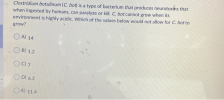 Clostridium botulinum (C. bot) is a type of bacterium that produces neurotoxins that when ingested by humans, can paralyze or kill. c. bot cannot grow when its environment is highly acidic. Which of the values below would not allow for C botto grow? O A) 14 OB) 1.2 OC) 7 OD) 6.2 E) 11.4
1. Excess alcohol metabolism produces what toxin that damages the liver? and Draw the toxin reacting...
1. Excess alcohol metabolism produces what toxin that damages the liver? and Draw the toxin reacting with an amino acid. 2. When an enzymatic substrate is at relatively high concentration what reaction order does the substrate get processed by?
O/1 pts Incorrect Question 8 Which foodbone illness does not involve a toxin? Hemolytic uremic syndrome...
 O/1 pts Incorrect Question 8 Which foodbone illness does not involve a toxin? Hemolytic uremic syndrome (HUS) Hepatitis A Botulism Spontaneous abortion Question 9 From the list on the right, find the BEST match for the term on the left Biology Choose I classification membrane Taxonomy study of living organisms dead stuffed animals smallest unit of function in living things microbes of interest in food Cell Bacteria Choose Previous Next Question 10 From the list on the right, find the...
How does botulism result in neuromuscular weakness? Thanks in advance for your response.
How does botulism result in neuromuscular weakness? Thanks in advance for your response.
Explain how the Toxin-Anti-toxin system could promote maintenance of the biofilm and persister cells. What does...
Explain how the Toxin-Anti-toxin system could promote maintenance of the biofilm and persister cells. What does this mean regarding exposure and reaction to antibiotic treatment?
10. How does endotoxin differ in its mode of action from an A-B-type toxin?
10. How does endotoxin differ in its mode of action from an A-B-type toxin?
 1. You have encountered 2 different pathogenic bacteria in the past 3 months and developed an upper respiratory tract infection of the same approximate magnitude each time. The inoculum size of organism #1 was 100 organisms, the inoculum size of organism #2 was 500 organisms. Explain how this is possible-that each would produce the same amount of disease. 2. Nosocomial infections. What are they and give a specific example. 3. Indicate at least 4 contributing causes to the development of...
 Clostridium botulinum (C. bot) is a type of bacterium that produces neurotoxins that when ingested by humans, can paralyze or kill. c. bot cannot grow when its environment is highly acidic. Which of the values below would not allow for C botto grow? O A) 14 OB) 1.2 OC) 7 OD) 6.2 E) 11.4
 O/1 pts Incorrect Question 8 Which foodbone illness does not involve a toxin? Hemolytic uremic syndrome (HUS) Hepatitis A Botulism Spontaneous abortion Question 9 From the list on the right, find the BEST match for the term on the left Biology Choose I classification membrane Taxonomy study of living organisms dead stuffed animals smallest unit of function in living things microbes of interest in food Cell Bacteria Choose Previous Next Question 10 From the list on the right, find the...
Most questions answered within 3 hours.
-
Where is the error in this code sequence?
String s1 = "Hello";
String s2 = "ello";...
asked 10 months ago -
Financial data for Joel de Paris, Inc., for last year
follow:
Joel de Paris, Inc.
Balance...
asked 10 months ago -
Consider this reaction:
Al2(SO4)3 (aq)+ BaCl3
(aq) Al2Cl6 (aq)- +
3BaSO4(s) . What is the...
asked 10 months ago -
Suppose that Savneet is considering increasing her
recent random sample from 20 car rentals to 40...
asked 10 months ago -
Trucks arrive at an unloading terminal at an average rate of 120
per hour.
Trucks arrive...
asked 10 months ago -
Why are methanol and ethanol completely soluble in water while
octanol is not very little soluble....
asked 10 months ago -
A facilities manager at a university reads in a research report
that the mean amount of...
asked 10 months ago -
When the CuSO4 is rehydrated by adding water to the anhydrous
compound, is this an endothermic...
asked 10 months ago -
A ray of sunlight is passing from diamond into crown glass; the
angle of incidence is...
asked 10 months ago -
A block of mass 0.249 kg is placed on top of a light, vertical
spring of...
asked 10 months ago -
how do the kidneys compensate in the presences of acidosis
a) trigger hyperventilate
b) reserve acid...
asked 10 months ago -
Question 501 pts
The rental rate of capital to the firm increases. Which of the
following...
asked 10 months ago