Consider a well-insulated horizontal rigid cylinder that is divided into two compartments by a piston that...
Consider a well-insulated horizontal rigid cylinder that is divided into two compartments by a piston that is free to move but does not allow either gas to leak into the other side. Initially, one side of the piston contains 1 m3 of N2 gas at 500 kPa and 120 °C, while the other side contains 1 m3 of He gas at 500 kPa and 40 °C. Now thermal equilibrium is established in the cylinder as a result of heat transfer through the piston. Using constant specific heats at room temperature, determine the final equilibrium temperature in the cylinder. What would your answer be if the piston were not free to move?
Homework Answers
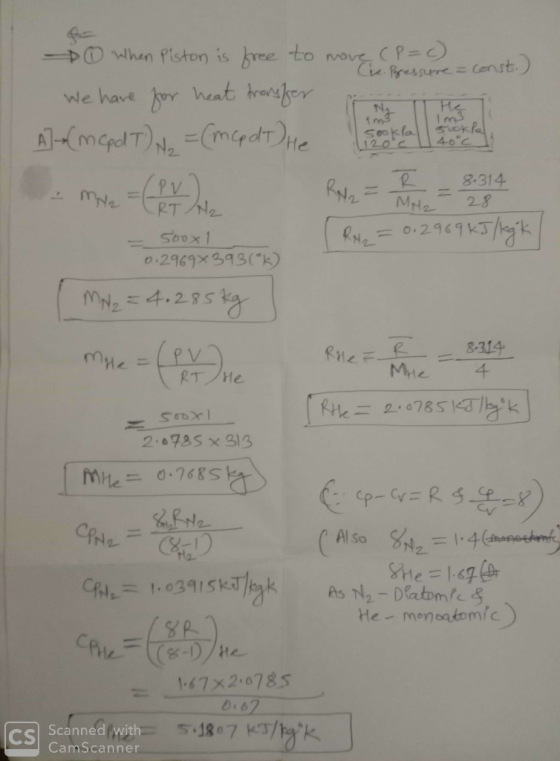

Answer remains same in both cases that is final temperature is equal to 82.248.
Add Answer to:
Consider a well-insulated horizontal rigid cylinder that is
divided into two compartments by a piston that...
4-40 4.40 A rigid, insulated tank consists of two compartments of equal volume separated by a...
 4-40
4.40 A rigid, insulated tank consists of two compartments of equal volume separated by a valve. Initially, one compartment contains air at a pressure of 750 kPa and a temperature of 50°C, while the second compartment is completely empty. The valve is opened and it remains open until the two compartments reach pressure and temperature equilibrium. Determine the final pressure and temperature of the air, assuming each compartment has a volume of 0.65 m'.
4-40
4.40 A rigid, insulated tank consists of two compartments of equal volume separated by a valve. Initially, one compartment contains air at a pressure of 750 kPa and a temperature of 50°C, while the second compartment is completely empty. The valve is opened and it remains open until the two compartments reach pressure and temperature equilibrium. Determine the final pressure and temperature of the air, assuming each compartment has a volume of 0.65 m'.
Problem 3-2 A rigid, well-insulated tank consists of two compartments eparated by a valve, one being...
 Problem 3-2 A rigid, well-insulated tank consists of two compartments eparated by a valve, one being twice the volume of the other. Initially, the smaller compartment contains 10 kg of nitrogen at 6 bar and 100°C, while the larger one is evacuated. The valve is opened and the gas expands to fill the total volume, eventually achieving an equilibrium state. Calculate: a) The final temperature, in K. b) The final pressure, in bar, c) The total exergy destroyed, in kJ...
A cylinder is closed at both ends and has insulating walls. It is divided into two...
 A cylinder is closed at both ends and has insulating walls. It is divided into two compartments by an insulating piston that is perpendicular to the axis of the cylinder as shown in Figure a. Each compartment contains 1.00 mol of oxygen that behaves as an ideal gas with y = 1.40. Initially, the two compartments have equal volumes and their temperatures are T_1i = 585 K and T_2i = 185 K. The piston is then allowed to move slowly...
Heat Problem #2 An insulated free piton-cylinder arrangement initially contains 10 kg of water at 200...
 Heat Problem #2 An insulated free piton-cylinder arrangement initially contains 10 kg of water at 200 kPa with a quality of 60%. A supply line of steam at 500 kPa and 350 °C is opened to allow steam into the piston-cylinder arrangement until all the liquid inside just vaporizes. Determine: a) b) The final temperature in the cylinder The mass of steam that has entered Steam:
An isolated chamber with rigid walls is divided into two equal compartments
An isolated chamber with rigid walls is divided into two equal compartments, one containing steam at 10 bar and 370oC, and the other evacuated. A valve between the compartments is opened to permit steam to pass from one chamber to the other. a)After the pressure (but not the temperatures) in the two chambers have equalized, the valve is closed, isolating the two systems. What are the temperature and pressure in each cylinder?b)If the valve were left open, and equilibrium state...
please help with this problem Ext-2.2 (35 points) An insulated, rigid tank is divided into two...
 please help with this problem
Ext-2.2 (35 points) An insulated, rigid tank is divided into two compartments by a frictionless, thermally conducting piston. One compartment initially contains 0.6 m' of saturated water vapor at 200 °C and the other compartment contains 0.8 m' of superheated water vapor at 210 bar, 780 °C. The piston is released and equilibrium is attained. The mass of piston is small enough to be neglected in this problem. (a) Draw a schematic diagram of the...
please help with this problem
Ext-2.2 (35 points) An insulated, rigid tank is divided into two compartments by a frictionless, thermally conducting piston. One compartment initially contains 0.6 m' of saturated water vapor at 200 °C and the other compartment contains 0.8 m' of superheated water vapor at 210 bar, 780 °C. The piston is released and equilibrium is attained. The mass of piston is small enough to be neglected in this problem. (a) Draw a schematic diagram of the...
Consider the piston/cylinder arrangement shown in Fig1. A frictionless piston is free to move between two...
 Consider the piston/cylinder arrangement shown in Fig1. A
frictionless piston is free to move between two sets of stops. When
3 the piston rests on the lower stops, the enclosed volume is 0.5
m3. When the piston reaches the upper stops, the volume is 0.8 m .
The cylinder initially contains water at 200 kPa, 60% quality. The
mass of the piston requires 600 kPa pressure to move it against the
outside ambient pressure.
a) When heat is transferred until...
Consider the piston/cylinder arrangement shown in Fig1. A
frictionless piston is free to move between two sets of stops. When
3 the piston rests on the lower stops, the enclosed volume is 0.5
m3. When the piston reaches the upper stops, the volume is 0.8 m .
The cylinder initially contains water at 200 kPa, 60% quality. The
mass of the piston requires 600 kPa pressure to move it against the
outside ambient pressure.
a) When heat is transferred until...
Problem 3. (10 points) A closed and insulated rigid tank (perfectly insulated) is initially divided into...
 Problem 3. (10 points) A closed and insulated rigid tank (perfectly insulated) is initially divided into halves by a separator. On one side of the separator is 1 m of air at 300 K, 2 bar. On the other side is 1 m of air at 500 K, 1 bar. The separator is removed, and the air from the two sides mixes and reaches equilibrium state Please treat the air as ideal gas with cp-1.001 kJ/kg K and c0.714 kJ/kg...
9 Required information NOTE: This is a multi-part question. Once an answer is submitted, you will...
 9 Required information NOTE: This is a multi-part question. Once an answer is submitted, you will be unable to return to this part. An insulated rigid tank is divided into two compartments by a partition. One compartment contains 9.5 kg of oxygen gas at 40°C and 100 kPa, and the other compartment contains 4 kg of nitrogen gas at 20°C and 150 kPa. Now the partition is removed, and the two gases are allowed to mix N2 4 kg 20℃...
Problem 6: A cylinder of length L = 85 cm is divided in two by a...
 Problem 6: A cylinder of length L = 85 cm is divided in two by a freely movable rigid piston. One of the compartments is filled with oxygen gas, the other - with hydrogen. The mass of the oxygen is equal to the mass of the hydrogen. (a) If you know that the temperature is the same in both compartments, determine at what position of the piston the pressure on both sides will be equal? (b) If you remove the...
 4-40
4.40 A rigid, insulated tank consists of two compartments of equal volume separated by a valve. Initially, one compartment contains air at a pressure of 750 kPa and a temperature of 50°C, while the second compartment is completely empty. The valve is opened and it remains open until the two compartments reach pressure and temperature equilibrium. Determine the final pressure and temperature of the air, assuming each compartment has a volume of 0.65 m'.
4-40
4.40 A rigid, insulated tank consists of two compartments of equal volume separated by a valve. Initially, one compartment contains air at a pressure of 750 kPa and a temperature of 50°C, while the second compartment is completely empty. The valve is opened and it remains open until the two compartments reach pressure and temperature equilibrium. Determine the final pressure and temperature of the air, assuming each compartment has a volume of 0.65 m'.
 Problem 3-2 A rigid, well-insulated tank consists of two compartments eparated by a valve, one being twice the volume of the other. Initially, the smaller compartment contains 10 kg of nitrogen at 6 bar and 100°C, while the larger one is evacuated. The valve is opened and the gas expands to fill the total volume, eventually achieving an equilibrium state. Calculate: a) The final temperature, in K. b) The final pressure, in bar, c) The total exergy destroyed, in kJ...
 A cylinder is closed at both ends and has insulating walls. It is divided into two compartments by an insulating piston that is perpendicular to the axis of the cylinder as shown in Figure a. Each compartment contains 1.00 mol of oxygen that behaves as an ideal gas with y = 1.40. Initially, the two compartments have equal volumes and their temperatures are T_1i = 585 K and T_2i = 185 K. The piston is then allowed to move slowly...
 Heat Problem #2 An insulated free piton-cylinder arrangement initially contains 10 kg of water at 200 kPa with a quality of 60%. A supply line of steam at 500 kPa and 350 °C is opened to allow steam into the piston-cylinder arrangement until all the liquid inside just vaporizes. Determine: a) b) The final temperature in the cylinder The mass of steam that has entered Steam:
 please help with this problem
Ext-2.2 (35 points) An insulated, rigid tank is divided into two compartments by a frictionless, thermally conducting piston. One compartment initially contains 0.6 m' of saturated water vapor at 200 °C and the other compartment contains 0.8 m' of superheated water vapor at 210 bar, 780 °C. The piston is released and equilibrium is attained. The mass of piston is small enough to be neglected in this problem. (a) Draw a schematic diagram of the...
please help with this problem
Ext-2.2 (35 points) An insulated, rigid tank is divided into two compartments by a frictionless, thermally conducting piston. One compartment initially contains 0.6 m' of saturated water vapor at 200 °C and the other compartment contains 0.8 m' of superheated water vapor at 210 bar, 780 °C. The piston is released and equilibrium is attained. The mass of piston is small enough to be neglected in this problem. (a) Draw a schematic diagram of the...
 Consider the piston/cylinder arrangement shown in Fig1. A
frictionless piston is free to move between two sets of stops. When
3 the piston rests on the lower stops, the enclosed volume is 0.5
m3. When the piston reaches the upper stops, the volume is 0.8 m .
The cylinder initially contains water at 200 kPa, 60% quality. The
mass of the piston requires 600 kPa pressure to move it against the
outside ambient pressure.
a) When heat is transferred until...
Consider the piston/cylinder arrangement shown in Fig1. A
frictionless piston is free to move between two sets of stops. When
3 the piston rests on the lower stops, the enclosed volume is 0.5
m3. When the piston reaches the upper stops, the volume is 0.8 m .
The cylinder initially contains water at 200 kPa, 60% quality. The
mass of the piston requires 600 kPa pressure to move it against the
outside ambient pressure.
a) When heat is transferred until...
 Problem 3. (10 points) A closed and insulated rigid tank (perfectly insulated) is initially divided into halves by a separator. On one side of the separator is 1 m of air at 300 K, 2 bar. On the other side is 1 m of air at 500 K, 1 bar. The separator is removed, and the air from the two sides mixes and reaches equilibrium state Please treat the air as ideal gas with cp-1.001 kJ/kg K and c0.714 kJ/kg...
 9 Required information NOTE: This is a multi-part question. Once an answer is submitted, you will be unable to return to this part. An insulated rigid tank is divided into two compartments by a partition. One compartment contains 9.5 kg of oxygen gas at 40°C and 100 kPa, and the other compartment contains 4 kg of nitrogen gas at 20°C and 150 kPa. Now the partition is removed, and the two gases are allowed to mix N2 4 kg 20℃...
 Problem 6: A cylinder of length L = 85 cm is divided in two by a freely movable rigid piston. One of the compartments is filled with oxygen gas, the other - with hydrogen. The mass of the oxygen is equal to the mass of the hydrogen. (a) If you know that the temperature is the same in both compartments, determine at what position of the piston the pressure on both sides will be equal? (b) If you remove the...
Most questions answered within 3 hours.
-
Where is the error in this code sequence?
String s1 = "Hello";
String s2 = "ello";...
asked 11 months ago -
Financial data for Joel de Paris, Inc., for last year
follow:
Joel de Paris, Inc.
Balance...
asked 11 months ago -
Consider this reaction:
Al2(SO4)3 (aq)+ BaCl3
(aq) Al2Cl6 (aq)- +
3BaSO4(s) . What is the...
asked 11 months ago -
Suppose that Savneet is considering increasing her
recent random sample from 20 car rentals to 40...
asked 11 months ago -
Trucks arrive at an unloading terminal at an average rate of 120
per hour.
Trucks arrive...
asked 11 months ago -
Why are methanol and ethanol completely soluble in water while
octanol is not very little soluble....
asked 11 months ago -
A facilities manager at a university reads in a research report
that the mean amount of...
asked 11 months ago -
When the CuSO4 is rehydrated by adding water to the anhydrous
compound, is this an endothermic...
asked 11 months ago -
A ray of sunlight is passing from diamond into crown glass; the
angle of incidence is...
asked 11 months ago -
A block of mass 0.249 kg is placed on top of a light, vertical
spring of...
asked 11 months ago -
how do the kidneys compensate in the presences of acidosis
a) trigger hyperventilate
b) reserve acid...
asked 11 months ago -
Question 501 pts
The rental rate of capital to the firm increases. Which of the
following...
asked 11 months ago