Why is 1-Bromobutane faster than Allyl Chloride in a NaI in acetone reaction? It is an...
Why is 1-Bromobutane faster than Allyl Chloride in a NaI in acetone reaction? It is an SN2 reaction.
Homework Answers

Add Answer to:
Why is 1-Bromobutane faster than Allyl Chloride in a NaI in
acetone reaction? It is an...
organic chemistry question kinetic study lab 1) justify why benzyl chloride (PhCH2Cl) reacts faster than 2-Chlorobutane...
organic chemistry question kinetic study lab 1) justify why benzyl chloride (PhCH2Cl) reacts faster than 2-Chlorobutane under any of the reaction conditions studied. (Sn2 and Sn1) 2) the compounds 2-bromobutane and 2-clorobutane are secondary alkyl halides. what can be concluded with reactions Sn1 (AgNO3 )and Sn2 (NaI)
1. In both the sodium iodide test and the silver nitrate test, why does 2-bromobutane react faster...
 1. In both the sodium iodide
test and the silver nitrate test, why does 2-bromobutane react
faster than 2-chlorobutane?
Bromine is a better leaving group since it is a weaker base than
chlorine is.
2. a. Why does benzyl chloride react under both
SN1 and SN2 conditions?
Benzyl
chloride is a primary alkyl halide, hence reactive under SN2
conditions.
The
primary carbocation formed due to the departure of Cl- is
stabilized by the pi electrons in the benzene ring.
b. Why is...
1. In both the sodium iodide
test and the silver nitrate test, why does 2-bromobutane react
faster than 2-chlorobutane?
Bromine is a better leaving group since it is a weaker base than
chlorine is.
2. a. Why does benzyl chloride react under both
SN1 and SN2 conditions?
Benzyl
chloride is a primary alkyl halide, hence reactive under SN2
conditions.
The
primary carbocation formed due to the departure of Cl- is
stabilized by the pi electrons in the benzene ring.
b. Why is...
Please order these alkyl halides from most to least reactive and explain why structurally. Allyl chloride,...
 Please order these alkyl halides from most to least reactive and
explain why structurally. Allyl chloride, n-butyl bromide,
n-butyl chloride, sec butyl chloride. They are reacted
with NaI and it is an Sn2 reaction.
Structures:
N-butyl bromide Allyl chloride Br | CV N-butyl chloride Sec-butyl chloride
Please order these alkyl halides from most to least reactive and
explain why structurally. Allyl chloride, n-butyl bromide,
n-butyl chloride, sec butyl chloride. They are reacted
with NaI and it is an Sn2 reaction.
Structures:
N-butyl bromide Allyl chloride Br | CV N-butyl chloride Sec-butyl chloride
2-chlorobutane 2-bromobutane 1-chlorobutane 1-bromobutane 2-chloro-2-methyl-propane Allyl chloride Benzyl Chloride Bromobenzene Bromocyclohexane Bromocyclopentane 1. Which substrates should...
2-chlorobutane 2-bromobutane 1-chlorobutane 1-bromobutane 2-chloro-2-methyl-propane Allyl chloride Benzyl Chloride Bromobenzene Bromocyclohexane Bromocyclopentane 1. Which substrates should be "very reactive" in SN2 reactions? 2. Which substrates should be "very reactive" in SN1 reactions?
Product Structure in NaI, acetone of the following (Note: it should follow an SN2 mechanism). Dont...
Product Structure in NaI, acetone of the following (Note: it should follow an SN2 mechanism). Dont need the entire mechanism just the final product structure please. Thank you. 2-chlorobutane 2-bromobutane 1-chlorobutane 1-bromobutane 2-chloro-2-methyl propane Crotyl chloride Benzyl chloride Bromobenzene Bromocyclohexane Bromocyclopentane
Please HELP!! Table 1: Alkyl Halides in NaI Substrate Time for Precipitate to Form Heated? Temp...
Please HELP!! Table 1: Alkyl Halides in NaI Substrate Time for Precipitate to Form Heated? Temp (℃) Time (min) Heat Relative Ranking (#1-#6) Predicted Relative Ranking (#1-#6) Bromobenzene No reaction Yes 44 10 6 6 2-Chlorobutane No reaction Yes 44 10 5 4 1-Chlorobutane 13 min Yes 44 8 4 3 Benzyl Chloride 2min 30 sec No --- --- 2 1 1-Chloro-2-butene 1 second No --- --- 1 5 1-Bromobutane 5 min No --- --- 3 2 1. Why did...
nucleophile: NaI electrophile: 1-bromobutane b. If this reaction was an SNI reaction, it would follow the...
 nucleophile: NaI
electrophile: 1-bromobutane
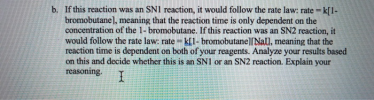
b. If this reaction was an SNI reaction, it would follow the rate law: rate =k[1- bromobutanel, meaning that the reaction time is only dependent on the concentration of the 1-bromobutane. If this reaction was an SN2 reaction, it would follow the rate law: rate = K[1-bromobutane] Nal), meaning that the reaction time is dependent on both of your reagents. Analyze your results based on this and decide whether this is an SN1 or an SN2...
nucleophile: NaI
electrophile: 1-bromobutane
b. If this reaction was an SNI reaction, it would follow the rate law: rate =k[1- bromobutanel, meaning that the reaction time is only dependent on the concentration of the 1-bromobutane. If this reaction was an SN2 reaction, it would follow the rate law: rate = K[1-bromobutane] Nal), meaning that the reaction time is dependent on both of your reagents. Analyze your results based on this and decide whether this is an SN1 or an SN2...
Predict if the given compounds below undergo SN2 or SN1 in presence of NaI / acetone...
Predict if the given compounds below undergo SN2 or SN1 in presence of NaI / acetone and AgNO3 / ethanol medium. (1-bromobutane, 1-chlorobutane, 2-bromobutane, 2-chlorobutane, 2-chloro-2methylpropane, 2-bromo-2-methylpropane)
Why does 1-bromobutane react faster than l-bromobenzene?
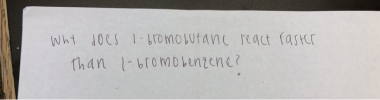 Why does 1-bromobutane react faster than l-bromobenzene?
Arrange the haloalkanes in order of increasing reactivity in an Sn2 reaction with NaI in acetone...
 Arrange the haloalkanes in
order of increasing reactivity in an Sn2 reaction with NaI in
acetone (least first).
a. Methyl bromide b Isopropyl chloride t-butyl iodide d. Isobutyl chloride aus CH3 cиз C. Arrange the haloalkanes in order of increasing reactivity in an SN2 reaction with Nal in acetone (least first). CH3 - CH2CH2-I C-Br CI Br CH3 I 11 II IV I, IV, III, II b II, II, I, IV a. IV,I, II, II с. d. III, II, IV,...
Arrange the haloalkanes in
order of increasing reactivity in an Sn2 reaction with NaI in
acetone (least first).
a. Methyl bromide b Isopropyl chloride t-butyl iodide d. Isobutyl chloride aus CH3 cиз C. Arrange the haloalkanes in order of increasing reactivity in an SN2 reaction with Nal in acetone (least first). CH3 - CH2CH2-I C-Br CI Br CH3 I 11 II IV I, IV, III, II b II, II, I, IV a. IV,I, II, II с. d. III, II, IV,...
 1. In both the sodium iodide
test and the silver nitrate test, why does 2-bromobutane react
faster than 2-chlorobutane?
Bromine is a better leaving group since it is a weaker base than
chlorine is.
2. a. Why does benzyl chloride react under both
SN1 and SN2 conditions?
Benzyl
chloride is a primary alkyl halide, hence reactive under SN2
conditions.
The
primary carbocation formed due to the departure of Cl- is
stabilized by the pi electrons in the benzene ring.
b. Why is...
1. In both the sodium iodide
test and the silver nitrate test, why does 2-bromobutane react
faster than 2-chlorobutane?
Bromine is a better leaving group since it is a weaker base than
chlorine is.
2. a. Why does benzyl chloride react under both
SN1 and SN2 conditions?
Benzyl
chloride is a primary alkyl halide, hence reactive under SN2
conditions.
The
primary carbocation formed due to the departure of Cl- is
stabilized by the pi electrons in the benzene ring.
b. Why is...
 Please order these alkyl halides from most to least reactive and
explain why structurally. Allyl chloride, n-butyl bromide,
n-butyl chloride, sec butyl chloride. They are reacted
with NaI and it is an Sn2 reaction.
Structures:
N-butyl bromide Allyl chloride Br | CV N-butyl chloride Sec-butyl chloride
Please order these alkyl halides from most to least reactive and
explain why structurally. Allyl chloride, n-butyl bromide,
n-butyl chloride, sec butyl chloride. They are reacted
with NaI and it is an Sn2 reaction.
Structures:
N-butyl bromide Allyl chloride Br | CV N-butyl chloride Sec-butyl chloride
 nucleophile: NaI
electrophile: 1-bromobutane
b. If this reaction was an SNI reaction, it would follow the rate law: rate =k[1- bromobutanel, meaning that the reaction time is only dependent on the concentration of the 1-bromobutane. If this reaction was an SN2 reaction, it would follow the rate law: rate = K[1-bromobutane] Nal), meaning that the reaction time is dependent on both of your reagents. Analyze your results based on this and decide whether this is an SN1 or an SN2...
nucleophile: NaI
electrophile: 1-bromobutane
b. If this reaction was an SNI reaction, it would follow the rate law: rate =k[1- bromobutanel, meaning that the reaction time is only dependent on the concentration of the 1-bromobutane. If this reaction was an SN2 reaction, it would follow the rate law: rate = K[1-bromobutane] Nal), meaning that the reaction time is dependent on both of your reagents. Analyze your results based on this and decide whether this is an SN1 or an SN2...
 Why does 1-bromobutane react faster than l-bromobenzene?
 Arrange the haloalkanes in
order of increasing reactivity in an Sn2 reaction with NaI in
acetone (least first).
a. Methyl bromide b Isopropyl chloride t-butyl iodide d. Isobutyl chloride aus CH3 cиз C. Arrange the haloalkanes in order of increasing reactivity in an SN2 reaction with Nal in acetone (least first). CH3 - CH2CH2-I C-Br CI Br CH3 I 11 II IV I, IV, III, II b II, II, I, IV a. IV,I, II, II с. d. III, II, IV,...
Arrange the haloalkanes in
order of increasing reactivity in an Sn2 reaction with NaI in
acetone (least first).
a. Methyl bromide b Isopropyl chloride t-butyl iodide d. Isobutyl chloride aus CH3 cиз C. Arrange the haloalkanes in order of increasing reactivity in an SN2 reaction with Nal in acetone (least first). CH3 - CH2CH2-I C-Br CI Br CH3 I 11 II IV I, IV, III, II b II, II, I, IV a. IV,I, II, II с. d. III, II, IV,...
Most questions answered within 3 hours.
-
Where is the error in this code sequence?
String s1 = "Hello";
String s2 = "ello";...
asked 10 months ago -
Financial data for Joel de Paris, Inc., for last year
follow:
Joel de Paris, Inc.
Balance...
asked 10 months ago -
Consider this reaction:
Al2(SO4)3 (aq)+ BaCl3
(aq) Al2Cl6 (aq)- +
3BaSO4(s) . What is the...
asked 10 months ago -
Suppose that Savneet is considering increasing her
recent random sample from 20 car rentals to 40...
asked 10 months ago -
Trucks arrive at an unloading terminal at an average rate of 120
per hour.
Trucks arrive...
asked 10 months ago -
Why are methanol and ethanol completely soluble in water while
octanol is not very little soluble....
asked 10 months ago -
A facilities manager at a university reads in a research report
that the mean amount of...
asked 10 months ago -
When the CuSO4 is rehydrated by adding water to the anhydrous
compound, is this an endothermic...
asked 10 months ago -
A ray of sunlight is passing from diamond into crown glass; the
angle of incidence is...
asked 10 months ago -
A block of mass 0.249 kg is placed on top of a light, vertical
spring of...
asked 10 months ago -
how do the kidneys compensate in the presences of acidosis
a) trigger hyperventilate
b) reserve acid...
asked 10 months ago -
Question 501 pts
The rental rate of capital to the firm increases. Which of the
following...
asked 10 months ago