1. Primate females always invest in their young because primate males do not have the appropriate...
1.
Primate females always invest in their young because
| primate males do not have the appropriate neurological foundation. |
| they produce large, nutrient-rich gametes. |
| parenting effort is equal to mating effort. |
| they are committed to parental investment by their physiology. |
2.
Which of the following is true of primates in general?
| One-male, multifemale groups have less dimorphism in body size than do pair-bonded species. |
| Pair-bonded groups have the least amount of sexual dimorphism in body size. |
| Multimale, multifemale groups tend to have greater sexual dimorphism than one-male, multifemale groups. |
| Multimale, multifemale groups are not dimorphic in body size. |
3.
Birds and mammals have very different typical reproductive strategies. What is a key reason for this?
| Birds are not as highly evolved as primates, so they have simple undifferentiated mating systems mostly involving male songs and calls. |
| Because they can fly, birds do not experience limitations on food availability and therefore undergo mainly sexual selection and almost no natural selection. |
| In birds, both males and females can provide a great deal of parental investment for the young, because both can incubate the egg(s) and both can bring food to the chick(s). |
4.
Male reproduction is limited by
| the number of fertile females. |
| food availability. |
| the number of sex cells a male produces. |
Thanks!
Homework Answers
Ans 1)Female primates are heavily invested in their offspring, because they are committed to parental investment by their physiology. Female primates lactate where as males do not , their is a difference in physiology of males and females , thats y females invest better in young ones. Correct answer is D
Ans 2)A few primates are monogamous. That means they mate in an pair-bond until one of the pair dies. The species that are monogamous have minimal sexual dimorphism.
Correct answer is B
Paor bonded groups have leaat amount of sexual dimorphism
Ans 3)in birds, both males and females can provide a great deal of parental investment for the young, because both can incubate the egg(s) and both can bring food to the chick(s
Ans 4) male reproduction us limited by the no. Of fertile females .
males compete among themselves for access to females, whereas females tend to be choosy and mate only with preferred males.
Add Answer to:
1.
Primate females always invest in their young because
primate males do not have the appropriate...
Can someone who is good with primates help me answer these questions? 1. Male primates commit...
Can someone who is good with primates help me answer these questions? 1. Male primates commit infanticide in one-male, multifemale groups because they want to limit the number of males in their group. females without nursing infants resume sexual receptivity. females do not want infants sired by a nonalpha male. it enhances male attractiveness to females. 2. Which of the following statements is true? Patterns of courtship, mate choice, and parental care vary greatly within the primate order. The reproductive...
. Male drosophila typically have a higher potential reproductive output than females because a. The more...
 . Male drosophila typically have a higher potential reproductive output than females because a. The more females fertilized, the higher the male's fitness b. Females are limited by the resources that they have to use to produce eggs c. Males do not provide any parental care d. All of the above e. None of the above 2. The handicap theory of mate choice in sexual selection says that : a. Male display genes spread and female choice genes only spread...
1. What are territories? fixed areas defended by members of a group against conspecifics fixed areas...
1. What are territories? fixed areas defended by members of a group against conspecifics fixed areas defended by members of a group against other species areas where groups come together in areas where their ranges overlap areas where members of a group are often found 2. A high degree of sexual dimorphism observed in a fossil primate species could indicate that this species had social groups with a single male and multiple females. This would be an example of direct...
Seems like one answer was correct above. Partial Question 1 0.33/1 pts Three of the following...
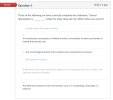 Seems like one answer was correct above.
Partial Question 1 0.33/1 pts Three of the following six items correctly complete the statement, "Sexual dimorphism is "while the other three do not. Which three are correct? Usually caused by sexual selection. An evolutionary consequence of different levels of investment of males and females in mating and parental care. Any morphological feature that is influenced by reproductive hormones. Not present in humans. A difference in the sexes that always takes the form...
Seems like one answer was correct above.
Partial Question 1 0.33/1 pts Three of the following six items correctly complete the statement, "Sexual dimorphism is "while the other three do not. Which three are correct? Usually caused by sexual selection. An evolutionary consequence of different levels of investment of males and females in mating and parental care. Any morphological feature that is influenced by reproductive hormones. Not present in humans. A difference in the sexes that always takes the form...
According to Robert Trivers, why are men generally larger and more physically aggressive than women? Because...
According to Robert Trivers, why are men generally larger and more physically aggressive than women? Because women are more reproductively “valuable” than men, hence competition for mates is fiercer among men Because men invest more heavily in reproduction than women Because men secrete more testosterone Trivers’ theory does not speculate on the origin of the sex difference in size and physical aggression Although some women are interested in casual sex (short-term mating), research has suggested that there are differences in...
asap Chapter 08 Social Relations: 1-26 1. Fitness is defined as the A. health of an...
 asap
Chapter 08 Social Relations: 1-26 1. Fitness is defined as the A. health of an individual organism. B. ability of an organism to adap C. quality of offspring produced. D. number of genes contri an organism to adapt to new environmental situations. of genes contributed by an individual to the next generation. 2. Secondary sexual ondary sexual characteristics are often considered a handicap because of increased A. predation. B. competition C. parasitism. D. infertility. 3. In any animal, the...
asap
Chapter 08 Social Relations: 1-26 1. Fitness is defined as the A. health of an individual organism. B. ability of an organism to adap C. quality of offspring produced. D. number of genes contri an organism to adapt to new environmental situations. of genes contributed by an individual to the next generation. 2. Secondary sexual ondary sexual characteristics are often considered a handicap because of increased A. predation. B. competition C. parasitism. D. infertility. 3. In any animal, the...
Why does sexual monogamy tend to reduce sexual conflict? O It benefits the fitness of both...
 Why does sexual monogamy tend to reduce sexual conflict? O It benefits the fitness of both the male and female to not thwart or harm each other because they have only one partner for mating. Once a female and male bond in the all-important goal of raising their offspring, each can then engage in extra-pair copulations. Mating measures and countermeasures occur least with monogamy, the ideal mating system for the fitness of both sexes in every species. Both competition between...
Questions on primates... can you guys help? Thanks! 1. Sociality is costly to primates because there...
Questions on primates... can you guys help? Thanks! 1. Sociality is costly to primates because there is greater competition for resources. it is harder to carry out infanticide. they have to share home ranges with other primates. there is increased vulnerability to attacks from conspecifics. 2. Resource-defense territoriality occurs when food is clumped in a space. resources are distributed over a wide area. females are clumped in space. resources are abundant and thus worth defending. 3. Among primates, a social...
ON MULTIPLE CHOICE, CIRCLE LETTER OF ALL CORRECT ANSWERS!!! 31. (2 pts) True or False. Sexual...
 ON MULTIPLE CHOICE, CIRCLE LETTER OF ALL CORRECT ANSWERS!!! 31. (2 pts) True or False. Sexual dimorphism is the phenomenon that caused biologists to focus on sexual selection. 32. ( pts) What is the most important basic underlying difference between the sexes that causes sexual selection to usually operate differently in males than in females? A. The cost of reproduction is usually higher in females. B. The cost of reproduction is usually higher in males. C. Males have only 1...
Female stalk-eyed flies prefer to mate with males that have longer eye stalks
1Female stalk-eyed flies prefer to mate with males that have longer eye stalks, and the average male eye stalk length is much longer than that of females. This is an example of _______ mutation macroevolution. disruptive selection sexual selection. 2 Several different species of small nocturnal primates called, bush babies live in the woodlands of Africa While several different species of bush babies often live in the same habitat they cannot interbreed because bush babies have genitalia that will only fit the genitalia of females belonging...
 . Male drosophila typically have a higher potential reproductive output than females because a. The more females fertilized, the higher the male's fitness b. Females are limited by the resources that they have to use to produce eggs c. Males do not provide any parental care d. All of the above e. None of the above 2. The handicap theory of mate choice in sexual selection says that : a. Male display genes spread and female choice genes only spread...
 Seems like one answer was correct above.
Partial Question 1 0.33/1 pts Three of the following six items correctly complete the statement, "Sexual dimorphism is "while the other three do not. Which three are correct? Usually caused by sexual selection. An evolutionary consequence of different levels of investment of males and females in mating and parental care. Any morphological feature that is influenced by reproductive hormones. Not present in humans. A difference in the sexes that always takes the form...
Seems like one answer was correct above.
Partial Question 1 0.33/1 pts Three of the following six items correctly complete the statement, "Sexual dimorphism is "while the other three do not. Which three are correct? Usually caused by sexual selection. An evolutionary consequence of different levels of investment of males and females in mating and parental care. Any morphological feature that is influenced by reproductive hormones. Not present in humans. A difference in the sexes that always takes the form...
 asap
Chapter 08 Social Relations: 1-26 1. Fitness is defined as the A. health of an individual organism. B. ability of an organism to adap C. quality of offspring produced. D. number of genes contri an organism to adapt to new environmental situations. of genes contributed by an individual to the next generation. 2. Secondary sexual ondary sexual characteristics are often considered a handicap because of increased A. predation. B. competition C. parasitism. D. infertility. 3. In any animal, the...
asap
Chapter 08 Social Relations: 1-26 1. Fitness is defined as the A. health of an individual organism. B. ability of an organism to adap C. quality of offspring produced. D. number of genes contri an organism to adapt to new environmental situations. of genes contributed by an individual to the next generation. 2. Secondary sexual ondary sexual characteristics are often considered a handicap because of increased A. predation. B. competition C. parasitism. D. infertility. 3. In any animal, the...
 Why does sexual monogamy tend to reduce sexual conflict? O It benefits the fitness of both the male and female to not thwart or harm each other because they have only one partner for mating. Once a female and male bond in the all-important goal of raising their offspring, each can then engage in extra-pair copulations. Mating measures and countermeasures occur least with monogamy, the ideal mating system for the fitness of both sexes in every species. Both competition between...
 ON MULTIPLE CHOICE, CIRCLE LETTER OF ALL CORRECT ANSWERS!!! 31. (2 pts) True or False. Sexual dimorphism is the phenomenon that caused biologists to focus on sexual selection. 32. ( pts) What is the most important basic underlying difference between the sexes that causes sexual selection to usually operate differently in males than in females? A. The cost of reproduction is usually higher in females. B. The cost of reproduction is usually higher in males. C. Males have only 1...
Most questions answered within 3 hours.
-
Where is the error in this code sequence?
String s1 = "Hello";
String s2 = "ello";...
asked 11 months ago -
Financial data for Joel de Paris, Inc., for last year
follow:
Joel de Paris, Inc.
Balance...
asked 11 months ago -
Consider this reaction:
Al2(SO4)3 (aq)+ BaCl3
(aq) Al2Cl6 (aq)- +
3BaSO4(s) . What is the...
asked 11 months ago -
Suppose that Savneet is considering increasing her
recent random sample from 20 car rentals to 40...
asked 11 months ago -
Trucks arrive at an unloading terminal at an average rate of 120
per hour.
Trucks arrive...
asked 11 months ago -
Why are methanol and ethanol completely soluble in water while
octanol is not very little soluble....
asked 11 months ago -
A facilities manager at a university reads in a research report
that the mean amount of...
asked 11 months ago -
When the CuSO4 is rehydrated by adding water to the anhydrous
compound, is this an endothermic...
asked 11 months ago -
A ray of sunlight is passing from diamond into crown glass; the
angle of incidence is...
asked 11 months ago -
A block of mass 0.249 kg is placed on top of a light, vertical
spring of...
asked 11 months ago -
how do the kidneys compensate in the presences of acidosis
a) trigger hyperventilate
b) reserve acid...
asked 11 months ago -
Question 501 pts
The rental rate of capital to the firm increases. Which of the
following...
asked 11 months ago