1) Assume to include in a processor a new fast floating-point unit that speeds up floating-point...
1) Assume to include in a processor a new fast floating-point unit that speeds up floating-point operations by an average factor 2×. In addition, assume that floating-point operations take 20% of the original program execution. What is the overall speedup?
Homework Answers
Hi there,
Please find the answer attached as under. Please give a Thumbs UP
if you find the answer useful. Have a rocking day Ahead:)
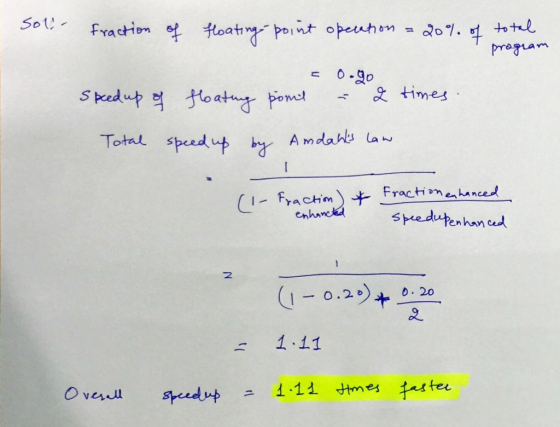
******************************************************************************************************************************
PS: Please do not forget the thumbs up!
Add Answer to:
1) Assume to include in a processor a new fast floating-point
unit that speeds up floating-point...
.13 : Assume that we make an enhancement to a computer that improves some mode of...
.13 : Assume that we make an enhancement to a computer that improves some mode of execution by a factor of 10. Enhanced mode is used 50% of the time, measured as a percentage of the execution time when the enhanced mode is in use. Recall that Amdahl’s law depends on the fraction of the original, unenhanced execution time that could make use of enhanced mode. Thus, we cannot directly use this 50% measurement to compute speedup with Amdahl’s law....
Assume that speeding up the floating-point operations causes a slow down in the data cache accesses....
Assume that speeding up the floating-point operations causes a slow down in the data cache accesses. For example, given the additional space taken by the more sophisticated floating-point unit, memory operations take some extra cycles to get to the cache. Specifically, assume that data cache accesses, which consume 10% of the original program execution time, are now slowed down by a factor 1.5×. What is the overall speedup? [
4. (10 pt) A processor Assuming that the integer instructions requires 80% of the original execution...
 4. (10 pt) A processor Assuming that the integer instructions requires 80% of the original execution time, and the floating point instructions requires 20%. How much faster should the integer instructions run for overall speedup of 2? (What is the improvement factor for a speedup of 2?) program consisting of integer instructions and floating-point instructions. runs a Improvement Factor
Memory operations currently take 30% of execution time. A new widget called a cache speeds up...
Memory operations currently take 30% of execution time. A new widget called a cache speeds up 80% memory operations by a factor of 4. A second new widget called an L2 cache speeds up 1/2 of the remaining 20% by a factor of 2. What is the total speed up?
2. Given Amdal's Law as shown below (1-2) Form A: T(0,N) 1 Form B:S(s) = (1-p)+...
 2. Given Amdal's Law as shown below (1-2) Form A: T(0,N) 1 Form B:S(s) = (1-p)+ The 60% of program could be parallellized. Using latest compiler, the serial part of N 1) the program double its performance. If the program running on a 5 processor machine, calculate its whole speedup ? (4 marks) 2) What is the overall speedup if we make 90 % of a program run 10 times faster? (4 marks) V Four parts of a program need...
Assume for arithmetic, load/store, and branch instructions, a processor has CPls of 3, 15, and 7, respectively. Also as...
 Assume for arithmetic, load/store, and branch instructions, a processor has CPls of 3, 15, and 7, respectively. Also assume that on a single processor a program requires the execution of 3.12E9 arithmetic instructions, 1.75E9 load/store instructions, and 512Million branch instructions. Assume that each processor has a 2.5GHz clock frequency. Assume that, as the program is parallelized to run over multiple cores, the number of arithmetic and load/store instructions per processor divided by 0.8xp ( where p is the number of...
Assume that for a program, compiler A results in a dynamic instruction count of 8.0E8 and...
Assume that for a program, compiler A results in a dynamic instruction count of 8.0E8 and has an execution time of 2.4 s, while compiler B results in a dynamic instruction count of 1.25E9 and an execution time of 1.8 s. a. [10] Find the average CPI for each program given that the processor has a clock cycle time of 2 ns. b. [10] Assume the compiled programs run on two different processors. If the execution times on the two...
1a. convert the following decimal number to 32 bit single precision Floating point binary number and...
1a. convert the following decimal number to 32 bit single precision Floating point binary number and convert that binary number to hexadecimal NUMBER = -134.5 in decimal b. convert the following 32-bit single precision floating point number to decimal: 01000111111100000000000000000000 2. Using Booth's algorithm, multiply the decimal numbers -12 and +13. 3. you have two improvement alternatives, which is better and why? The first one improves 15% of the instructions, and it improves that speed by a factor of 6....
In this exercise, assume that we are considering enhancing a quad-core machine by adding encryption hardware...
In this exercise, assume that we are considering enhancing a quad-core machine by adding encryption hardware to it. When computing encryption operations, it is 20 times faster than the normal mode of execution. We will define the percentage of encryption as the percentage of time in the original execution that is spent performing encryption operations. The specialized hardware increases power consumption by 2%. A: Draw a graph that plots the speedup as a percentage of the computation spent performing encryption....
Compller A Compler B Execution Ti Execution Time No. Instructions meNo. Instructions b. 1.9 s 1.60E+09 1.30E+09 2.1 s 1...
 Compller A Compler B Execution Ti Execution Time No. Instructions meNo. Instructions b. 1.9 s 1.60E+09 1.30E+09 2.1 s 1.71 [5] <1.4> For the same program, two different compilers are used. The table above shows the execution time of the two different compiled programs. Find the average CPI for each program given that the processor has a clock cycle time of 1 ns. 1.7.2 [5] <1.4> Assume the compiled programs run on two different processors If the execution times on...
 4. (10 pt) A processor Assuming that the integer instructions requires 80% of the original execution time, and the floating point instructions requires 20%. How much faster should the integer instructions run for overall speedup of 2? (What is the improvement factor for a speedup of 2?) program consisting of integer instructions and floating-point instructions. runs a Improvement Factor
 2. Given Amdal's Law as shown below (1-2) Form A: T(0,N) 1 Form B:S(s) = (1-p)+ The 60% of program could be parallellized. Using latest compiler, the serial part of N 1) the program double its performance. If the program running on a 5 processor machine, calculate its whole speedup ? (4 marks) 2) What is the overall speedup if we make 90 % of a program run 10 times faster? (4 marks) V Four parts of a program need...
 Assume for arithmetic, load/store, and branch instructions, a processor has CPls of 3, 15, and 7, respectively. Also assume that on a single processor a program requires the execution of 3.12E9 arithmetic instructions, 1.75E9 load/store instructions, and 512Million branch instructions. Assume that each processor has a 2.5GHz clock frequency. Assume that, as the program is parallelized to run over multiple cores, the number of arithmetic and load/store instructions per processor divided by 0.8xp ( where p is the number of...
 Compller A Compler B Execution Ti Execution Time No. Instructions meNo. Instructions b. 1.9 s 1.60E+09 1.30E+09 2.1 s 1.71 [5] <1.4> For the same program, two different compilers are used. The table above shows the execution time of the two different compiled programs. Find the average CPI for each program given that the processor has a clock cycle time of 1 ns. 1.7.2 [5] <1.4> Assume the compiled programs run on two different processors If the execution times on...
Most questions answered within 3 hours.
-
Where is the error in this code sequence?
String s1 = "Hello";
String s2 = "ello";...
asked 10 months ago -
Financial data for Joel de Paris, Inc., for last year
follow:
Joel de Paris, Inc.
Balance...
asked 10 months ago -
Consider this reaction:
Al2(SO4)3 (aq)+ BaCl3
(aq) Al2Cl6 (aq)- +
3BaSO4(s) . What is the...
asked 10 months ago -
Suppose that Savneet is considering increasing her
recent random sample from 20 car rentals to 40...
asked 10 months ago -
Trucks arrive at an unloading terminal at an average rate of 120
per hour.
Trucks arrive...
asked 10 months ago -
Why are methanol and ethanol completely soluble in water while
octanol is not very little soluble....
asked 10 months ago -
A facilities manager at a university reads in a research report
that the mean amount of...
asked 10 months ago -
When the CuSO4 is rehydrated by adding water to the anhydrous
compound, is this an endothermic...
asked 10 months ago -
A ray of sunlight is passing from diamond into crown glass; the
angle of incidence is...
asked 10 months ago -
A block of mass 0.249 kg is placed on top of a light, vertical
spring of...
asked 10 months ago -
how do the kidneys compensate in the presences of acidosis
a) trigger hyperventilate
b) reserve acid...
asked 10 months ago -
Question 501 pts
The rental rate of capital to the firm increases. Which of the
following...
asked 10 months ago