Write a Python script named assignment2.py that implements the following steps given an integer value: 1.)...
Write a Python script named assignment2.py that implements the following steps given an integer value:
1.) Double the value of every second digit beginning from the right. For example, the number 1386 has digits [1, 3, 8, 6] which become [2, 3, 16, 6].
2.) Add the digits of the doubled values and the digits that were not doubled from the original number. For example, [2, 3, 16, 6] becomes 2 + 3 + 1 + 6 + 6 = 18.
3. Calculate the remainder when the sum is divided by 10. For the previous example, the remainder is 8. If the result equals zero then return True otherwise return false.
You must define the following functions for this assignment:
• toDigits takes an integer an returns a list of its digits
• doubleEveryOther takes a list of digits and returns a new list of digits where every other number is doubled beginning from the right.
• sumDigits takes a list of integers and sums up the digits of the numbers.
• validate that indicates whether an integer is valid according to the algorithm described above. This function must use the functions defined previously in this list.
* Note it must be done using python 3 and not import any libraries, functions names must be in there so toDigits is one list doubleEveryOther another list
Homework Answers
#give it a thumbs up
Code
def toDigits(x):
l = []
#empty list
while x!=0:
#extract digits using while loop
temp = x%10
l.append(temp)
x = int(x/10)
i = len(l)-1
rev = []
while i>=0:
#reverse digits to get them back in correct
order
rev.append(l[i])
i-=1
return rev
def doubleEveryOther(x):
alt = []
i = len(x) - 1
j = 0
while i>=0: #from
end reverse every second number on list and make new list
if j%2!=0:
alt.append(2*x[i])
else:
alt.append(x[i])
i-=1
j+=1
i = len(alt)-1
rev = []
while i>=0:
#reverse digits to get them back in correct order
rev.append(alt[i])
i-=1
return rev
def sumDigits(x):
i = 0
tot = 0
while i<len(x): #add digits
if x[i]/10 == 0: #if
single digit number add directly
tot +=
x[i]
else:
#if 2 or more digit number,
split digits and add
temp =
x[i]
while temp !=
0:
tot += (temp%10)
temp = int(temp/10)
i += 1
if tot%10 == 0: #if number divisible by
10, return true otherwise false
return True
else:
return False
inp = int(input("Enter number : ")) #input number
li = toDigits(inp) #first function call
alt = doubleEveryOther(li) #second function call
tot = sumDigits(alt) #third function call
print(li)
print(alt)
print(tot)
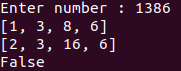
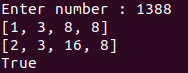
Output 1
Output 2
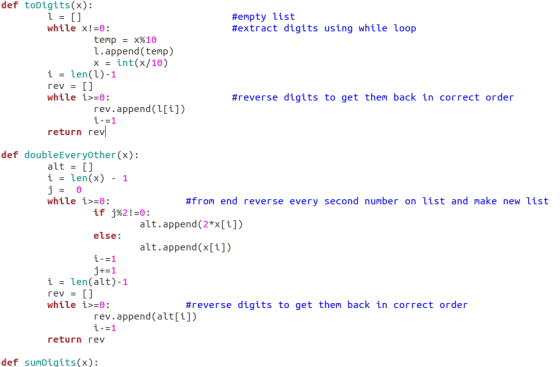
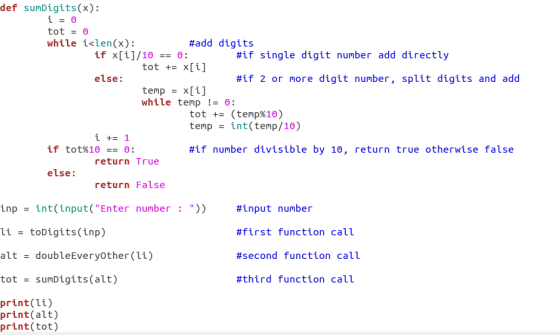
Check indentation of the code here if it doesn't work
Add Answer to:
Write a Python script named assignment2.py that implements the
following steps given an integer value:
1.)...
In Python 3 (2.5 pts] Write the recursive function thirtyTwos(n) that takes an integer greater or...
 In Python 3
(2.5 pts] Write the recursive function thirtyTwos(n) that takes an integer greater or equal to 0 and returns an integer that represents the number of times that a 2 directly follows a 3 in the digits of n. Hint: The % and // operations from sumDigits could be helpful here >>> thirtyTwos (132432601)
In Python 3
(2.5 pts] Write the recursive function thirtyTwos(n) that takes an integer greater or equal to 0 and returns an integer that represents the number of times that a 2 directly follows a 3 in the digits of n. Hint: The % and // operations from sumDigits could be helpful here >>> thirtyTwos (132432601)
how to add the digits of the doubled values and the digits that were not doubled...
how to add the digits of the doubled values and the digits that were not doubled from the original number in python? The first part prints it in a list: def toDigits(g): return [int (y) for y in str(g)] print (str(toDigits(759283))) The second part: prints every number and multiplies all by 2 def doubleEveryOther(g): return [int(y) * 2 if i % 2 == 0 else int(y) for i, y in enumerate(toDigits(g))] print(str(doubleEveryOther(759283))) The third part: I'm trying to add the...
IN PYTHON: Write a function that takes, as an argument, a positive integer n, and returns...
IN PYTHON: Write a function that takes, as an argument, a positive integer n, and returns a LIST consisting of all of the digits of n (as integers) in the same order. Name this function intToList(n). For example, intToList(123) should return the list [1,2,3].
how to add the digits of the doubled values and the digits that were not doubled...
how to add the digits of the doubled values and the digits that were not doubled from the original number in python? The first part prints it in a list: def toDigits(g): return [int (y) for y in str(g)] print (str(toDigits(759283))) The second part: prints every number and multiplies all by 2 def doubleEveryOther(g): return [int(y) * 2 if i % 2 == 0 else int(y) for i, y in enumerate(toDigits(g))] print(str(doubleEveryOther(759283))) The third part: I'm trying to add the...
Python Script format please! 1. Write a script that takes in three integer numbers from the...
 Python Script format please!
1. Write a script that takes in three integer numbers from the
user, calculates, and displays the sum, average, product, smallest,
and largest of the numbers input. Important things to note: a. You
cannot use the min() or max() functions, you must provide the logic
yourself b. The calculated average must be displayed as an integer
value (ex. If the sum of the three values is 7, the average
displayed should be 2, not 2.3333). Example:...
Python Script format please!
1. Write a script that takes in three integer numbers from the
user, calculates, and displays the sum, average, product, smallest,
and largest of the numbers input. Important things to note: a. You
cannot use the min() or max() functions, you must provide the logic
yourself b. The calculated average must be displayed as an integer
value (ex. If the sum of the three values is 7, the average
displayed should be 2, not 2.3333). Example:...
Write a Python file containing the following functions. Also turn in the output from testing the...
Write a Python file containing the following functions. Also turn in the output from testing the functions. All arguments to the functions may be hard-coded. Function 1 takes a list of strings as a parameter and returns a list of strings consisting of all the strings in the original list that have identical consecutive letters. For example: fun1 ([llama, good, cat, abba, abab, 112, dog]) returns [llama, good, abba, 112] Function 2 takes an integer (n), representing the number of...
1. (Sum the digits in an integer) Write a method that computes the sum of the...
1. (Sum the digits in an integer) Write a method that computes the sum of the digits in an integer. Use the following method header: public static int sumDigits(long n) For example, sumDigits (234) returns 9 (2 + 3 + 4). (Hint: Use the % operator to extract digits, and the / operator to remove the extracted digit. For instance, to extract 4 from 234, use 234 % 10(= 4). To remove 4 from 234, use 234 / 10(= 23)....
Please write code in Python! You are asked to implement the following checksum formula to validate...
 Please write code in
Python!
You are asked to
implement the following checksum formula to validate an identifi-
cation number given to you. The formula works as follows. Using the
original number, double the value of every other digit. Then add
the values of the individual digits together (if a doubled value
now has two digits, add the digits individually). The
identification number is valid if the resulting sum is divisible by
10. Write a function called validateID that takes...
Please write code in
Python!
You are asked to
implement the following checksum formula to validate an identifi-
cation number given to you. The formula works as follows. Using the
original number, double the value of every other digit. Then add
the values of the individual digits together (if a doubled value
now has two digits, add the digits individually). The
identification number is valid if the resulting sum is divisible by
10. Write a function called validateID that takes...
Python code that: Accepts a list of integers and an integer, and returns the index of...
Python code that: Accepts a list of integers and an integer, and returns the index of the SECOND occurrence of the integer in the list. It returns None if the number does not occur two or more times in the list. Example 1: second_index([2,34,3,45,34,45,3,3], 3) returns 6 Example 2: second_index([2,34,3,45,34,45,3,3], 45) returns 5 Example 3: second_index([2,34,3,45,134,45,3,3], 134) returns None Example 4: second_index([2,34,3,45,134,45,3,3], 100) returns None
write a Python function that takes in a list of integers and returns maximum and minimum values in the list as a tuple
1 write a Python function that takes in a list of integers and returns maximum and minimum values in the list as a tuple. Hint (can be done in one pass, you are not allowed to use built-on min and max functions.)max, min = find_max_min(my_list):2 write a Python function that takes in a list of integers (elements), and an integer number (num). The functions should count and return number of integers in elements greater than, less than, and equal to...
 In Python 3
(2.5 pts] Write the recursive function thirtyTwos(n) that takes an integer greater or equal to 0 and returns an integer that represents the number of times that a 2 directly follows a 3 in the digits of n. Hint: The % and // operations from sumDigits could be helpful here >>> thirtyTwos (132432601)
In Python 3
(2.5 pts] Write the recursive function thirtyTwos(n) that takes an integer greater or equal to 0 and returns an integer that represents the number of times that a 2 directly follows a 3 in the digits of n. Hint: The % and // operations from sumDigits could be helpful here >>> thirtyTwos (132432601)
 Python Script format please!
1. Write a script that takes in three integer numbers from the
user, calculates, and displays the sum, average, product, smallest,
and largest of the numbers input. Important things to note: a. You
cannot use the min() or max() functions, you must provide the logic
yourself b. The calculated average must be displayed as an integer
value (ex. If the sum of the three values is 7, the average
displayed should be 2, not 2.3333). Example:...
Python Script format please!
1. Write a script that takes in three integer numbers from the
user, calculates, and displays the sum, average, product, smallest,
and largest of the numbers input. Important things to note: a. You
cannot use the min() or max() functions, you must provide the logic
yourself b. The calculated average must be displayed as an integer
value (ex. If the sum of the three values is 7, the average
displayed should be 2, not 2.3333). Example:...
 Please write code in
Python!
You are asked to
implement the following checksum formula to validate an identifi-
cation number given to you. The formula works as follows. Using the
original number, double the value of every other digit. Then add
the values of the individual digits together (if a doubled value
now has two digits, add the digits individually). The
identification number is valid if the resulting sum is divisible by
10. Write a function called validateID that takes...
Please write code in
Python!
You are asked to
implement the following checksum formula to validate an identifi-
cation number given to you. The formula works as follows. Using the
original number, double the value of every other digit. Then add
the values of the individual digits together (if a doubled value
now has two digits, add the digits individually). The
identification number is valid if the resulting sum is divisible by
10. Write a function called validateID that takes...
Most questions answered within 3 hours.
-
Where is the error in this code sequence?
String s1 = "Hello";
String s2 = "ello";...
asked 11 months ago -
Financial data for Joel de Paris, Inc., for last year
follow:
Joel de Paris, Inc.
Balance...
asked 11 months ago -
Consider this reaction:
Al2(SO4)3 (aq)+ BaCl3
(aq) Al2Cl6 (aq)- +
3BaSO4(s) . What is the...
asked 11 months ago -
Suppose that Savneet is considering increasing her
recent random sample from 20 car rentals to 40...
asked 11 months ago -
Trucks arrive at an unloading terminal at an average rate of 120
per hour.
Trucks arrive...
asked 11 months ago -
Why are methanol and ethanol completely soluble in water while
octanol is not very little soluble....
asked 11 months ago -
A facilities manager at a university reads in a research report
that the mean amount of...
asked 11 months ago -
When the CuSO4 is rehydrated by adding water to the anhydrous
compound, is this an endothermic...
asked 11 months ago -
A ray of sunlight is passing from diamond into crown glass; the
angle of incidence is...
asked 11 months ago -
A block of mass 0.249 kg is placed on top of a light, vertical
spring of...
asked 11 months ago -
how do the kidneys compensate in the presences of acidosis
a) trigger hyperventilate
b) reserve acid...
asked 11 months ago -
Question 501 pts
The rental rate of capital to the firm increases. Which of the
following...
asked 11 months ago