Red-green color blindness is an X-linked trait. In a population genetics study, 1,000 people (500 men...
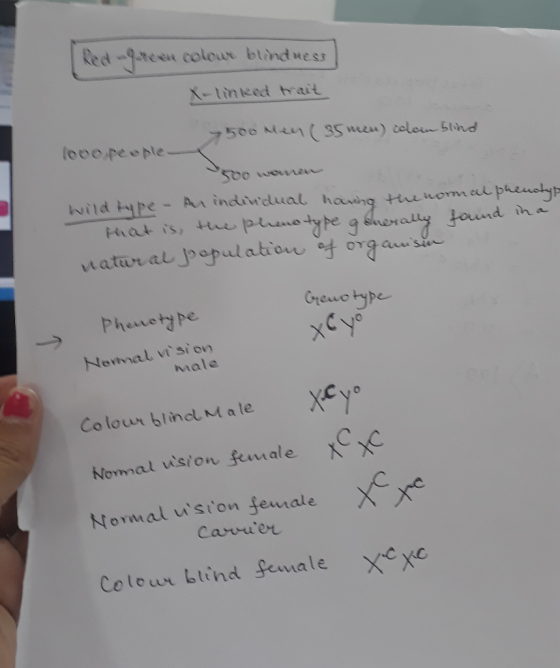
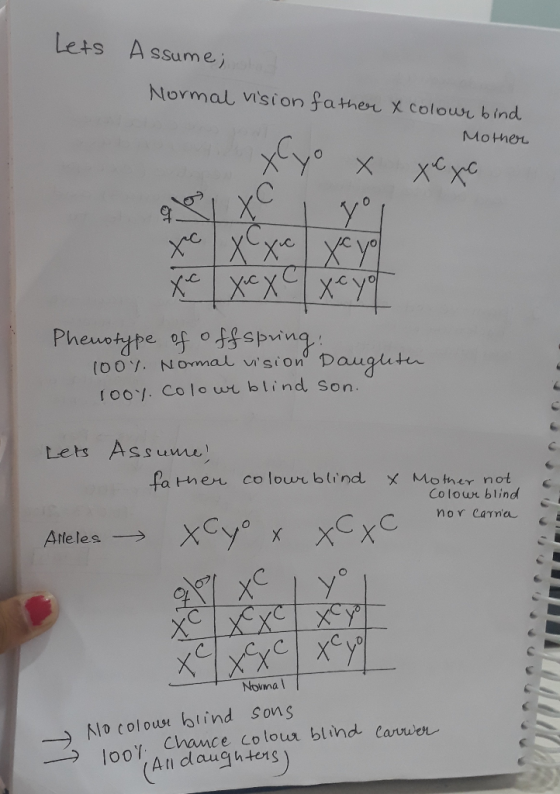
- Red-green color blindness is an X-linked trait. In a population genetics study, 1,000 people (500 men and 500 women) were tested for this trait, and 35 men were found to be color blind. Use this information to compute the frequency of the allele for color blindness and the wild-type allele in this population, and estimate the expected number of carrier females.
Homework Answers
The most common type of red-green colour perception defect is due to a mutation on the X-chromosome (i.e. a red-green colour blind allele).X-linked red-colour blindness is a recessive trait. Females heterozygous for this trait have normal vision.
Add Answer to:
Red-green color blindness is an X-linked trait. In a population
genetics study, 1,000 people (500 men...
Color Blindness in Men and Women: In a study of red/green color blindness, 500 men and...
Color Blindness in Men and Women: In a study of red/green color blindness, 500 men and 2100 women are randomly selected and tested. Among the men, 45 have a red/green color blindness. Among the women, 6 have a red/green color blindness. Is there sufficient evidence to support the claim that men have a higher rate of red/green color blindness that women? Conduct the appropriate test at the alpha =.01 level. Is there one or two populations in this problem? Is...
Red-green color blindness is an X-linked recessive trait. Heterozygous females have normal color vision but are...
 Red-green color blindness is an X-linked recessive trait. Heterozygous females have normal color vision but are carriers of the allele for red-green color blindness. Based on the information presented in the pedigree, select all of the females from the list below that are known carriers of red-green color blindness.
Fill in the blank. Hemophilia is an X-linked trait. In a population of 20,000 people in...
Fill in the blank. Hemophilia is an X-linked trait. In a population of 20,000 people in HW equilibrium, 10,000 women and 10,000 men were tested for this trait, and 15 men were found to have the disorder. The value that you calculated for the Hemophilia allele was (to 4 decimal places) _______ and there would be _______ carrier females in this population.
Red-green color blindness is a sex-linked trait, with the normal vision phenotype being dominant (C) and...
Red-green color blindness is a sex-linked trait, with the normal vision phenotype being dominant (C) and the color blind (c) phenotype being recessive. If you are male and your father is color blind, what is the chance (expressed as a percentage) that you will inherit his trait for color blindness? What if your mother is a carrier for color blindness (but your father is not color blind), what is the chance of you being color blind? Make sure...
SEX-LINKAGE Red-Green color-blindness is sex-linked X-linked recessive trait. A normal sighted woman whose father is color-...
SEX-LINKAGE Red-Green color-blindness is sex-linked X-linked recessive trait. A normal sighted woman whose father is color- blind marries a color-blind man. they have 20 children. Of those 20, 6 are normal sighted females, 5 are color-blind females, 4 are normal sighted males and 5 are color-blind males. 7. What are the genotypes of the parents and all the children? 8. Theoretically, what would be the genotypic and phenotypic ratios of the offspring?
(1 pt) In a study of red/green color blindness, 800 men and 2500 women are randomly...
 (1 pt) In a study of red/green color blindness, 800 men and 2500 women are randomly selected and tested. Among the men, 69 have red/green color blindness. Among the women, 8 have red/green color blindness. Construct the 99% confidence interval for the difference between the color blindness rates of men and women. < (PM – Pw) <
In a study of red/green color blindness, 850 men and 2700 women are randomly selected and...
In a study of red/green color blindness, 850 men and 2700 women are randomly selected and tested. Among the men, 78 have red/green color blindness. Among the women, 5 have red/green color blindness. Test the claim that men have a higher rate of red/green color blindness. (Note: Type p_mnot=p_w p_mnot=p_w for the proportions are not equal, p_m>p_w p_m>p_w for the proportion of men with color blindness is larger, p_m
(1 point) In a study of red/green color blindness, 650 men and 2400 women are randomly...
 (1 point) In a study of red/green color blindness, 650 men and 2400 women are randomly selected and tested. Among the men, 58 have red/green color blindness. Among the women, 7 have red/green color blindness. Construct the 95% confidence interval for the difference between the color blindness rates of men and women. 0.865 < (PM – Pw) < 0.9133
1. In a study of red/green color blindness, 750 men and 2700 women are randomly selected...
1. In a study of red/green color blindness, 750 men and 2700 women are randomly selected and tested. Among the men, 66 have red/green color blindness. Among the women, 8 have red/green color blindness. Test the claim that men have a higher rate of red/green color blindness. The test statistic is The p-value is Is there sufficient evidence to support the claim that men have a higher rate of red/green color blindness than women using the 0.01% significance level? A....
In a study of red/green color blindness, 1000 men and 2550 women are randomly selected and...
In a study of red/green color blindness, 1000 men and 2550 women are randomly selected and tested. Among the men, 90 have red/green color blindness. Among the women, 8 have red/green color blindness. Test the claim that men have a higher rate of red/green color blindness. (Note: Type p_mnot=p_w for the proportions are not equal, p_m>p_w for the proportion of men with color blindness is larger, p_m (a) State the null hypothesis: (b) State the alternative hypothesis: (c) The test...
 Red-green color blindness is an X-linked recessive trait. Heterozygous females have normal color vision but are carriers of the allele for red-green color blindness. Based on the information presented in the pedigree, select all of the females from the list below that are known carriers of red-green color blindness.
 (1 pt) In a study of red/green color blindness, 800 men and 2500 women are randomly selected and tested. Among the men, 69 have red/green color blindness. Among the women, 8 have red/green color blindness. Construct the 99% confidence interval for the difference between the color blindness rates of men and women. < (PM – Pw) <
 (1 point) In a study of red/green color blindness, 650 men and 2400 women are randomly selected and tested. Among the men, 58 have red/green color blindness. Among the women, 7 have red/green color blindness. Construct the 95% confidence interval for the difference between the color blindness rates of men and women. 0.865 < (PM – Pw) < 0.9133
Most questions answered within 3 hours.
-
Where is the error in this code sequence?
String s1 = "Hello";
String s2 = "ello";...
asked 11 months ago -
Financial data for Joel de Paris, Inc., for last year
follow:
Joel de Paris, Inc.
Balance...
asked 11 months ago -
Consider this reaction:
Al2(SO4)3 (aq)+ BaCl3
(aq) Al2Cl6 (aq)- +
3BaSO4(s) . What is the...
asked 11 months ago -
Suppose that Savneet is considering increasing her
recent random sample from 20 car rentals to 40...
asked 11 months ago -
Trucks arrive at an unloading terminal at an average rate of 120
per hour.
Trucks arrive...
asked 11 months ago -
Why are methanol and ethanol completely soluble in water while
octanol is not very little soluble....
asked 11 months ago -
A facilities manager at a university reads in a research report
that the mean amount of...
asked 11 months ago -
When the CuSO4 is rehydrated by adding water to the anhydrous
compound, is this an endothermic...
asked 11 months ago -
A ray of sunlight is passing from diamond into crown glass; the
angle of incidence is...
asked 11 months ago -
A block of mass 0.249 kg is placed on top of a light, vertical
spring of...
asked 11 months ago -
how do the kidneys compensate in the presences of acidosis
a) trigger hyperventilate
b) reserve acid...
asked 11 months ago -
Question 501 pts
The rental rate of capital to the firm increases. Which of the
following...
asked 11 months ago