Distinguish tertian malaria from quatran malaria. Which species of Plasmodium cause each form of the disease?
Homework Answers
In all types of malaria the periodic febrile response is caused by rupture of mature schizonts. In tertian malaria, a brood of schizonts matures in red blood cells every 48 hours (2 days), so the periodicity of fever is tertian. The bout of fever comes every 2 days. In quartan malaria, the schizonts mature every 72 hours (3 days), so the fever occurs every 72 hours.
The tertian malaria is caused by Plasmodium vivax or Plasmodium ovale. Quartan malaria is caused by Plasmodium malariae.
Add Answer to:
Distinguish tertian malaria from quatran malaria. Which species of
Plasmodium cause each form of the disease?
O P. falciparum originated independently from all of these Plasmodium species. Malaria is a tropical, mosquito-borne...
 O P. falciparum originated independently from all of these Plasmodium species. Malaria is a tropical, mosquito-borne disease caused by a parasitic protist, Plasmodium. The species P. falciparum is particularly deadly, killing about 1 million people each year. Submit Previous Answers ✓ Correct Plasmodium in chimpanzees Plasmodium in gorillas Plasmodium in humans P. falciparum Part B P. malariae P. Knowlesi How might this information be useful in developing medical treatments for malaria? Match the terms in the left column to the...
A) Distinguish between the cyst and the trophozoite form of a protozoan. B) Name one species...
 A) Distinguish between the cyst and the trophozoite form of a protozoan. B) Name one species that is classified as an apicomplexan and the disease that it causes. C) Name one species that is classified as a flagellate and the disease that it causes. 9. Name three different modes of transmission used by parasitic worms. Give an example of each.
Read the following scenario to answer the following question. Malaria is a disease caused by parasitic...
 Read the following scenario to answer the following question. Malaria is a disease caused by parasitic protists in the genus Plasmodium. The parasite is transmitted to humans by female Anopheles mosquitoes. The Plasmodium parasite feeds on human red blood cells, eventually destroying them. Humans infected with malaria can exhibit many symptoms. Depending on the severity of the infection, these can range from fever, chills, sweating, and headaches to anemia and kidney failure. Ultimately, malaria can result in death. However, if...
QUESTION 1 Which one of the following pairs is mismatched? Plasmodium falciparum-malaria puffball-club fungus Trypanosoma brucei-...
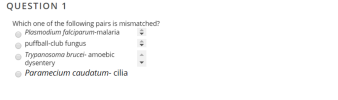 QUESTION 1 Which one of the following pairs is mismatched? Plasmodium falciparum-malaria puffball-club fungus Trypanosoma brucei- amoebic dysentery Paramecium caudatum- cilia
Pre-Lecture Quiz, Chapter 12, Antiprotozoal Agents True/False . Malaria is the most common protozoal parasite that...
 Pre-Lecture Quiz, Chapter 12, Antiprotozoal Agents True/False . Malaria is the most common protozoal parasite that causes acute disease in travelers Antimalarial drugs are frequently given in combination form in order to attach to the plasmodium at various stages of its life cycle. 2. Lactating women planning to travel to a high-risk malaria area may safely take antimalarials because they do not enter breast milk. 3. Pneumocystis carinii pneumonia is the most common opportunistic infection seen in patients with HIV/AIDS...
Which disease would you predict to be more prevalent in people, malaria or DENV? Mosquitoes on...
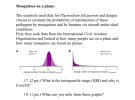 Which disease would you predict to be more prevalent in people,
malaria or DENV?
Mosquitoes on a plane: The scientists used data for Plasmodium falciparum and dengue viruses to estimate the probability of introduction of these pathogens by mosquitoes and by humans via aircraft under ideal conditions First, they took data from the International Civil Aviation Organization and looked at how many people are on a plane and how many mosquitos are found on planes A B Median: 104 Median:...
Which disease would you predict to be more prevalent in people,
malaria or DENV?
Mosquitoes on a plane: The scientists used data for Plasmodium falciparum and dengue viruses to estimate the probability of introduction of these pathogens by mosquitoes and by humans via aircraft under ideal conditions First, they took data from the International Civil Aviation Organization and looked at how many people are on a plane and how many mosquitos are found on planes A B Median: 104 Median:...
1:14 Back T F Relapse, the recurrence of malaria symptoms after months or even years of...
 1:14 Back T F Relapse, the recurrence of malaria symptoms after months or even years of no disease, is associated with infections involving either P. vivax or P. ovale. T F If a different patient again experiences paroxysms after a period of time being symptom-free, and is diagnosed to be undergoing recrudescence, they are being exposed to the reactivation of hypnozoites within ytes T F If an individual receives a blood transfusion during a surgery, they could show symptoms of...
Topic: MALARIA Cause of Disease 1. What type of microbe causes the disease? 2. If it...
Topic: MALARIA Cause of Disease 1. What type of microbe causes the disease? 2. If it is a bacterium, what are the characteristics of the cell (Gram-negative or positive (what does that mean?), cell shape and arrangement? metabolic capabilities?). 3. If it is eukaryote, is it a fungus, an alga, a protozoan, a Platyhelminthes, or a nematode? Is it multicellular or unicellular? What is its life cycle? 4. If it is a virus, it must include the complete classification and...
Links (10 Multiple Alleles Confer Drug Resistance in the Malaria Parasite Malaria is a parasitic disease...
 Links (10 Multiple Alleles Confer Drug Resistance in the Malaria Parasite Malaria is a parasitic disease in humans that is transmitted by infected female mosquitoes, including Anopheles gambiae (Figure 12. 10a), and is characterized by cyclic high fevers, chills, flu-like symptoms, and severe anemia, Plasmodium falciparum and P. vivax are the most common causative agents of malaria, and P. falciparum is the most deadly (Figure 12.10b). When promptly and correctly treated, P. falciparum malaria has a mortality rate of 0.1...
Fill in the blank: Malaria is caused by several species of the protozoan parasite ____________________, which...
Fill in the blank: Malaria is caused by several species of the protozoan parasite ____________________, which has a complicated life cycle. True or False: Animal parasites are organisms that have become adapted to living within or on the body of another animal, called the ____________________. True or False: Type 2 herpes usually infects the oral mucous membrane, where it causes the familiar fever blisters. True or False: A pregnant woman with a genital herpes infection may or may not infect...
 O P. falciparum originated independently from all of these Plasmodium species. Malaria is a tropical, mosquito-borne disease caused by a parasitic protist, Plasmodium. The species P. falciparum is particularly deadly, killing about 1 million people each year. Submit Previous Answers ✓ Correct Plasmodium in chimpanzees Plasmodium in gorillas Plasmodium in humans P. falciparum Part B P. malariae P. Knowlesi How might this information be useful in developing medical treatments for malaria? Match the terms in the left column to the...
 A) Distinguish between the cyst and the trophozoite form of a protozoan. B) Name one species that is classified as an apicomplexan and the disease that it causes. C) Name one species that is classified as a flagellate and the disease that it causes. 9. Name three different modes of transmission used by parasitic worms. Give an example of each.
 Read the following scenario to answer the following question. Malaria is a disease caused by parasitic protists in the genus Plasmodium. The parasite is transmitted to humans by female Anopheles mosquitoes. The Plasmodium parasite feeds on human red blood cells, eventually destroying them. Humans infected with malaria can exhibit many symptoms. Depending on the severity of the infection, these can range from fever, chills, sweating, and headaches to anemia and kidney failure. Ultimately, malaria can result in death. However, if...
 QUESTION 1 Which one of the following pairs is mismatched? Plasmodium falciparum-malaria puffball-club fungus Trypanosoma brucei- amoebic dysentery Paramecium caudatum- cilia
 Pre-Lecture Quiz, Chapter 12, Antiprotozoal Agents True/False . Malaria is the most common protozoal parasite that causes acute disease in travelers Antimalarial drugs are frequently given in combination form in order to attach to the plasmodium at various stages of its life cycle. 2. Lactating women planning to travel to a high-risk malaria area may safely take antimalarials because they do not enter breast milk. 3. Pneumocystis carinii pneumonia is the most common opportunistic infection seen in patients with HIV/AIDS...
 Which disease would you predict to be more prevalent in people,
malaria or DENV?
Mosquitoes on a plane: The scientists used data for Plasmodium falciparum and dengue viruses to estimate the probability of introduction of these pathogens by mosquitoes and by humans via aircraft under ideal conditions First, they took data from the International Civil Aviation Organization and looked at how many people are on a plane and how many mosquitos are found on planes A B Median: 104 Median:...
Which disease would you predict to be more prevalent in people,
malaria or DENV?
Mosquitoes on a plane: The scientists used data for Plasmodium falciparum and dengue viruses to estimate the probability of introduction of these pathogens by mosquitoes and by humans via aircraft under ideal conditions First, they took data from the International Civil Aviation Organization and looked at how many people are on a plane and how many mosquitos are found on planes A B Median: 104 Median:...
 1:14 Back T F Relapse, the recurrence of malaria symptoms after months or even years of no disease, is associated with infections involving either P. vivax or P. ovale. T F If a different patient again experiences paroxysms after a period of time being symptom-free, and is diagnosed to be undergoing recrudescence, they are being exposed to the reactivation of hypnozoites within ytes T F If an individual receives a blood transfusion during a surgery, they could show symptoms of...
 Links (10 Multiple Alleles Confer Drug Resistance in the Malaria Parasite Malaria is a parasitic disease in humans that is transmitted by infected female mosquitoes, including Anopheles gambiae (Figure 12. 10a), and is characterized by cyclic high fevers, chills, flu-like symptoms, and severe anemia, Plasmodium falciparum and P. vivax are the most common causative agents of malaria, and P. falciparum is the most deadly (Figure 12.10b). When promptly and correctly treated, P. falciparum malaria has a mortality rate of 0.1...
Most questions answered within 3 hours.
-
Where is the error in this code sequence?
String s1 = "Hello";
String s2 = "ello";...
asked 11 months ago -
Financial data for Joel de Paris, Inc., for last year
follow:
Joel de Paris, Inc.
Balance...
asked 11 months ago -
Consider this reaction:
Al2(SO4)3 (aq)+ BaCl3
(aq) Al2Cl6 (aq)- +
3BaSO4(s) . What is the...
asked 11 months ago -
Suppose that Savneet is considering increasing her
recent random sample from 20 car rentals to 40...
asked 11 months ago -
Trucks arrive at an unloading terminal at an average rate of 120
per hour.
Trucks arrive...
asked 11 months ago -
Why are methanol and ethanol completely soluble in water while
octanol is not very little soluble....
asked 11 months ago -
A facilities manager at a university reads in a research report
that the mean amount of...
asked 11 months ago -
When the CuSO4 is rehydrated by adding water to the anhydrous
compound, is this an endothermic...
asked 11 months ago -
A ray of sunlight is passing from diamond into crown glass; the
angle of incidence is...
asked 11 months ago -
A block of mass 0.249 kg is placed on top of a light, vertical
spring of...
asked 11 months ago -
how do the kidneys compensate in the presences of acidosis
a) trigger hyperventilate
b) reserve acid...
asked 11 months ago -
Question 501 pts
The rental rate of capital to the firm increases. Which of the
following...
asked 11 months ago