Draw the structure of the peptide GlnCysAlaMet at pH = 7.0 (Gln pka(NH3)= 9.13, Cys (SH)=8.3,...
- Draw the structure of the peptide GlnCysAlaMet at pH = 7.0 (Gln pka(NH3)= 9.13, Cys (SH)=8.3, Met (C terminal)=2.13)
Homework Answers
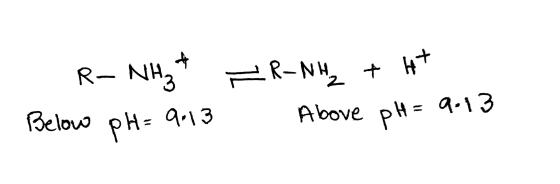
When the pH is below the pKa, that particular group will not have lost H+. Once the pH rises above pKa , H+ is lost.
For eg, pKa (NH3) = 9.13
So the structure of GlnCysAlaMet will be :
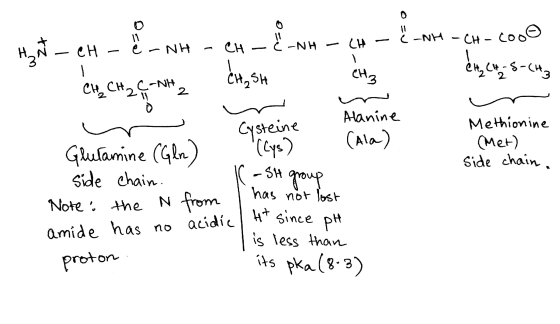
The NH3 + on the left side is still protonated since pH (7) < pKa (9.13).
The COOH on the extreme right has lost H+ to become COO- since pH (7) > pKa ( 2.13)
Add Answer to:
Draw the structure of the peptide GlnCysAlaMet at pH = 7.0 (Gln
pka(NH3)= 9.13, Cys (SH)=8.3,...
6. A peptide has the sequence Cys-His-Phe-Glu-Ala-Arg a. Write the single letter sequence of the peptide...
 6. A peptide has the sequence Cys-His-Phe-Glu-Ala-Arg a. Write the single letter sequence of the peptide b. Calculate the percentage and indicate the charge of the predominant peptide species at pH 6.5. Use the following pKa values: pKa Cys = 8.3, pKa N-terminus = 10.8, pKa His =6.0, pKa Glu = 4.3, pKa Arg = 12.5, pKa C-terminus =2.0 c. What is the charge of the peptide at pH 4.3? d. Draw the chemical structure of the predominant peptide species...
a) Draw the structure of a Gln-Lys-Met tripeptide at pH 7. b) Calculate the pl of...
 a) Draw the structure of a Gln-Lys-Met tripeptide at pH 7. b) Calculate the pl of the peptide. Show your work.
What is the approximate net charge of the following pentapeptide at pH 10? Arg-Gln-Cys-His-Ala What is...
What is the approximate net charge of the following pentapeptide at pH 10? Arg-Gln-Cys-His-Ala What is the Isoelectric point (pI) of the peptide given above? Use the pKa values given here when needed: Side group/ amino acid pKa Asp 3.9 Glu 4.1 HIs 6.0 Cys 8.4 Tyr 10.5 Lys 10.5 Arg 12.5 C-term 3.5 N-term 9.0
An octapeptide contains the following amino acids: Met, Thr, Cys, Asp, Phe, Arg, Glu, Gln. Carboxypeptidase...
An octapeptide contains the following amino acids: Met, Thr, Cys, Asp, Phe, Arg, Glu, Gln. Carboxypeptidase treatment of the octapeptide forms Asp and a heptapeptide. Treatment of the octapeptide with Chymotrypsin forms forms two tetrapeptides, A and B. Treatment of A with Trypsin yields two dipeptides, C and D. Edman degradation cleaves the following amino acids from each peptide: Cys (octapeptide), Cys (A), Gln (B), Cys (C), Glu(D). Partial hydrolysis of tetrapeptide B forms Gln-Thr in addition to other products....
An octapeptide contains the following amino acids: Met, Thr, Cys, Asp, Phe, Arg, Glu, Gln. Carboxypeptidase...
An octapeptide contains the following amino acids: Met, Thr, Cys, Asp, Phe, Arg, Glu, Gln. Carboxypeptidase treatment of the octapeptide forms Asp and a heptapeptide. Treatment of the octapeptide with Chymotrypsin forms forms two tetrapeptides, A and B. Treatment of A with Trypsin yields two dipeptides, C and D. Edman degradation cleaves the following amino acids from each peptide: Cys (octapeptide), Cys (A), Gln (B), Cys (C), Glu(D). Partial hydrolysis of tetrapeptide B forms Gln-Thr in addition to other products....
Draw the structure of the dipeptide Lys-Glu at pH 7.0. Label the following: a) Peptide bond...
 Draw the structure of the dipeptide Lys-Glu at pH 7.0. Label the
following:
a) Peptide bond
b) N-terminus
c) C-terminus
d) An α-amino group and an ε-amino group
e) An α-carboxylate group and a Y-carboxylate group
Draw the structure of the dipeptide Lys-Glu at pH 7.0. Label the following: (a). peptide bond, (b). N-terminus, (c). C-terminus, (d). an a-amino group and an e-amino group, (e), an α-carboxylate group and a -carboxylate group.
Draw the structure of the dipeptide Lys-Glu at pH 7.0. Label the
following:
a) Peptide bond
b) N-terminus
c) C-terminus
d) An α-amino group and an ε-amino group
e) An α-carboxylate group and a Y-carboxylate group
Draw the structure of the dipeptide Lys-Glu at pH 7.0. Label the following: (a). peptide bond, (b). N-terminus, (c). C-terminus, (d). an a-amino group and an e-amino group, (e), an α-carboxylate group and a -carboxylate group.
Draw the following peptide at physiological pH. Gln-ser-his
Draw the following peptide at physiological pH. Gln-ser-his
Predict the charge on the major species of the peptide Ile–Arg–Asp–Ala–Lys–Ser–Gln at pH 7.0
Predict the charge on the major species of the peptide Ile–Arg–Asp–Ala–Lys–Ser–Gln at pH 7.0
The tetrapeptide Ac-Asn-Met-Cys-Lys has its N-terminus blocked by acetylation. Its C-terminal pKa is 4.30. The side...
The tetrapeptide Ac-Asn-Met-Cys-Lys has its N-terminus blocked by acetylation. Its C-terminal pKa is 4.30. The side chain pKa’s are 7.8 and 10.4. a. Write this peptide sequence using single letter abbreviations. b. Draw its predominant chemical structure at pH 8.0, including charges. c. What fraction of the peptide will exist in the predominant form at pH 8.0? (Discount any species that represent less than 1% of all species.) d. Calculate the pI of the peptide. e. If this tetrapeptide is...
Calculate the net charge of a peptide sequence W-S-N-G-C-H (all connected : Tryptophan-Serine-Asparagine-Glycine-Cysteine-Histidine) pKa values at...
Calculate the net charge of a peptide sequence W-S-N-G-C-H (all connected : Tryptophan-Serine-Asparagine-Glycine-Cysteine-Histidine) pKa values at (a) pH 2.0, (b) 6.0 (c) 7.0 and (d) 11.5. Assuming the ionisable groups have pKa values of His 6.0, Asp 3.6, Tyr 10.0, Cys 8.3, Arg 12.5, Lys, 10.5, Glu 4.3 C-term -COOH 2.0, N-term -NH3 + 9.5.
 6. A peptide has the sequence Cys-His-Phe-Glu-Ala-Arg a. Write the single letter sequence of the peptide b. Calculate the percentage and indicate the charge of the predominant peptide species at pH 6.5. Use the following pKa values: pKa Cys = 8.3, pKa N-terminus = 10.8, pKa His =6.0, pKa Glu = 4.3, pKa Arg = 12.5, pKa C-terminus =2.0 c. What is the charge of the peptide at pH 4.3? d. Draw the chemical structure of the predominant peptide species...
 a) Draw the structure of a Gln-Lys-Met tripeptide at pH 7. b) Calculate the pl of the peptide. Show your work.
 Draw the structure of the dipeptide Lys-Glu at pH 7.0. Label the
following:
a) Peptide bond
b) N-terminus
c) C-terminus
d) An α-amino group and an ε-amino group
e) An α-carboxylate group and a Y-carboxylate group
Draw the structure of the dipeptide Lys-Glu at pH 7.0. Label the following: (a). peptide bond, (b). N-terminus, (c). C-terminus, (d). an a-amino group and an e-amino group, (e), an α-carboxylate group and a -carboxylate group.
Draw the structure of the dipeptide Lys-Glu at pH 7.0. Label the
following:
a) Peptide bond
b) N-terminus
c) C-terminus
d) An α-amino group and an ε-amino group
e) An α-carboxylate group and a Y-carboxylate group
Draw the structure of the dipeptide Lys-Glu at pH 7.0. Label the following: (a). peptide bond, (b). N-terminus, (c). C-terminus, (d). an a-amino group and an e-amino group, (e), an α-carboxylate group and a -carboxylate group.
Most questions answered within 3 hours.
-
Where is the error in this code sequence?
String s1 = "Hello";
String s2 = "ello";...
asked 11 months ago -
Financial data for Joel de Paris, Inc., for last year
follow:
Joel de Paris, Inc.
Balance...
asked 11 months ago -
Consider this reaction:
Al2(SO4)3 (aq)+ BaCl3
(aq) Al2Cl6 (aq)- +
3BaSO4(s) . What is the...
asked 11 months ago -
Suppose that Savneet is considering increasing her
recent random sample from 20 car rentals to 40...
asked 11 months ago -
Trucks arrive at an unloading terminal at an average rate of 120
per hour.
Trucks arrive...
asked 11 months ago -
Why are methanol and ethanol completely soluble in water while
octanol is not very little soluble....
asked 11 months ago -
A facilities manager at a university reads in a research report
that the mean amount of...
asked 11 months ago -
When the CuSO4 is rehydrated by adding water to the anhydrous
compound, is this an endothermic...
asked 11 months ago -
A ray of sunlight is passing from diamond into crown glass; the
angle of incidence is...
asked 11 months ago -
A block of mass 0.249 kg is placed on top of a light, vertical
spring of...
asked 11 months ago -
how do the kidneys compensate in the presences of acidosis
a) trigger hyperventilate
b) reserve acid...
asked 11 months ago -
Question 501 pts
The rental rate of capital to the firm increases. Which of the
following...
asked 11 months ago