Shortly after the initiation of DNA replication at the Origin of Replication, an antibiotic has inactivated...
Shortly after the initiation of DNA replication at the Origin of Replication, an antibiotic has inactivated the RNA primate. In this condition, the synthesis of which new DNA strand at the replication fork would be interrupted?
A. Leading strand
B. Lagging strand
C. Both strands
D. None of the strands
Homework Answers
Answer=(B) Lagging strand
Explanation-
Free 3'OH is necessary for the initiation of DNA replication in both of the strand (Lagging strand and Leading Strand) but leading strand required only an initial primer while lagging strand required multiple primers.
Now consider other option-
A) Leading Strand-
Leading strand required only an initial primer and question says initiation already started so incorrect option.
C)Both strands-
Only lagging strand affected by antibiotics so incorrect option.
Add Answer to:
Shortly after the initiation of DNA replication
at the Origin of Replication, an antibiotic has inactivated...
QUESTION 3 Replication Now DNA Origin of replication DOC Replication fork B CON RO Unreplicated DNA...
 QUESTION 3 Replication Now DNA Origin of replication DOC Replication fork B CON RO Unreplicated DNA Prokaryotic DNA The above diagram shows DNA replication in bacterial cells. An antibody specific only to DNA polymerase I was added to DNA undergoing replication in bacterial cells. Which of the following statements are CORRECT? a. There would be a higher concentration of antibodies on the leading strands of replication foris A and B and a lower concentration of antibodies on the lagging strands...
Vocabulary: DNA Replication
Vocabulary: DNA Replication A. Helicase B. Primase C. Single Strand Binding Protein (SSB) D. Topoisomerase E. Origin of Replication F. DNA Polymerase G. Leading Strand H. Lagging strand I. DNA Ligase J. Okazaki Fragment K. Replication Fork L. RNA Primer M. Topoisomerase .1. Site where the replication of a DNA molecule begins. 2. The new continuous complementary DNA strand synthesized in the direction for the replication fork. 3. A discontinuously synthesized DNA strand that elongates in a direction away from the replication fork 4. Relaxes...
The lagging strand in DNA replication?: (A) is synthesized after the leading strand. (B) causes the...
The lagging strand in DNA replication?: (A) is synthesized after the leading strand. (B) causes the formation of Okazaki fragments in the leading strand. (C) is a consequence of replicating both strands of template DNA at a single replication fork. (D) requires its own replisome.
Draw a figure of one double stranded DNA molecule that has initiated replication and produced two...
Draw a figure of one double stranded DNA molecule that has initiated replication and produced two okazaki fragment in each lagging strand. The figure must include both template strands, all newly synthesized DNA molecules on both leading and lagging strands, all RNA primers, direction of chain growth for each fragment/strand indicated with arrowheads, direction of replication forks. Each molecule must be labeled with the origin of replication on both strands, leading and lagging strands labeled, template or newly synthesized, DNA...
1. DNA is coiled around what type of proteins to form nucleosomes A. Polymerases DNA replication...
 1. DNA is coiled around what type of proteins to form nucleosomes A. Polymerases DNA replication of the lagging strand is discontinuous B. Transcription factors DNA replication of the lagging strand is continuous C. Helicases D. Histones E. DICER 2. Which of the following statements is true? A. DNA replication of the leading strand is discontinuous B. DNA replication of the lagging strand is discontinuous C. DNA replication of the leading strand is dispersive D. DNA replication of the lagging...
*Microbiology. Please answer the below two multiple choice questions. The current selected answers are incorrect. Thank...
 *Microbiology. Please answer the below two multiple choice
questions. The current selected answers are incorrect. Thank you,
will provide positive feedback for correct answers!
Incorrect Question 3 0/1 pts The replication fork has both leading (continuous) and lagging (discontinuous) synthesis because: a. The origin of replication only allows DNA synthesis to occur in one direction around the chromosome. b. Primase only works on the leading strand c. Helicase is slow in unwinding the double helix so the polymerization moving toward...
*Microbiology. Please answer the below two multiple choice
questions. The current selected answers are incorrect. Thank you,
will provide positive feedback for correct answers!
Incorrect Question 3 0/1 pts The replication fork has both leading (continuous) and lagging (discontinuous) synthesis because: a. The origin of replication only allows DNA synthesis to occur in one direction around the chromosome. b. Primase only works on the leading strand c. Helicase is slow in unwinding the double helix so the polymerization moving toward...
Draw new strand based on following template. Remember origin of replication is where DNA synthesis starts...
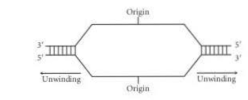 Draw new strand based on following template. Remember origin of
replication is where DNA synthesis starts and there are two
replication forks. Indicate which strand is leading and lagging
strand.
Origin Unwinding Unwinding Origin
Draw new strand based on following template. Remember origin of
replication is where DNA synthesis starts and there are two
replication forks. Indicate which strand is leading and lagging
strand.
Origin Unwinding Unwinding Origin
both stranas es:COVID mation & es Question 2 DNA polymerase III (DNA pol III) is needed...
 both stranas es:COVID mation & es Question 2 DNA polymerase III (DNA pol III) is needed for leading strand synthesis o lagging strand synthesis both strands D Question 3 ONE RNA primer is needed for o both strands O lagging strand synthesis leading strand synthesis Question 4 Multiple RNA primers are needed for O both strands leading strand synthesis lagging strand synthesis Question 5
Write a concept map with the following terms. DNA Complementarity of bases Antiparallel Semiconservative replication Origin...
Write a concept map with the following terms. DNA Complementarity of bases Antiparallel Semiconservative replication Origin of replication Replication fork Helicase SSBP Topoisomerase RNA Primase Polymerization proceeds 5’ to 3’ DNA polymerase Leading strand Lagging strand Okasaki fragments DNA ligase Bidirectional replication Telomeres Telomerase PCR Gel electrophoresis Restriction enzymes Palindromic sequence Southern blots Sanger dideoxy sequencing Genetic engineering Recombinant DNA Transgenic Organism GMOs
5a. For the replication fork shown below: - label the leading and lagging strands; - draw...
 5a. For the replication fork shown below: - label the leading and lagging strands; - draw arrows to indicate which direction DNA synthesis is proceeding in for each of these strands; - label their 5' and 3' ends. Replication fork movement →→→ 5'-ATCTGGCAGTACGTACTGGATC CGUCAUGC GTCGAATCTGAC-3' CAGCTTAGACTG-5' ATCTGGCTATTCGT 3'-TAGACCGATAAGCATGACCTAG b. Okazaki fragments are generated during (leading / lagging) strand synthesis (circle the correct answer). c. Some U's are included in one of the strands in the figure. Why are there U's...
 QUESTION 3 Replication Now DNA Origin of replication DOC Replication fork B CON RO Unreplicated DNA Prokaryotic DNA The above diagram shows DNA replication in bacterial cells. An antibody specific only to DNA polymerase I was added to DNA undergoing replication in bacterial cells. Which of the following statements are CORRECT? a. There would be a higher concentration of antibodies on the leading strands of replication foris A and B and a lower concentration of antibodies on the lagging strands...
 1. DNA is coiled around what type of proteins to form nucleosomes A. Polymerases DNA replication of the lagging strand is discontinuous B. Transcription factors DNA replication of the lagging strand is continuous C. Helicases D. Histones E. DICER 2. Which of the following statements is true? A. DNA replication of the leading strand is discontinuous B. DNA replication of the lagging strand is discontinuous C. DNA replication of the leading strand is dispersive D. DNA replication of the lagging...
 *Microbiology. Please answer the below two multiple choice
questions. The current selected answers are incorrect. Thank you,
will provide positive feedback for correct answers!
Incorrect Question 3 0/1 pts The replication fork has both leading (continuous) and lagging (discontinuous) synthesis because: a. The origin of replication only allows DNA synthesis to occur in one direction around the chromosome. b. Primase only works on the leading strand c. Helicase is slow in unwinding the double helix so the polymerization moving toward...
*Microbiology. Please answer the below two multiple choice
questions. The current selected answers are incorrect. Thank you,
will provide positive feedback for correct answers!
Incorrect Question 3 0/1 pts The replication fork has both leading (continuous) and lagging (discontinuous) synthesis because: a. The origin of replication only allows DNA synthesis to occur in one direction around the chromosome. b. Primase only works on the leading strand c. Helicase is slow in unwinding the double helix so the polymerization moving toward...
 Draw new strand based on following template. Remember origin of
replication is where DNA synthesis starts and there are two
replication forks. Indicate which strand is leading and lagging
strand.
Origin Unwinding Unwinding Origin
Draw new strand based on following template. Remember origin of
replication is where DNA synthesis starts and there are two
replication forks. Indicate which strand is leading and lagging
strand.
Origin Unwinding Unwinding Origin
 both stranas es:COVID mation & es Question 2 DNA polymerase III (DNA pol III) is needed for leading strand synthesis o lagging strand synthesis both strands D Question 3 ONE RNA primer is needed for o both strands O lagging strand synthesis leading strand synthesis Question 4 Multiple RNA primers are needed for O both strands leading strand synthesis lagging strand synthesis Question 5
 5a. For the replication fork shown below: - label the leading and lagging strands; - draw arrows to indicate which direction DNA synthesis is proceeding in for each of these strands; - label their 5' and 3' ends. Replication fork movement →→→ 5'-ATCTGGCAGTACGTACTGGATC CGUCAUGC GTCGAATCTGAC-3' CAGCTTAGACTG-5' ATCTGGCTATTCGT 3'-TAGACCGATAAGCATGACCTAG b. Okazaki fragments are generated during (leading / lagging) strand synthesis (circle the correct answer). c. Some U's are included in one of the strands in the figure. Why are there U's...
Most questions answered within 3 hours.
-
Where is the error in this code sequence?
String s1 = "Hello";
String s2 = "ello";...
asked 10 months ago -
Financial data for Joel de Paris, Inc., for last year
follow:
Joel de Paris, Inc.
Balance...
asked 10 months ago -
Consider this reaction:
Al2(SO4)3 (aq)+ BaCl3
(aq) Al2Cl6 (aq)- +
3BaSO4(s) . What is the...
asked 10 months ago -
Suppose that Savneet is considering increasing her
recent random sample from 20 car rentals to 40...
asked 10 months ago -
Trucks arrive at an unloading terminal at an average rate of 120
per hour.
Trucks arrive...
asked 10 months ago -
Why are methanol and ethanol completely soluble in water while
octanol is not very little soluble....
asked 10 months ago -
A facilities manager at a university reads in a research report
that the mean amount of...
asked 10 months ago -
When the CuSO4 is rehydrated by adding water to the anhydrous
compound, is this an endothermic...
asked 10 months ago -
A ray of sunlight is passing from diamond into crown glass; the
angle of incidence is...
asked 10 months ago -
A block of mass 0.249 kg is placed on top of a light, vertical
spring of...
asked 10 months ago -
how do the kidneys compensate in the presences of acidosis
a) trigger hyperventilate
b) reserve acid...
asked 10 months ago -
Question 501 pts
The rental rate of capital to the firm increases. Which of the
following...
asked 10 months ago