In non-error prone DNA repair which of the following is usually the initial step in repairing...
In non-error prone DNA repair which of the following is usually the initial step in repairing a damage base:
A. Excision of a small region around the damaged base.
B. The binding of a sensor protein to the damaged region of DNA.
C. The re-synthesis of the removed segment of DNA by DNA polymerase.
D. The integrity of the resynthesized sugar-phosphate backbone is restored by ligase.
E. None of the answers listed above (ABCD) are correct.
Homework Answers
During a non-error prone DNA repair, the first or the initial step for the DNA repair is A) Excision of a small region around the damaged base.
Add Answer to:
In non-error prone DNA repair which of the following is usually
the initial step in repairing...
Question 5 1 pts Non-homologous end joining is "error prone" because There is no template used...
 Question 5 1 pts Non-homologous end joining is "error prone" because There is no template used during repair The DNA polymerase invovled adds incorrect bases ODNA ends are often trimmed before repair Damaged bases are incorrectly paired during repair Question 6 1 pts Global genomic and transcription coupled are the two sub-types of nucleotide excision repair. Select true statements relevant to these processes Both can detect damage involving multiple damaged bases Both involve proteins that recognize the damaged bases Both...
1)Repairing damaged DNA is essential to maintaining the integrity of the genome. One type of repair...
1)Repairing damaged DNA is essential to maintaining the integrity of the genome. One type of repair is known as nucleotide excision repair. In this system, which order do the necessary enzymes act? A) exonuclease, DNA polymerase III, RNA primase B) helicase, DNA polymerase I, DNA ligase C) DNA ligase, nuclease, helicase D) DNA polymerase I, DNA polymerase III, DNA ligase E) endonuclease, DNA polymerase II, DNA ligase 2) What might be the result if all cells had functioning telomerase? A)...
Which are true about direct repair of DNA? O The damaged base is excised and a...
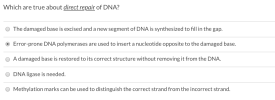 Which are true about direct repair of DNA? O The damaged base is excised and a new segment of DNA is synthesized to fill in the gap. Error-prone DNA polymerases are used to insert a nucleotide opposite to the damaged base. O A damaged base is restored to its correct structure without removing it from the DNA. O DNA ligase is needed. O Methylation marks can be used to distinguish the correct strand from the incorrect strand.
Identify the various types of DNA repair mechanisms known to counteract the effects of UV radiation....
 Identify the various types of DNA repair mechanisms known to counteract the effects of UV radiation. Recombinational repair Excision repair Photoactivation repair SOS repair 1. is dependent on a photon-activated enzyme that cleaves thymine dimers. 2. is the process by which an endonuclease clips out UV- induced dimers, DNA polymerase III fills in the gap, and DNA ligase rejoins the phosphodiester backbone. 3. uses the corresponding region on the undamaged parental strand of the same polarity. 4. is a process...
1. In eukaryotes, which DNA polymerase is primarily responsible for filling in the gaps in the...
1. In eukaryotes, which DNA polymerase is primarily responsible for filling in the gaps in the DNA generated during base excision repair? DNA polymerase α DNA polymerase β DNA polymerase γ DNA polymerase ö DNA polymerase μ 2. High energy electromagnetic radiation includes which of the following? ultraviolet light x-rays gamma rays two of the above all three of the above 3. Which of the following types of damage to DNA cannot be caused by x-rays and gamma rays? deletions...
Choose the repair mechanism that is best associated with the statement. Some statements may have more...
Choose the repair mechanism that is best associated with the statement. Some statements may have more than one answer. a. nucleotide excision repair b. mismatch repair c. translesion synthesis d. recombinational repair e. base excision repair _____ 1. Uses an enzyme called the DNA-N-glycosylases. _____ 2. Utilizes a group of proteins called Mut. _____ 3. The disease Xeroderma pigmentosum is caused by a defect in this system. _____ 4. This is associated with the SOS response in bacteria. _____ 5....
Prokaryotic mRNA usually encodes for more than one protein while eukaryotic mRNA a single protein. Eukaryotic...
 Prokaryotic mRNA usually encodes for more than one protein while eukaryotic mRNA a single protein. Eukaryotic DNA is linear and bacterial and archaeal DNA is-linear. In prokaryotes, ribosomes attach to the mRNA and start protein synthesis even before transcription is completed. Eukaryotic mRNA, rRNA, and tRNA are all highway processed. Nuclear pore complexes control the entry and exit to and from the nucleus. They will not let mRNA exit the nucleus before it is full processed. Eukaryotic and archaeal DNA...
The nonprotein portion required by complex enzymes for proper functioning called a(en) _________. zymogen substrate inhibitor...
 The nonprotein portion required by complex enzymes for proper functioning called a(en) _________. zymogen substrate inhibitor cofactor activator Which of the following are required to form a DNA nucleotide? ribose and phosphate deoxyribose and phosphate ribose, phosphate, and a base deoxyribose and a base deoxyribose phosphate, and a base How many hydrogen bonds link the following two strands of DNA 2 3 8 14 16 Which of the following enzymes is NOT involved in replication? DNA polymerase DNA ligase peptidyl...
1.Which of the following DNA repair systems involving DNA N-glycosylasesrecognizes an abnormal DNA nucleotide (i.e. uracil)...
1.Which of the following DNA repair systems involving DNA N-glycosylasesrecognizes an abnormal DNA nucleotide (i.e. uracil) and cleaves the bond between it and the sugar? - Mismatch repair -Base excision repair -Non-homologous end-joining repair -Homologous recombination repair 2. self-splicing is the most common mechanism for splicing mRNA transcribed from eukaryotic, nuclear, structural genes - true or false 3. True or False, during elongation of transcription, RNA polymerase is primarily in a closed complex
A segment of DNA is replicated. If the original segment reads S'-CGATTC-3', the new segment will...
 A segment of DNA is replicated. If the original segment reads S'-CGATTC-3', the new segment will read During the cloning of a gene.. a) genes are cut with restriction enzymes, and inserted into bacterial plasmids. b) holes are created in the bacterial cells. c) colour markers or antibiotic resistance genes are attached to the gene. d) b, and c only Restriction enzymes a) cut DNA at specific base sequences. c) punch holes in the bacterial cell membrane. b) proof-read DNA...
 Question 5 1 pts Non-homologous end joining is "error prone" because There is no template used during repair The DNA polymerase invovled adds incorrect bases ODNA ends are often trimmed before repair Damaged bases are incorrectly paired during repair Question 6 1 pts Global genomic and transcription coupled are the two sub-types of nucleotide excision repair. Select true statements relevant to these processes Both can detect damage involving multiple damaged bases Both involve proteins that recognize the damaged bases Both...
 Which are true about direct repair of DNA? O The damaged base is excised and a new segment of DNA is synthesized to fill in the gap. Error-prone DNA polymerases are used to insert a nucleotide opposite to the damaged base. O A damaged base is restored to its correct structure without removing it from the DNA. O DNA ligase is needed. O Methylation marks can be used to distinguish the correct strand from the incorrect strand.
 Identify the various types of DNA repair mechanisms known to counteract the effects of UV radiation. Recombinational repair Excision repair Photoactivation repair SOS repair 1. is dependent on a photon-activated enzyme that cleaves thymine dimers. 2. is the process by which an endonuclease clips out UV- induced dimers, DNA polymerase III fills in the gap, and DNA ligase rejoins the phosphodiester backbone. 3. uses the corresponding region on the undamaged parental strand of the same polarity. 4. is a process...
 Prokaryotic mRNA usually encodes for more than one protein while eukaryotic mRNA a single protein. Eukaryotic DNA is linear and bacterial and archaeal DNA is-linear. In prokaryotes, ribosomes attach to the mRNA and start protein synthesis even before transcription is completed. Eukaryotic mRNA, rRNA, and tRNA are all highway processed. Nuclear pore complexes control the entry and exit to and from the nucleus. They will not let mRNA exit the nucleus before it is full processed. Eukaryotic and archaeal DNA...
 The nonprotein portion required by complex enzymes for proper functioning called a(en) _________. zymogen substrate inhibitor cofactor activator Which of the following are required to form a DNA nucleotide? ribose and phosphate deoxyribose and phosphate ribose, phosphate, and a base deoxyribose and a base deoxyribose phosphate, and a base How many hydrogen bonds link the following two strands of DNA 2 3 8 14 16 Which of the following enzymes is NOT involved in replication? DNA polymerase DNA ligase peptidyl...
 A segment of DNA is replicated. If the original segment reads S'-CGATTC-3', the new segment will read During the cloning of a gene.. a) genes are cut with restriction enzymes, and inserted into bacterial plasmids. b) holes are created in the bacterial cells. c) colour markers or antibiotic resistance genes are attached to the gene. d) b, and c only Restriction enzymes a) cut DNA at specific base sequences. c) punch holes in the bacterial cell membrane. b) proof-read DNA...
Most questions answered within 3 hours.
-
Where is the error in this code sequence?
String s1 = "Hello";
String s2 = "ello";...
asked 11 months ago -
Financial data for Joel de Paris, Inc., for last year
follow:
Joel de Paris, Inc.
Balance...
asked 11 months ago -
Consider this reaction:
Al2(SO4)3 (aq)+ BaCl3
(aq) Al2Cl6 (aq)- +
3BaSO4(s) . What is the...
asked 11 months ago -
Suppose that Savneet is considering increasing her
recent random sample from 20 car rentals to 40...
asked 11 months ago -
Trucks arrive at an unloading terminal at an average rate of 120
per hour.
Trucks arrive...
asked 11 months ago -
Why are methanol and ethanol completely soluble in water while
octanol is not very little soluble....
asked 11 months ago -
A facilities manager at a university reads in a research report
that the mean amount of...
asked 11 months ago -
When the CuSO4 is rehydrated by adding water to the anhydrous
compound, is this an endothermic...
asked 11 months ago -
A ray of sunlight is passing from diamond into crown glass; the
angle of incidence is...
asked 11 months ago -
A block of mass 0.249 kg is placed on top of a light, vertical
spring of...
asked 11 months ago -
how do the kidneys compensate in the presences of acidosis
a) trigger hyperventilate
b) reserve acid...
asked 11 months ago -
Question 501 pts
The rental rate of capital to the firm increases. Which of the
following...
asked 11 months ago