Explain why slow addition of bromobutane and 2 methylpropanal is used in the formation of the...
Explain why slow addition of bromobutane and 2 methylpropanal is used in the formation of the grignard reagent and alcohol?
Homework Answers

Add Answer to:
Explain why slow addition of bromobutane and 2 methylpropanal is
used in the formation of the...
What is the tertiary alcohol created from converting 1-bromobutane to a Grignard reagent by the reaction...
What is the tertiary alcohol created from converting 1-bromobutane to a Grignard reagent by the reaction with magnesium in diethyl ether and then adding this to 2-butanone.
Please only answer 3 P Grignard 1. During the formation of the Grignard reagent, the solution...
 Please only answer 3
P
Grignard 1. During the formation of the Grignard reagent, the solution can boil without addition of external heat. Explain 2. Explain why acetone and water should be excluded from the reaction vessel during the formation of the Grignard reagent. 3. At what stage of the procedure can water be allowed to come into contact with the reaction solution? 4. Why is the dry ice crushed before use and why should you wait to crush the...
Please only answer 3
P
Grignard 1. During the formation of the Grignard reagent, the solution can boil without addition of external heat. Explain 2. Explain why acetone and water should be excluded from the reaction vessel during the formation of the Grignard reagent. 3. At what stage of the procedure can water be allowed to come into contact with the reaction solution? 4. Why is the dry ice crushed before use and why should you wait to crush the...
which alkyl halide reacts fastest with sodium iodide in acetone: 1-bromobutane, 2-bromobutane or 2-bromo-2-methylpropane? explain why
which alkyl halide reacts fastest with sodium iodide in acetone: 1-bromobutane, 2-bromobutane or 2-bromo-2-methylpropane? explain why
S RROwn as nucleophilic addition. The C-O bond is highly polarized, making carbonyl compounds ele...
 S RROwn as nucleophilic addition. The C-O bond is highly polarized, making carbonyl compounds electrophilic at carbon. If the Grignard reagent reacts with an aldehyde, ketone or ester, the ultimate product is an alcohol. Overall Reaction 0 Br Me PartA Part B Pre-lab questions (15 points) Show the mechanism of the reaction of bromobenzene with magnesium metal in anhydrous diethyl ether There are many inert solvents that could be used but diethyl ether was chosen because it can assist the...
Draw the mechanism for the formation of bromobutane from butane and br2. what is the major...
Draw the mechanism for the formation of bromobutane from butane and br2. what is the major product? would your answer change if cl2 was used instead? which step of the radical reaction typically requires the most energy? why are peroxides and halogens good radical initiators?
Why is it unwise to begin addition of the solution of carbonyl compound to the Grignard...
Why is it unwise to begin addition of the solution of carbonyl compound to the Grignard reagent before the latter has cooled to room temperature?
-Compare rates of S2 and SN1 product formation for 5 halides (1-chlorobutane, 1- bromobutane, 2-bromobutane, 2-chloro-2-methylpropane,...
 -Compare rates of S2 and SN1 product formation for 5 halides (1-chlorobutane, 1- bromobutane, 2-bromobutane, 2-chloro-2-methylpropane, and chlorobenzene) -Arrange 5 compounds in order of decreasing reactivity toward (a) Nal in acetone, and (b) AgNO3 in ethanol reagents. [Use structural formula for halides]
In the dehydrohalogenation of 2-bromobutane, which conformation below leads directly to the formation of trans-2-butene...
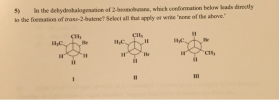 In the dehydrohalogenation of 2-bromobutane, which
conformation below leads directly to the formation of
trans-2-butene? Select all that apply or write ‘none of the
above.’
5) In the dehydrohalogenation of 2-bromobutane, which conformation below leads directly to the formation of trans-2-butene? Select all that apply or write 'none of the above.' н H5C CH, Br CH, нсти HỌC н НЕ? Br сн, 2
In the dehydrohalogenation of 2-bromobutane, which
conformation below leads directly to the formation of
trans-2-butene? Select all that apply or write ‘none of the
above.’
5) In the dehydrohalogenation of 2-bromobutane, which conformation below leads directly to the formation of trans-2-butene? Select all that apply or write 'none of the above.' н H5C CH, Br CH, нсти HỌC н НЕ? Br сн, 2
Question 17 (1 point) Ethers can be prepared from alcohols by? O a reductive addition. O...
 Question 17 (1 point) Ethers can be prepared from alcohols by? O a reductive addition. O an oxidative addition. O a nucleophilic substitution. O an electrophilic addition. O a condensation. Question 15 (1 point) Which reaction cannot be used to prepare an alcohol? addition of H30+ to an alkene. O an Organocuprate with an alkyl halide O a Grignard reagent with an aldehyde. O a Grignard with an ester Oa Grignard with a ketone Question 16 (1 point) Fischer esterification...
Could you help with #2,4,3,6, please 1. Define the term "Nucleophile" and explain how a Grignard...
 Could you help with #2,4,3,6, please
1. Define the term "Nucleophile" and explain how a Grignard reagent acts as a nucleophile. Briefly explain using a chemical equation, why it is necessary to use dry apparatus and reagents during the synthesis of C6H5MgBr. phenylmagnesium bromide. 3. By referring to a textbook, write a mechanism for the reaction between phenylmagnesium bromide and the ketone butanone. In a reaction of phenylmagnesium bromide with butanone the Grignard reagent was prepared from 25 g of...
Could you help with #2,4,3,6, please
1. Define the term "Nucleophile" and explain how a Grignard reagent acts as a nucleophile. Briefly explain using a chemical equation, why it is necessary to use dry apparatus and reagents during the synthesis of C6H5MgBr. phenylmagnesium bromide. 3. By referring to a textbook, write a mechanism for the reaction between phenylmagnesium bromide and the ketone butanone. In a reaction of phenylmagnesium bromide with butanone the Grignard reagent was prepared from 25 g of...
 Please only answer 3
P
Grignard 1. During the formation of the Grignard reagent, the solution can boil without addition of external heat. Explain 2. Explain why acetone and water should be excluded from the reaction vessel during the formation of the Grignard reagent. 3. At what stage of the procedure can water be allowed to come into contact with the reaction solution? 4. Why is the dry ice crushed before use and why should you wait to crush the...
Please only answer 3
P
Grignard 1. During the formation of the Grignard reagent, the solution can boil without addition of external heat. Explain 2. Explain why acetone and water should be excluded from the reaction vessel during the formation of the Grignard reagent. 3. At what stage of the procedure can water be allowed to come into contact with the reaction solution? 4. Why is the dry ice crushed before use and why should you wait to crush the...
 S RROwn as nucleophilic addition. The C-O bond is highly polarized, making carbonyl compounds electrophilic at carbon. If the Grignard reagent reacts with an aldehyde, ketone or ester, the ultimate product is an alcohol. Overall Reaction 0 Br Me PartA Part B Pre-lab questions (15 points) Show the mechanism of the reaction of bromobenzene with magnesium metal in anhydrous diethyl ether There are many inert solvents that could be used but diethyl ether was chosen because it can assist the...
 -Compare rates of S2 and SN1 product formation for 5 halides (1-chlorobutane, 1- bromobutane, 2-bromobutane, 2-chloro-2-methylpropane, and chlorobenzene) -Arrange 5 compounds in order of decreasing reactivity toward (a) Nal in acetone, and (b) AgNO3 in ethanol reagents. [Use structural formula for halides]
 In the dehydrohalogenation of 2-bromobutane, which
conformation below leads directly to the formation of
trans-2-butene? Select all that apply or write ‘none of the
above.’
5) In the dehydrohalogenation of 2-bromobutane, which conformation below leads directly to the formation of trans-2-butene? Select all that apply or write 'none of the above.' н H5C CH, Br CH, нсти HỌC н НЕ? Br сн, 2
In the dehydrohalogenation of 2-bromobutane, which
conformation below leads directly to the formation of
trans-2-butene? Select all that apply or write ‘none of the
above.’
5) In the dehydrohalogenation of 2-bromobutane, which conformation below leads directly to the formation of trans-2-butene? Select all that apply or write 'none of the above.' н H5C CH, Br CH, нсти HỌC н НЕ? Br сн, 2
 Question 17 (1 point) Ethers can be prepared from alcohols by? O a reductive addition. O an oxidative addition. O a nucleophilic substitution. O an electrophilic addition. O a condensation. Question 15 (1 point) Which reaction cannot be used to prepare an alcohol? addition of H30+ to an alkene. O an Organocuprate with an alkyl halide O a Grignard reagent with an aldehyde. O a Grignard with an ester Oa Grignard with a ketone Question 16 (1 point) Fischer esterification...
 Could you help with #2,4,3,6, please
1. Define the term "Nucleophile" and explain how a Grignard reagent acts as a nucleophile. Briefly explain using a chemical equation, why it is necessary to use dry apparatus and reagents during the synthesis of C6H5MgBr. phenylmagnesium bromide. 3. By referring to a textbook, write a mechanism for the reaction between phenylmagnesium bromide and the ketone butanone. In a reaction of phenylmagnesium bromide with butanone the Grignard reagent was prepared from 25 g of...
Could you help with #2,4,3,6, please
1. Define the term "Nucleophile" and explain how a Grignard reagent acts as a nucleophile. Briefly explain using a chemical equation, why it is necessary to use dry apparatus and reagents during the synthesis of C6H5MgBr. phenylmagnesium bromide. 3. By referring to a textbook, write a mechanism for the reaction between phenylmagnesium bromide and the ketone butanone. In a reaction of phenylmagnesium bromide with butanone the Grignard reagent was prepared from 25 g of...
Most questions answered within 3 hours.
-
Where is the error in this code sequence?
String s1 = "Hello";
String s2 = "ello";...
asked 10 months ago -
Financial data for Joel de Paris, Inc., for last year
follow:
Joel de Paris, Inc.
Balance...
asked 10 months ago -
Consider this reaction:
Al2(SO4)3 (aq)+ BaCl3
(aq) Al2Cl6 (aq)- +
3BaSO4(s) . What is the...
asked 10 months ago -
Suppose that Savneet is considering increasing her
recent random sample from 20 car rentals to 40...
asked 10 months ago -
Trucks arrive at an unloading terminal at an average rate of 120
per hour.
Trucks arrive...
asked 10 months ago -
Why are methanol and ethanol completely soluble in water while
octanol is not very little soluble....
asked 10 months ago -
A facilities manager at a university reads in a research report
that the mean amount of...
asked 10 months ago -
When the CuSO4 is rehydrated by adding water to the anhydrous
compound, is this an endothermic...
asked 10 months ago -
A ray of sunlight is passing from diamond into crown glass; the
angle of incidence is...
asked 10 months ago -
A block of mass 0.249 kg is placed on top of a light, vertical
spring of...
asked 10 months ago -
how do the kidneys compensate in the presences of acidosis
a) trigger hyperventilate
b) reserve acid...
asked 10 months ago -
Question 501 pts
The rental rate of capital to the firm increases. Which of the
following...
asked 10 months ago