how does mendel's monohybrid experiment support law of segregation
how does mendel's monohybrid experiment support law of segregation
Homework Answers
Mendel's monohybrid experiment support law of segregation by-
Let's understand by this
We are taking pea plant with dominant tall pea plant with gene T and small pea plant gene is t.
Now allele of tall plant- TT it is dominant
Allele of short plant-tt
Now if we cross both the parent plants
TT× tt
Gametes formed by TT will be T ,T
Gametes formed by tt will be t and t
Law of segregation supports that allele pairs separate during the formation of gametes .
Now parent TT will segregate into its individual gene that is T.
TT× tt
Tt- F1 progeny
Now if we cross Tt× Tt
Gametes of Tt are T and t.
So this how it explains law of segregation.
If you like my answer please upvote
Recall Mendel's law of segregation for autosomal alleles D and d and consider the behavior of...
Recall Mendel's law of segregation for autosomal alleles D and d and consider the behavior of homologous chromosomes in meiosis. During which stage of M phase do these two alleles segregate from one another? (Assume no crossovers between homologs.) - prophase I - anaphase I - metaphase I - telephase I
Question 24 (2 points) Mendel's law of segregation can be explained by a specific event that...
 Question 24 (2 points) Mendel's law of segregation can be explained by a specific event that occurs during meiosis. That event is V 1) homologous chromosomes synapse and cross over during Prophase 2) independent assortment of homologous chromosomes at Metaphase I 3) random fertilization 4) sister chromatids separate during Anaphase II 5) homologous chromosomes separate during Anaphasel
How does a monohybrid cross demonstrate the principle of segregation? A. Crossing two F1 individuals produced...
How does a monohybrid cross demonstrate the principle of segregation? A. Crossing two F1 individuals produced F2 offspring that all had the same phenotype as the F1 parents b Crossing two F1 individuals produced some F2 offspring with phenotypes seen only in the P generation c Crossing two F1 individuals produced F2 offspring in the same ratio as the parent generation d Crossing two F1 individuals produced some F2 offspring with new phenotypes not seen in any generation
2. Mendel's Principle of Segregation (In the formation of gametes, the paired hereditary determinants (genes) separate...
 2. Mendel's Principle of Segregation (In the formation of gametes, the paired hereditary determinants (genes) separate (segregate) in such a way that each gamete is equally likely to contain either member of a pair) was later supported by microscopic studies of chromosome movement during meiosis. Which of the following symbolic representations best depicts the Principle of Segregation? A. AaBb cells ---------→ roughly 50% Aa gametes and 50% Bb gametes B. Aa cells ------------→ 100% Aa gametes C. AaBb cells -------->...
What stages of meiosis does the law of segregation and the law of independent assortment occur?
What stages of meiosis does the law of segregation and the law of independent assortment occur?
explain the Chromosome Theory of Inheritance. Explain how Mendal’s law of segregation and law of independent...
explain the Chromosome Theory of Inheritance. Explain how Mendal’s law of segregation and law of independent assortment relate to the above theory. How does crossing over disrupt these laws? Please use the term “linkage group” in your answer and explain how that term relates to all of the above (In own words)
How do key events of meiosis explain Mendel’s law of segregation and independent assortment? How did...
How do key events of meiosis explain Mendel’s law of segregation and independent assortment? How did T.H Morgan’s drosophila experiment validate chromosome theory of inheritance? How did analysis of nondisjunction validate the chromosome theory of inheritance?
Please explain the Chromosome Theory of Inheritance. Explain how Mendal’s law of segregation and law of...
Please explain the Chromosome Theory of Inheritance. Explain how Mendal’s law of segregation and law of independent assortment relate to the above theory. How does crossing over disrupt these laws? Please use the term “linkage group” in your answer and explain how that term relates to all of the above. (500 word minimum).
Define Mendel's law of independent assortment. A) The expression of one gene has no effect on...
Define Mendel's law of independent assortment. A) The expression of one gene has no effect on the expression of another gene. B) Segregation of homologous chromosomes is random. C) The inheritance of one character has no effect on the inheritance of another character. D) There are two versions of each trait, a dominant and a recessive; the one you get is random.
Question 1 2 pts Mendel's monohybrid crosses demonstrate that O Genes are stored in chromosomes O...
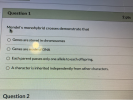 Question 1 2 pts Mendel's monohybrid crosses demonstrate that O Genes are stored in chromosomes O Genes are made of DNA O Each parent passes only one allele to each offspring. O A character is inherited independently from other characters. Question 2
 Question 24 (2 points) Mendel's law of segregation can be explained by a specific event that occurs during meiosis. That event is V 1) homologous chromosomes synapse and cross over during Prophase 2) independent assortment of homologous chromosomes at Metaphase I 3) random fertilization 4) sister chromatids separate during Anaphase II 5) homologous chromosomes separate during Anaphasel
 2. Mendel's Principle of Segregation (In the formation of gametes, the paired hereditary determinants (genes) separate (segregate) in such a way that each gamete is equally likely to contain either member of a pair) was later supported by microscopic studies of chromosome movement during meiosis. Which of the following symbolic representations best depicts the Principle of Segregation? A. AaBb cells ---------→ roughly 50% Aa gametes and 50% Bb gametes B. Aa cells ------------→ 100% Aa gametes C. AaBb cells -------->...
 Question 1 2 pts Mendel's monohybrid crosses demonstrate that O Genes are stored in chromosomes O Genes are made of DNA O Each parent passes only one allele to each offspring. O A character is inherited independently from other characters. Question 2
Most questions answered within 3 hours.
-
Where is the error in this code sequence?
String s1 = "Hello";
String s2 = "ello";...
asked 10 months ago -
Financial data for Joel de Paris, Inc., for last year
follow:
Joel de Paris, Inc.
Balance...
asked 10 months ago -
Consider this reaction:
Al2(SO4)3 (aq)+ BaCl3
(aq) Al2Cl6 (aq)- +
3BaSO4(s) . What is the...
asked 10 months ago -
Suppose that Savneet is considering increasing her
recent random sample from 20 car rentals to 40...
asked 10 months ago -
Trucks arrive at an unloading terminal at an average rate of 120
per hour.
Trucks arrive...
asked 10 months ago -
Why are methanol and ethanol completely soluble in water while
octanol is not very little soluble....
asked 10 months ago -
A facilities manager at a university reads in a research report
that the mean amount of...
asked 10 months ago -
When the CuSO4 is rehydrated by adding water to the anhydrous
compound, is this an endothermic...
asked 10 months ago -
A ray of sunlight is passing from diamond into crown glass; the
angle of incidence is...
asked 10 months ago -
A block of mass 0.249 kg is placed on top of a light, vertical
spring of...
asked 10 months ago -
how do the kidneys compensate in the presences of acidosis
a) trigger hyperventilate
b) reserve acid...
asked 10 months ago -
Question 501 pts
The rental rate of capital to the firm increases. Which of the
following...
asked 10 months ago