A room is gaining 842 W of heat that needs to be removed by an air-conditioning...
A room is gaining 842 W of heat that needs to be removed by an air-conditioning system. Cold supply air is blown into the room and warmer return air is removed. What volumetric flow rate (in m3/s) of air is needed if the temperature difference between the supply and return air is 9 °C? Assume standard air density (1.2 kg/m3). Use specific heat of air = 1 kJ/kg-K.
Homework Answers

Add Answer to:
A room is gaining 842 W of heat that needs to be removed by an
air-conditioning...
4. Refrigeration and air conditioning is quite useful, but it is, in effect, a way to move heat f...
 4. Refrigeration and air conditioning is quite useful, but it is, in effect, a way to move heat from a low temperature to a high temperature. Is this possible, given the second law? Answer the following questions below, for R-134a (a common refrigerant), and then state whether you believe refrigeration violates the second law, and why (or why not) a. R-134a arrives to the inside of the refrigerator that you are trying to keep cooled to T- 4°C. The air...
A car air conditioning system takes air at 35 °C from the surrounding atmosphere and cools...
A car air conditioning system takes air at 35 °C from the surrounding atmosphere and cools it down to 15 °C in a heat exchanger from which heat is removed by an ideal refrigeration cycle using refrigerant 134a. The condenser pressure is 1.2 MPa and the evaporator pressure is 0.2 MPa. If the car engine can supply 2 kW of power to run the air conditioner what is the maximum mass flow rate of cold air that can be supplied
-Rome can get pretty hot in the mid-summer! Most of the air conditioning units in the Tiber campus use the working flui...
 -Rome can get pretty hot in the mid-summer! Most of the air conditioning units in the Tiber campus use the working fluid R-134a (1,1,1,2-tetrafluoroethane), which is replaces the less environmentally-friendly R-12 of years ago. a) Illustrate the following air conditioning cycle, indicating material, heat, and work flows, as well as given/known temperatures and pressures: R-134a is pressurized to 10.2 bar in an adiabatic, reversible compressor. This high-pressure, hot refrigerant is condensed outside of the building using ambient air to a...
A summer air conditioning system with recirculating air stream and BPF = 0 has a room sensible heat load of 20 kW and a room latent heat load of 2.22 kW. The required inside conditions are 22\degc and 50% RH, and the outdoor design conditions are 36\degc
A summer air conditioning system with recirculating air stream and BPF = 0 has a room sensible heat load of 20 kW and a room latent heat load of 2.22 kW. The required inside conditions are 22°C and 50% RH, and the outdoor design conditions are 36°C and 60% RH. The mass flow rate of the outside air is 15% of the mass flow rate of the supply air. Find a) RSHF b) the point s on the chart, mass...
Physics Help? We all have had the experience that a room full of people always feels...
 Physics Help? We all have had the experience that a room full
of people always feels warmer than when the room is empty...
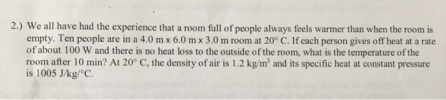
2.) We all have had the experience that a room full of people always feels warmer than when the room is empty. Ten people are in a 4.0 m x 6.0 m x 3.0 m room at 20° C. If each person gives off heat at a rate of about 100 W and there is no heat...
Physics Help? We all have had the experience that a room full
of people always feels warmer than when the room is empty...
2.) We all have had the experience that a room full of people always feels warmer than when the room is empty. Ten people are in a 4.0 m x 6.0 m x 3.0 m room at 20° C. If each person gives off heat at a rate of about 100 W and there is no heat...
A building is designed for the following cooling loads. Room specific heat gain and latent heat g...
 A building is designed for the following cooling loads. Room specific heat gain and latent heat gains are 310 kW and 100 kW respectively. The room is maintained at a dry bulb temperature of 25°C and relative humidity of 50%. The outdoor air is at 28°C with 50% relative humidity, 10% by mass of outdoor air is supplied to the building. If the air supplied to the room should be at a temperature lower than 18°C, detemine the following. (a)...
3. An air-conditioning system is shown in Fig.3, in which air flows over tubes carrying Refrigerant...
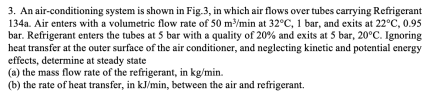 3. An air-conditioning system is shown in Fig.3, in which air flows over tubes carrying Refrigerant 134a. Air enters with a volumetric flow rate of 50 m3/min at 32°C, 1 bar, and exits at 22°C, 0.95 bar. Refrigerant enters the tubes at 5 bar with a quality of 20% and exits at 5 bar, 20°C. Ignoring heat transfer at the outer surface of the air conditioner, and neglecting kinetic and potential energy effects, determine at steady state (a) the mass...
2. The temperature of the air in a room needs to be adjusted (from room temperature...
 2. The temperature of the air in a room needs to be adjusted (from room temperature and pressure, 298 K and latm). The room is 10.0 m wide, 22.0 m deep, and 3.0 m high. The approximate constant pressure heat capacity of air is Cp 1.0 kJ/(K*kg)1. Assume the air in the room is an ideal gas. 2.1 What is the approximate mass of the air in the room? (Use molar volume and molar weight of air) 2.2 How much...
1. An air conditioning plant using refrigerant R 134a has evaporating and condensing temperatures of 0°C...
 1. An air conditioning plant using refrigerant R 134a has evaporating and condensing temperatures of 0°C and 35°C, respectively. a) Calculate the refrigerating effect for the plant. If the duty is 352 kW of refrigeration, determine the mass flow rate of refrigerant. b) c) What is the volumetric flow rate under suction conditions? d) Calculate the work done in the compression and the corresponding compressor power e) Evaluate the heat rejected and the rate of heat rejection. f) Calculate the...
Problem: The condenser in an air conditioning system is a heat exchanger in which cool air...
Problem: The condenser in an air conditioning system is a heat exchanger in which cool air absorbs latent energy from the refrigerant, condensing the refrigerant from vapor to liquid. Refrigerant R-134 enters the condenser at 1 MPa and 90°C. It leaves the condenser at 1 MPa and 30°C. Cool air enters the condenser at 100 kPa and 27°C at a volume flow rate of 10 m3/s, and it leaves at 95 kPa and 60°C. Assume the specific heat of the...
 4. Refrigeration and air conditioning is quite useful, but it is, in effect, a way to move heat from a low temperature to a high temperature. Is this possible, given the second law? Answer the following questions below, for R-134a (a common refrigerant), and then state whether you believe refrigeration violates the second law, and why (or why not) a. R-134a arrives to the inside of the refrigerator that you are trying to keep cooled to T- 4°C. The air...
 -Rome can get pretty hot in the mid-summer! Most of the air conditioning units in the Tiber campus use the working fluid R-134a (1,1,1,2-tetrafluoroethane), which is replaces the less environmentally-friendly R-12 of years ago. a) Illustrate the following air conditioning cycle, indicating material, heat, and work flows, as well as given/known temperatures and pressures: R-134a is pressurized to 10.2 bar in an adiabatic, reversible compressor. This high-pressure, hot refrigerant is condensed outside of the building using ambient air to a...
 Physics Help? We all have had the experience that a room full
of people always feels warmer than when the room is empty...
2.) We all have had the experience that a room full of people always feels warmer than when the room is empty. Ten people are in a 4.0 m x 6.0 m x 3.0 m room at 20° C. If each person gives off heat at a rate of about 100 W and there is no heat...
Physics Help? We all have had the experience that a room full
of people always feels warmer than when the room is empty...
2.) We all have had the experience that a room full of people always feels warmer than when the room is empty. Ten people are in a 4.0 m x 6.0 m x 3.0 m room at 20° C. If each person gives off heat at a rate of about 100 W and there is no heat...
 A building is designed for the following cooling loads. Room specific heat gain and latent heat gains are 310 kW and 100 kW respectively. The room is maintained at a dry bulb temperature of 25°C and relative humidity of 50%. The outdoor air is at 28°C with 50% relative humidity, 10% by mass of outdoor air is supplied to the building. If the air supplied to the room should be at a temperature lower than 18°C, detemine the following. (a)...
 3. An air-conditioning system is shown in Fig.3, in which air flows over tubes carrying Refrigerant 134a. Air enters with a volumetric flow rate of 50 m3/min at 32°C, 1 bar, and exits at 22°C, 0.95 bar. Refrigerant enters the tubes at 5 bar with a quality of 20% and exits at 5 bar, 20°C. Ignoring heat transfer at the outer surface of the air conditioner, and neglecting kinetic and potential energy effects, determine at steady state (a) the mass...
 2. The temperature of the air in a room needs to be adjusted (from room temperature and pressure, 298 K and latm). The room is 10.0 m wide, 22.0 m deep, and 3.0 m high. The approximate constant pressure heat capacity of air is Cp 1.0 kJ/(K*kg)1. Assume the air in the room is an ideal gas. 2.1 What is the approximate mass of the air in the room? (Use molar volume and molar weight of air) 2.2 How much...
 1. An air conditioning plant using refrigerant R 134a has evaporating and condensing temperatures of 0°C and 35°C, respectively. a) Calculate the refrigerating effect for the plant. If the duty is 352 kW of refrigeration, determine the mass flow rate of refrigerant. b) c) What is the volumetric flow rate under suction conditions? d) Calculate the work done in the compression and the corresponding compressor power e) Evaluate the heat rejected and the rate of heat rejection. f) Calculate the...
Most questions answered within 3 hours.
-
Where is the error in this code sequence?
String s1 = "Hello";
String s2 = "ello";...
asked 10 months ago -
Financial data for Joel de Paris, Inc., for last year
follow:
Joel de Paris, Inc.
Balance...
asked 10 months ago -
Consider this reaction:
Al2(SO4)3 (aq)+ BaCl3
(aq) Al2Cl6 (aq)- +
3BaSO4(s) . What is the...
asked 10 months ago -
Suppose that Savneet is considering increasing her
recent random sample from 20 car rentals to 40...
asked 10 months ago -
Trucks arrive at an unloading terminal at an average rate of 120
per hour.
Trucks arrive...
asked 10 months ago -
Why are methanol and ethanol completely soluble in water while
octanol is not very little soluble....
asked 10 months ago -
A facilities manager at a university reads in a research report
that the mean amount of...
asked 10 months ago -
When the CuSO4 is rehydrated by adding water to the anhydrous
compound, is this an endothermic...
asked 10 months ago -
A ray of sunlight is passing from diamond into crown glass; the
angle of incidence is...
asked 10 months ago -
A block of mass 0.249 kg is placed on top of a light, vertical
spring of...
asked 10 months ago -
how do the kidneys compensate in the presences of acidosis
a) trigger hyperventilate
b) reserve acid...
asked 10 months ago -
Question 501 pts
The rental rate of capital to the firm increases. Which of the
following...
asked 10 months ago