3) Give an order of magnitude estimate (explaining your reasoning) for the magnitude of the friction...
3) Give an order of magnitude estimate (explaining your reasoning) for the magnitude of the friction force that stops your car when you slam the brakes, based on how long it takes for the car to stop from its initial speed.
Homework Answers
Lets take initial speed of car as 25 m/s, mass of car can be assumed to be 1000kg.
Usual. time taken to stop the car is 4s.
Friction force = ma because it is only horizontal force assumed to be acting.
= m*(v/t)
= 1000*25/4
= 6250 N
so friction force for a car to stop is usually of the order 6*10^3 N
Add Answer to:
3) Give an order of magnitude estimate (explaining your
reasoning) for the magnitude of the friction...
24) How much work is performed by friction in slowing a 10kg object from 4 m/s...
 24) How much work is performed by friction in slowing a 10kg object from 4 m/s to 2 m/s? 25) To avoid an accident, you slam on your brakes, skidding for a distance of 40 m before you stop. (Your anti-lock brakes were malfunctioning!). Assuming a coefficient of kinetic friction of 0.8 between your tires and the road, how fast were you going before slamming on the brakes? 26) A 1-kg block is held below a vertically mounted spring -...
A Review Constants Periodic Table Part A You are driving your 1400 kg car at 19...
 A Review Constants Periodic Table Part A You are driving your 1400 kg car at 19 m/s down a hill with a 5.0° slope when a deer suddenly jumps out onto the roadway. You slam on your brakes, skidding to a stop. How far do you skid before stopping if the kinetic friction force between your tires and the road is 1.1x10⁴ N ? Solve this problem using conservation of energy. Express your answer with the appropriate units. μΑ 2)...
A car that weighs 1.4×10⁴ N is initially moving at a speed of 50 km/h when...
A car that weighs 1.4×10⁴ N is initially moving at a speed of 50 km/h when the brakes are applied and the car is brought to a stop in 15 m. Assuming that the force that stops the car is constant, find the magnitude of that force. Incorrect. Tries 5/20 Previous Tries Find the time required for the change in speed. Tries 0/20 If the initial speed is, instead, twice as great, and the car experiences the same force during...
3. A wooden block with mass 500g is pushed along a table to give it an...
 3. A wooden block with mass 500g is pushed along a table to give it an initial speed of 3.00 m/s. It moves down the table and comes into contact with a spring, which it compresses. The block then comes to a stop. The block moves a distance of 1.20m between when the pushing force stops and when it is stopped by the spring. The coefficient of kinetic friction between the block and table is 0.150. The spring has a...
You are driving at 30m/s and hit your breaks, skidding to a stop. The static coefficient...
You are driving at 30m/s and hit your breaks, skidding to a stop. The static coefficient of friction between your tires and the road is μs = 0.7. The mass of your car is 1500 kg. a) What is your initial kinetic energy right before you hit the breaks? b) What is the magnitude of the static friction force acting on the car? c) Does the friction do positive or negative work on the car? Explain your reasoning. d) Use...
Write your answers (with 3 significant figures) in the blanks provided. 1 A 2000 lbs car...
 Write your answers (with 3 significant figures) in the blanks provided. 1 A 2000 lbs car is driving down a 10 slope at 40 mph The coefficient of dynamic friction between the road and the tires is 1, and the driver has the brakes Full 30 points will be awarded for the correct answer to the following question: What is the car's stopping distance? If the full credit cannot be awarded, then partial credit will be awarded for the correct...
A box (350 kg) sits inside the trailer of a semitruck traveling at a speed of...
A box (350 kg) sits inside the trailer of a semitruck traveling at a speed of 15 m/s (~ 33 mph). Suddenly, a car in front of the truck stops in the road. The driver of the truck hits the brakes to bring the truck to a stop. Assume that the coefficient of static friction µs = 0.7 between the box and the floor of the trailer. Assume g = 10 m/s2. When the truck is slowing down, what is...
Part 2: Written Response Questions Your method of solution must be clearly presented and valid in...
 Part 2: Written Response Questions Your method of solution must be clearly presented and valid in order to obtain full marks each question. Remember units and setting up positive directions (unless otherwise stated in the question). 1. A student walking at a constant speed takes 21.5 minutes to walk 1600 m southwards towards a bus stop. At this instant, a bus stops and picks up the student, and drives to 3.5 km North to the college at an average speed...
2) Playing with your younger sibling's toy car (m- 32g), you notice that if you launch...
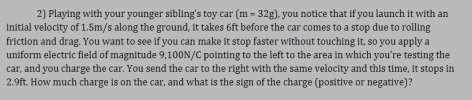 2) Playing with your younger sibling's toy car (m- 32g), you notice that if you launch it with an initial velocity of 1.5m/s along the ground, it takes 6ft before the car comes to a stop due to rolling friction and drag. You want to see if you can make it stop faster without touching it, so you apply a uniform electric field of magnitude 9,100N/C pointing to the left to the area in which you're testing the car, and...
The driver of a car of mass M which is moving along a straight road with...
The driver of a car of mass M which is moving along a straight road with initial speed v0 sees a deer in her headlights, and reacts quickly, lifting her foot of the gas and applying the brake pedal with maximum force. The anti-lock brakes cause the largest possible static friction force to be applied on the tires by the road, which continue to roll so the car does not skid. The coefficient of static friction between the tires and...
 24) How much work is performed by friction in slowing a 10kg object from 4 m/s to 2 m/s? 25) To avoid an accident, you slam on your brakes, skidding for a distance of 40 m before you stop. (Your anti-lock brakes were malfunctioning!). Assuming a coefficient of kinetic friction of 0.8 between your tires and the road, how fast were you going before slamming on the brakes? 26) A 1-kg block is held below a vertically mounted spring -...
 A Review Constants Periodic Table Part A You are driving your 1400 kg car at 19 m/s down a hill with a 5.0° slope when a deer suddenly jumps out onto the roadway. You slam on your brakes, skidding to a stop. How far do you skid before stopping if the kinetic friction force between your tires and the road is 1.1x10⁴ N ? Solve this problem using conservation of energy. Express your answer with the appropriate units. μΑ 2)...
 3. A wooden block with mass 500g is pushed along a table to give it an initial speed of 3.00 m/s. It moves down the table and comes into contact with a spring, which it compresses. The block then comes to a stop. The block moves a distance of 1.20m between when the pushing force stops and when it is stopped by the spring. The coefficient of kinetic friction between the block and table is 0.150. The spring has a...
 Write your answers (with 3 significant figures) in the blanks provided. 1 A 2000 lbs car is driving down a 10 slope at 40 mph The coefficient of dynamic friction between the road and the tires is 1, and the driver has the brakes Full 30 points will be awarded for the correct answer to the following question: What is the car's stopping distance? If the full credit cannot be awarded, then partial credit will be awarded for the correct...
 Part 2: Written Response Questions Your method of solution must be clearly presented and valid in order to obtain full marks each question. Remember units and setting up positive directions (unless otherwise stated in the question). 1. A student walking at a constant speed takes 21.5 minutes to walk 1600 m southwards towards a bus stop. At this instant, a bus stops and picks up the student, and drives to 3.5 km North to the college at an average speed...
 2) Playing with your younger sibling's toy car (m- 32g), you notice that if you launch it with an initial velocity of 1.5m/s along the ground, it takes 6ft before the car comes to a stop due to rolling friction and drag. You want to see if you can make it stop faster without touching it, so you apply a uniform electric field of magnitude 9,100N/C pointing to the left to the area in which you're testing the car, and...
Most questions answered within 3 hours.
-
Where is the error in this code sequence?
String s1 = "Hello";
String s2 = "ello";...
asked 11 months ago -
Financial data for Joel de Paris, Inc., for last year
follow:
Joel de Paris, Inc.
Balance...
asked 11 months ago -
Consider this reaction:
Al2(SO4)3 (aq)+ BaCl3
(aq) Al2Cl6 (aq)- +
3BaSO4(s) . What is the...
asked 11 months ago -
Suppose that Savneet is considering increasing her
recent random sample from 20 car rentals to 40...
asked 11 months ago -
Trucks arrive at an unloading terminal at an average rate of 120
per hour.
Trucks arrive...
asked 11 months ago -
Why are methanol and ethanol completely soluble in water while
octanol is not very little soluble....
asked 11 months ago -
A facilities manager at a university reads in a research report
that the mean amount of...
asked 11 months ago -
When the CuSO4 is rehydrated by adding water to the anhydrous
compound, is this an endothermic...
asked 11 months ago -
A ray of sunlight is passing from diamond into crown glass; the
angle of incidence is...
asked 11 months ago -
A block of mass 0.249 kg is placed on top of a light, vertical
spring of...
asked 11 months ago -
how do the kidneys compensate in the presences of acidosis
a) trigger hyperventilate
b) reserve acid...
asked 11 months ago -
Question 501 pts
The rental rate of capital to the firm increases. Which of the
following...
asked 11 months ago