Positive regulation of translation is used to control protein synthesis in chloroplasts after light stimulation. Please...
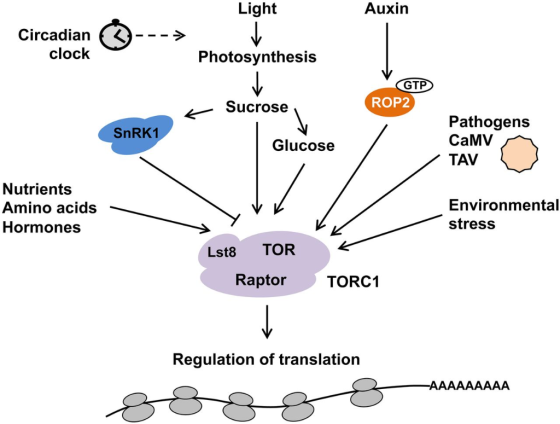
- Positive regulation of translation is used to control protein synthesis in chloroplasts after light stimulation. Please describe the translational activation of chloroplast mRNA. What is the translational activator responding to light intensity? And how does light activate this translational activator?
Homework Answers
Chloroplasts are the characteristic organelle of plant cells. They host numerous essential metabolic pathways including photosynthesis, which makes chloroplasts the primary source of chemical energy on earth. All chloroplasts are likely derived from a single ancient photosynthetic cyanobacterium that was engulfed by a mitochondrial eukaryotic cell more than a billion years ago. During subsequent host-endosymbiont coevolution, the genome of the endosymbiont shrank significantly
Chloroplast gene expression is primarily regulated at the post-transcriptional level, where a variety of complex mechanism has evolved to govern the interaction between the chloroplast and nuclear genomes. These rely on different nuclear-encoded proteins that act on chloroplast mRNAs, including RNA polymerase subunits, RNA stability factors, and translational activators. Such control mechanisms must be viewed in the light of the evolutionary heritage of the chloroplast, as an independent unicellular organism. Although some features of prokaryotic gene expression still occur in chloroplasts, their multiple genetic mechanisms for synthesizing RNA and protein are new and appear to have arisen to provide the flexibility of responding to the developmental or environmental state of the plant.
It has been shown that in both chloroplasts and mitochondria, following components of translation apparatus are found : (i) ribosomes specific to organelle, (ii) tRNAs specific to organelle, (iii) other factors for translation (little is known about these factors). Some of these components may be synthesized outside these organelles and then transported into organelles.
It has been shown that the translation apparatus in chloroplasts and mitochondria differ from that in cytoplasm in eukaryotes in the following respects, (i) Ribosomes in these organelles are smaller in size (the 70S) than those in cytoplasm (80S), (ii) The tRNAs are specific and differ, the number of tRNAs in mitochondria being 22 as against 55 in cytoplasm, (iii) Initiation of translation takes place by formyl-methionyl tRNA both in chloroplasts and mitochondria, although no formylation takes place in cytoplasm, (iv) Translation in chloroplasts and mitochondria can be inhibited by chloramphenicol, as in bacteria since the 70S ribosomes are sensitive to chloramphenicol and not to cycloheximide; on the other hand, the translation in cytoplasm is inhibited by cycloheximide, since 80S ribosomes are sensitive to cycloheximide. There are other antibiotics like spectinomycin, lincomycin, and erythromycin which also inhibit translation in bacteria and in all organelles of eukaryotes. These antibiotics help to stop the translation preferentially either (i) in the cytoplasm (by cycloheximide) thus permitting protein Synthesis only in chloroplasts or mitochondria or (ii) in organelles (by chloramphenicol) thus permitting protein synthesis only in the cytoplasm
Studies on the synthesis of 'chlorophyll-binding proteins', which play a major role in the primary reactions of photosynthesis have also provided new information about chloroplast translation and its regulation. In many plant species, in the absence of light the mRNA of chlorophyll-binding proteins, including those encoded by chloroplast genome, remain associated with thylakoid bound polysomes but are not translated. Transfer of seedlings to light induces synthesis of proteins, although no increase in transcription has been observed. This suggests that post-transcriptional processes play a key role in light-induced chloroplast gene expression.
It has also been shown that the polycistronic mRNA encoded by
the psbB operon in maize, need not be cleaved into tri-,
di- or monocistronic forms for successful translation
(psbB operon = psbB + psbH + petB +
petD). This suggests that plastid ribosomes can bind
directly to internal initiation regions for initiation of
translation as in prokaryotes. However, RNA processing does take
place in chloroplasts and mitochondria, and the transcripts may
differ in their translatability.
There are also nuclear genes, whose products are essential for the
translation of specific genes. Several of these nuclear-encoded
factors interact with the 5' untranslated region of chloroplast
massages, but little is known about the identity and precise
function of these factors. These products may be translational
activators of the type described in Regulation of Gene Expression
1. Operon Circuits in Bacteria and other Prokaryotes and Regulation
of Gene Expression 3. A Variety of Mechanisms in Eukaryotes for
prokaryotic and eukaryotic genes respectively.
Protein synthesis in isolated chloroplasts of pea was studied by R.J. Ellis of U.K. The proteins which could be synthesized in isolated chloroplasts included (i) large subunit of Fraction I protein, (ii) five unidentified proteins of the internal lamellar system, and (iii) two or three unidentified polypeptides of the envelope. These are only a few of a large number of proteins found in chloroplasts. It has also been demonstrated that while the large subunit of Fraction I protein is synthesized under the influence of chloroplast DNA the small subunit is synthesized in the cytoplasm under the influence of nuclear DNA. The small subunit is then transported to the chloroplast where it associates with large subunit to give rise to Fraction I protein
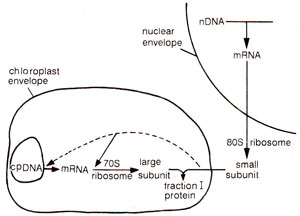
Genetic analysis has revealed a set of nuclear-encoded factors that regulate chloroplast mRNA translation by interacting with the 5' leaders of chloroplastic mRNAs. We have identified and isolated proteins that bind specifically to the 5' leader of the chloroplastic psbA mRNA, encoding the photosystem II reaction center protein D1. Binding of these proteins protects a 36 base RNA fragment containing a stem-loop located upstream of the ribosome binding site. Binding of these proteins to the psbA mRNA correlates with the level of translation of psbA mRNA observed in light- and dark-grown wild type cells and in a mutant that lacks D1 synthesis in the dark. The accumulation of at least one of these psbA mRNA-binding proteins is dependent upon chloroplast development, while its mRNA-binding activity appears to be light modulated in developed chloroplasts. These nuclear-encoded proteins are prime candidates for regulators of chloroplast protein synthesis and may play an important role in coordinating nuclear-chloroplast gene expression as well as provide a mechanism for regulating chloroplast gene expression during development in higher plants.
Add Answer to:
Positive regulation of translation is used to control protein
synthesis in chloroplasts after light stimulation. Please...
-regulation is used to describe the "turning on" of protein synthesis by cell signaling. 38. The...
 -regulation is used to describe the "turning on" of protein synthesis by cell signaling. 38. The term on a. b. up forward c. d. start 39. The three steps of protein synthesis, in the correct order from left to right, are: translation, transcription, and cell signaling. transcription, translation, and cell signaling. cell signaling, transcription, and translation. cell signaling, translation, and transcription a. b. c. d. the protein. 40. You are making a scrambled egg for breakfast. When you heat the...
1. Translation work is an essential step for protein synthesis. In order for the protein to...
1. Translation work is an essential step for protein synthesis. In order for the protein to be synthesized what must be recognized first in translation? How does this important part in translation have an effect on the rest of the reaction? Please provide a valid argument. Be as detailed as possible.
1. Describe the differences between prokaryotic and eukaryotic translation initiation. How does the ribosome find the...
1. Describe the differences between prokaryotic and eukaryotic translation initiation. How does the ribosome find the correct start codon and what proteins are involved in the process? please include the shine-dalgarno sequence in the answer. 2. Consider the following partial sequence of messenger RNA. The sequence below contains the code for a short, complete protein. 5 ́-UCCCCAGUCAUGGAGUCGUUAAUUAAAUGACCGGUGCGGAUCGUA - 3 ́ Using the codon chart (from your textbook or in the lecture slides), give the amino acid sequence of the protein...
Which of the following statements is correct concerning operon gene control? Positive control requires an activator...
 Which of the following statements is correct concerning operon gene control? Positive control requires an activator protein to stimulate transcription of the structural genes within an operon. In negative control, a repressor protein inhibits or turns off transcription of the structural genes within the operon. An inducible operon normally is not transcribed. It requires an inducer molecule to stimulate transcription either by inactivating a repressor protein in a negative inducible operon or by stimulating the activator protein in a positive...
#59) During protein synthesis, what happens to the ribosome? A) attach to the mRNA molecule and...
#59) During protein synthesis, what happens to the ribosome? A) attach to the mRNA molecule and travel along its length B) attach to the DNA molecule and travel along its length to produce an mRNA molecule C) Translate mRNA into tRNA D) Transcribe mRNA to tRNA E) Translate mRNA into DNA #60) if you digested the human genome (3 billion bp) with a 7-cutter restriction enzyme, approximately how many fragments would you get? A) 511461 B)183105 C)16384 D)88 E) None...
Regulation a) Please list two types of reversible covalent modification of proteins used for regulation b)...
 Regulation a) Please list two types of reversible covalent modification of proteins used for regulation b) How is chymotrypsin activated in the digestive system? c) Why is phosphorylation an effective means of regulating protein activity? d) What is the cascade for zymogen activation in the digestive system? e) What posttranslational modification does prothrombin undergo before it is converted to thrombin 1) What is the function of vitamin K?
Chapters 7, 8, 9 - Bacterial Growth & Metabolism (some chapter sections will be covered in...
 Chapters 7, 8, 9 - Bacterial Growth & Metabolism (some chapter sections will be covered in lab) Prerequisite: Basic catabolic pathways (respiration and fermentation) and anabolic reactions (photosynthesis) BACTERIAL GROWTH AND CONTROL- Some of these topics will be covered in greater detail during lab Environmental Growth Factors 1. Discuss the specific role of quorum sensing in biofilm formation Control of Microbial Growth 2. Describe the methods used to control microbial growth 3. List the types of antibiotics that inhibit (a)...
please answer all 6 questions Question 27 3 pts TRBP is a protein important for the...
 please answer all 6 questions
Question 27 3 pts TRBP is a protein important for the formation of the RISC complex. Which of the following would you expect in cells with null mutations in TRBP? o Reduced siRNA-mediated mRNA degradation o Increased miRNA-mediated translational repression o Increased deadenylase-mediated mRNA degradation o Reduced proteasome-mediated protein degradation D Question 28 3 pts A protein that binds to the 3' UTR of a VEGF mRNA and promotes deadenylation and uncapping is likely to:...
please answer all 6 questions
Question 27 3 pts TRBP is a protein important for the formation of the RISC complex. Which of the following would you expect in cells with null mutations in TRBP? o Reduced siRNA-mediated mRNA degradation o Increased miRNA-mediated translational repression o Increased deadenylase-mediated mRNA degradation o Reduced proteasome-mediated protein degradation D Question 28 3 pts A protein that binds to the 3' UTR of a VEGF mRNA and promotes deadenylation and uncapping is likely to:...
25. What binds to a stop codon on a mRNA during translation? a. transcription factor c....
 25. What binds to a stop codon on a mRNA during translation? a. transcription factor c. termination factor b. tRNA d. transcription initiator 26. What is typically attached to the acceptor end of a tRNA? a. a protein b. an amino acid C a ribosome d. a nucleosome 27. During mRNA processing, what is put on the 3' end of a primary mRNA transcript? a. a poly-A tail b. a cap d. an intron c. an exon 28. Which of...
Of: a) NA as the site s eukaryotic cells become more specialized, the nucleus is NOT important sy...
 PLEASE ANSWER ALL
of: a) NA as the site s eukaryotic cells become more specialized, the nucleus is NOT important synthesis. b) Changes in the regulation of genes, c) DNA mutation, d) synthesis of mRNA, e) Golgi apparatus synthesis 4. Which of the following is associated with Co-enzyme A by the membrane of the mitochondrion for use in the Krebs cycle? a) proteins, b) amino acids, c) fatty acids, d) pyruvate e) glycogen 5. Which is NOT a characteristic of...
PLEASE ANSWER ALL
of: a) NA as the site s eukaryotic cells become more specialized, the nucleus is NOT important synthesis. b) Changes in the regulation of genes, c) DNA mutation, d) synthesis of mRNA, e) Golgi apparatus synthesis 4. Which of the following is associated with Co-enzyme A by the membrane of the mitochondrion for use in the Krebs cycle? a) proteins, b) amino acids, c) fatty acids, d) pyruvate e) glycogen 5. Which is NOT a characteristic of...
 -regulation is used to describe the "turning on" of protein synthesis by cell signaling. 38. The term on a. b. up forward c. d. start 39. The three steps of protein synthesis, in the correct order from left to right, are: translation, transcription, and cell signaling. transcription, translation, and cell signaling. cell signaling, transcription, and translation. cell signaling, translation, and transcription a. b. c. d. the protein. 40. You are making a scrambled egg for breakfast. When you heat the...
 Which of the following statements is correct concerning operon gene control? Positive control requires an activator protein to stimulate transcription of the structural genes within an operon. In negative control, a repressor protein inhibits or turns off transcription of the structural genes within the operon. An inducible operon normally is not transcribed. It requires an inducer molecule to stimulate transcription either by inactivating a repressor protein in a negative inducible operon or by stimulating the activator protein in a positive...
 Regulation a) Please list two types of reversible covalent modification of proteins used for regulation b) How is chymotrypsin activated in the digestive system? c) Why is phosphorylation an effective means of regulating protein activity? d) What is the cascade for zymogen activation in the digestive system? e) What posttranslational modification does prothrombin undergo before it is converted to thrombin 1) What is the function of vitamin K?
 Chapters 7, 8, 9 - Bacterial Growth & Metabolism (some chapter sections will be covered in lab) Prerequisite: Basic catabolic pathways (respiration and fermentation) and anabolic reactions (photosynthesis) BACTERIAL GROWTH AND CONTROL- Some of these topics will be covered in greater detail during lab Environmental Growth Factors 1. Discuss the specific role of quorum sensing in biofilm formation Control of Microbial Growth 2. Describe the methods used to control microbial growth 3. List the types of antibiotics that inhibit (a)...
 please answer all 6 questions
Question 27 3 pts TRBP is a protein important for the formation of the RISC complex. Which of the following would you expect in cells with null mutations in TRBP? o Reduced siRNA-mediated mRNA degradation o Increased miRNA-mediated translational repression o Increased deadenylase-mediated mRNA degradation o Reduced proteasome-mediated protein degradation D Question 28 3 pts A protein that binds to the 3' UTR of a VEGF mRNA and promotes deadenylation and uncapping is likely to:...
please answer all 6 questions
Question 27 3 pts TRBP is a protein important for the formation of the RISC complex. Which of the following would you expect in cells with null mutations in TRBP? o Reduced siRNA-mediated mRNA degradation o Increased miRNA-mediated translational repression o Increased deadenylase-mediated mRNA degradation o Reduced proteasome-mediated protein degradation D Question 28 3 pts A protein that binds to the 3' UTR of a VEGF mRNA and promotes deadenylation and uncapping is likely to:...
 25. What binds to a stop codon on a mRNA during translation? a. transcription factor c. termination factor b. tRNA d. transcription initiator 26. What is typically attached to the acceptor end of a tRNA? a. a protein b. an amino acid C a ribosome d. a nucleosome 27. During mRNA processing, what is put on the 3' end of a primary mRNA transcript? a. a poly-A tail b. a cap d. an intron c. an exon 28. Which of...
 PLEASE ANSWER ALL
of: a) NA as the site s eukaryotic cells become more specialized, the nucleus is NOT important synthesis. b) Changes in the regulation of genes, c) DNA mutation, d) synthesis of mRNA, e) Golgi apparatus synthesis 4. Which of the following is associated with Co-enzyme A by the membrane of the mitochondrion for use in the Krebs cycle? a) proteins, b) amino acids, c) fatty acids, d) pyruvate e) glycogen 5. Which is NOT a characteristic of...
PLEASE ANSWER ALL
of: a) NA as the site s eukaryotic cells become more specialized, the nucleus is NOT important synthesis. b) Changes in the regulation of genes, c) DNA mutation, d) synthesis of mRNA, e) Golgi apparatus synthesis 4. Which of the following is associated with Co-enzyme A by the membrane of the mitochondrion for use in the Krebs cycle? a) proteins, b) amino acids, c) fatty acids, d) pyruvate e) glycogen 5. Which is NOT a characteristic of...
Most questions answered within 3 hours.
-
Where is the error in this code sequence?
String s1 = "Hello";
String s2 = "ello";...
asked 11 months ago -
Financial data for Joel de Paris, Inc., for last year
follow:
Joel de Paris, Inc.
Balance...
asked 11 months ago -
Consider this reaction:
Al2(SO4)3 (aq)+ BaCl3
(aq) Al2Cl6 (aq)- +
3BaSO4(s) . What is the...
asked 11 months ago -
Suppose that Savneet is considering increasing her
recent random sample from 20 car rentals to 40...
asked 11 months ago -
Trucks arrive at an unloading terminal at an average rate of 120
per hour.
Trucks arrive...
asked 11 months ago -
Why are methanol and ethanol completely soluble in water while
octanol is not very little soluble....
asked 11 months ago -
A facilities manager at a university reads in a research report
that the mean amount of...
asked 11 months ago -
When the CuSO4 is rehydrated by adding water to the anhydrous
compound, is this an endothermic...
asked 11 months ago -
A ray of sunlight is passing from diamond into crown glass; the
angle of incidence is...
asked 11 months ago -
A block of mass 0.249 kg is placed on top of a light, vertical
spring of...
asked 11 months ago -
how do the kidneys compensate in the presences of acidosis
a) trigger hyperventilate
b) reserve acid...
asked 11 months ago -
Question 501 pts
The rental rate of capital to the firm increases. Which of the
following...
asked 11 months ago