List four organic acids which might be produced by a bacterium during a typical fermentation tube...
List four organic acids which might be produced by a bacterium during a typical fermentation tube test?
Homework Answers
When bacteria ferment carbohydrate, an acid or acid with gas produce . Depending upon the type of bacteria and substrate being fermented , the end product may be different but some common end is always present, out of those common end products organic acid is common. Four common acid is Lactic acid ,Formic acid, Acetic acid, Butyric acid, and also butyl alcoho, acetone ethyl alcohol ect.
Production of acid decrease the ph of medium which is detected by colour change with ph-paper...
Thanks...
Add Answer to:
List four organic acids which might be produced by a
bacterium during a typical fermentation tube...
To distinguish one bacterium from another, which of the following might be useful? Testing fermentation of...
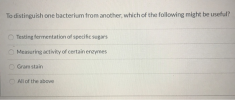 To distinguish one bacterium from another, which of the following might be useful? Testing fermentation of specific sugars Measuring activity of certain enzymes Gram stain All of the above
Which volatile fatty acids produced by microbial fermentation are ketogenic? O propionic o butyric acetic o...
 Which volatile fatty acids produced by microbial fermentation are ketogenic? O propionic o butyric acetic o lactic
What are the four possible results of a fermentation experiment and what does each indicate? What...
What are the four possible results of a fermentation experiment and what does each indicate? What does a pH indicator tell you? Which pH indicator did we use in fermentation tubes? Explain why E. coli would ferment glucose to acid/gas result while Pseudomonas does not? Why would a bacterium oxidize a molecule instead of fermenting it? If an inoculated OF tube turns yellow and DOES not have mineral oil on top – what process(es) caused the color change?
During the process of fermentation: Oxygen is required which makes the air pockets in bread There...
 During the process of fermentation: Oxygen is required which makes the air pockets in bread There can be 3 types - Lactic Acid, lactic digestion & alcoholic Some ATP is produced Carbon dioxide and nitrogen gas are produced
List the four classes of organic molecules, be able to describe them (i.e. functions/uses), recognize monomers...
List the four classes of organic molecules, be able to describe them (i.e. functions/uses), recognize monomers for carbohydrates, proteins, and nucleic acids, recognize representatives of each class
just the prelab worksheet, no data yet Lab Six: Fermentation Learning Objectives: • Explain the biochemistry...
 just the prelab worksheet, no data yet
Lab Six: Fermentation Learning Objectives: • Explain the biochemistry of fermentation, substrates and products, conditions, and purpose for cells • Describe alcoholic fermentation of yeast, naming reactants and products Perform a pre-designed experiment to measure the rate of yeast fermentation of glucose under two different conditions. Propose hypotheses and make predictions based on them. Design and perform a novel experiment to test additional substrates for yeast fermentation using findings of the pre-designed experiment....
just the prelab worksheet, no data yet
Lab Six: Fermentation Learning Objectives: • Explain the biochemistry of fermentation, substrates and products, conditions, and purpose for cells • Describe alcoholic fermentation of yeast, naming reactants and products Perform a pre-designed experiment to measure the rate of yeast fermentation of glucose under two different conditions. Propose hypotheses and make predictions based on them. Design and perform a novel experiment to test additional substrates for yeast fermentation using findings of the pre-designed experiment....
7. Which of the following reactions is involved with causing the pH to rise during a...
 7. Which of the following reactions is involved with causing the pH to rise during a biochemical test? a. Protein catabolism to amino acids b. Deamination of amino acids c. NH, + H, O NHA + OH d. All of the above 8. Which of the following statements is correct regarding the biochemical tests you will be using to identify your unknown bacteria? a. Media prepared in the laboratory is not intended to duplicate an organism's natural environment. b. Media...
You perform an experiment in which you add a synthetic mRNA to a test tube that...
You perform an experiment in which you add a synthetic mRNA to a test tube that contains all components required for translation (it was just lacking the mRNA). You find that a polypeptide consisting of 122 amino acids is produced. Then you perform another experiment, this time adding the mRNA from a mutant version of the gene and find that a polypeptide consisting of 48 amino acids was produced. What is a likely explanation for this observation? A. The mutant...
Please solve all During fatty acids synthesis, which group of the compound below is not incorporated...
 Please solve all
During fatty acids synthesis, which group of the compound below is not incorporated into fatty acid being synthesized? eC CHIC ACP d. none of the above hich of the following is not found in a glycerolphospholipid? a. phosphate group b. fatty acids c. sphingosine d. glycerol ATP is produced at which step of glycolysis? . lactate dehydrogenase o. phosphoglucoseisomerase . enolase . phosphoglycerate kinase Which of the following is contained in cytochrome c oxidase? a. cytochrome a...
Please solve all
During fatty acids synthesis, which group of the compound below is not incorporated into fatty acid being synthesized? eC CHIC ACP d. none of the above hich of the following is not found in a glycerolphospholipid? a. phosphate group b. fatty acids c. sphingosine d. glycerol ATP is produced at which step of glycolysis? . lactate dehydrogenase o. phosphoglucoseisomerase . enolase . phosphoglycerate kinase Which of the following is contained in cytochrome c oxidase? a. cytochrome a...
3. i). Write the formula of four strong acids and four strong bases. ii). List four...
 3. i). Write the formula of four strong acids and four strong bases. ii). List four factors that affect the strength of an acid. iii). Predict the relative strength of the following compounds: H2O, H2S and H2Se. iv). Which of the following is the stronger acids: CHCICOOH or CHCI-COOH? Explain. v). Al 3* is not a Bronsted acid, Al(H2O)" is. Explain. vi). All Bronsted acids are Lewis acids, but the reverse is not true. Give two examples of two Lewis...
 To distinguish one bacterium from another, which of the following might be useful? Testing fermentation of specific sugars Measuring activity of certain enzymes Gram stain All of the above
 Which volatile fatty acids produced by microbial fermentation are ketogenic? O propionic o butyric acetic o lactic
 During the process of fermentation: Oxygen is required which makes the air pockets in bread There can be 3 types - Lactic Acid, lactic digestion & alcoholic Some ATP is produced Carbon dioxide and nitrogen gas are produced
 just the prelab worksheet, no data yet
Lab Six: Fermentation Learning Objectives: • Explain the biochemistry of fermentation, substrates and products, conditions, and purpose for cells • Describe alcoholic fermentation of yeast, naming reactants and products Perform a pre-designed experiment to measure the rate of yeast fermentation of glucose under two different conditions. Propose hypotheses and make predictions based on them. Design and perform a novel experiment to test additional substrates for yeast fermentation using findings of the pre-designed experiment....
just the prelab worksheet, no data yet
Lab Six: Fermentation Learning Objectives: • Explain the biochemistry of fermentation, substrates and products, conditions, and purpose for cells • Describe alcoholic fermentation of yeast, naming reactants and products Perform a pre-designed experiment to measure the rate of yeast fermentation of glucose under two different conditions. Propose hypotheses and make predictions based on them. Design and perform a novel experiment to test additional substrates for yeast fermentation using findings of the pre-designed experiment....
 7. Which of the following reactions is involved with causing the pH to rise during a biochemical test? a. Protein catabolism to amino acids b. Deamination of amino acids c. NH, + H, O NHA + OH d. All of the above 8. Which of the following statements is correct regarding the biochemical tests you will be using to identify your unknown bacteria? a. Media prepared in the laboratory is not intended to duplicate an organism's natural environment. b. Media...
 Please solve all
During fatty acids synthesis, which group of the compound below is not incorporated into fatty acid being synthesized? eC CHIC ACP d. none of the above hich of the following is not found in a glycerolphospholipid? a. phosphate group b. fatty acids c. sphingosine d. glycerol ATP is produced at which step of glycolysis? . lactate dehydrogenase o. phosphoglucoseisomerase . enolase . phosphoglycerate kinase Which of the following is contained in cytochrome c oxidase? a. cytochrome a...
Please solve all
During fatty acids synthesis, which group of the compound below is not incorporated into fatty acid being synthesized? eC CHIC ACP d. none of the above hich of the following is not found in a glycerolphospholipid? a. phosphate group b. fatty acids c. sphingosine d. glycerol ATP is produced at which step of glycolysis? . lactate dehydrogenase o. phosphoglucoseisomerase . enolase . phosphoglycerate kinase Which of the following is contained in cytochrome c oxidase? a. cytochrome a...
 3. i). Write the formula of four strong acids and four strong bases. ii). List four factors that affect the strength of an acid. iii). Predict the relative strength of the following compounds: H2O, H2S and H2Se. iv). Which of the following is the stronger acids: CHCICOOH or CHCI-COOH? Explain. v). Al 3* is not a Bronsted acid, Al(H2O)" is. Explain. vi). All Bronsted acids are Lewis acids, but the reverse is not true. Give two examples of two Lewis...
Most questions answered within 3 hours.
-
Where is the error in this code sequence?
String s1 = "Hello";
String s2 = "ello";...
asked 10 months ago -
Financial data for Joel de Paris, Inc., for last year
follow:
Joel de Paris, Inc.
Balance...
asked 10 months ago -
Consider this reaction:
Al2(SO4)3 (aq)+ BaCl3
(aq) Al2Cl6 (aq)- +
3BaSO4(s) . What is the...
asked 10 months ago -
Suppose that Savneet is considering increasing her
recent random sample from 20 car rentals to 40...
asked 10 months ago -
Trucks arrive at an unloading terminal at an average rate of 120
per hour.
Trucks arrive...
asked 10 months ago -
Why are methanol and ethanol completely soluble in water while
octanol is not very little soluble....
asked 10 months ago -
A facilities manager at a university reads in a research report
that the mean amount of...
asked 10 months ago -
When the CuSO4 is rehydrated by adding water to the anhydrous
compound, is this an endothermic...
asked 10 months ago -
A ray of sunlight is passing from diamond into crown glass; the
angle of incidence is...
asked 10 months ago -
A block of mass 0.249 kg is placed on top of a light, vertical
spring of...
asked 10 months ago -
how do the kidneys compensate in the presences of acidosis
a) trigger hyperventilate
b) reserve acid...
asked 10 months ago -
Question 501 pts
The rental rate of capital to the firm increases. Which of the
following...
asked 10 months ago