Using Matlab: If x(n)=cos(5π n/6) and y(n)=cos(4π n/9), stem plot the sum z(n)=x(n)+y(n) over n=0:100. Write...
Using Matlab:
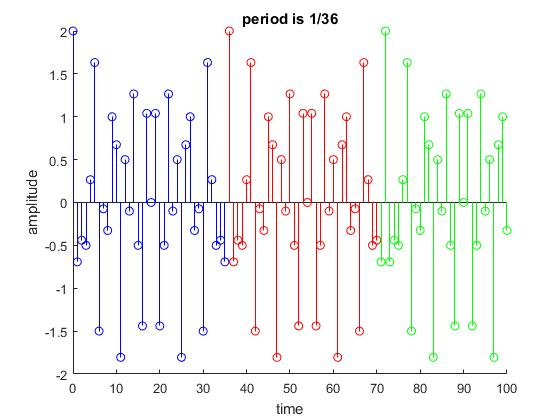
If x(n)=cos(5π n/6) and y(n)=cos(4π n/9), stem plot the sum z(n)=x(n)+y(n) over n=0:100. Write the arguments of the sinusoids as (2π n M/N). By finding the least common multiple of the denominators, determine the period of z(n). Put the period of the sum z(n) in the title of the plot. Stem plot the samples of the first period in blue, the second in red and the remainder in green in your plot.
Homework Answers
n=0:100;
x=cos(5*pi*n/6);
y=cos(4*pi*n/9);
z=x+y;
hold on
stem(0:1:35,z(1:36),'b');
stem(36:1:71,z(37:72),'r');
stem(71:1:100,z(72:101),'g');
xlabel('time');
ylabel('amplitude');
title(sprintf('period is 1/36'))
Add Answer to:
Using Matlab:
If x(n)=cos(5π n/6) and y(n)=cos(4π n/9), stem plot the sum
z(n)=x(n)+y(n) over n=0:100. Write...
Using Matlab: If x(n) = cos(5π e-n/10) over n=[-10:30] and y(m)=sin(0.03πem/20) over m=[0:40], find z =...
Using Matlab: If x(n) = cos(5π e-n/10) over n=[-10:30] and y(m)=sin(0.03πem/20) over m=[0:40], find z = x*y and its support vector k. Here * means convolution. Stem plot the results setting the axes using the command axis([-20,80,-2. .5,2.5]).
(MATLAB) In the same figure plot 7 vertically arranged DT sinusoids x k (m)=cos*2*pi*m/N, m=0,1,...6, using...
(MATLAB) In the same figure plot 7 vertically arranged DT sinusoids x k (m)=cos*2*pi*m/N, m=0,1,...6, using the function subplot(7,1,p).
MATLAB ICA 1: a) Using plot3, plot x, y and z given by the follow equations,...
 MATLAB
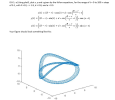
ICA 1: a) Using plot3, plot x, y and z given by the follow equations, for the range oft of 0.1, with R-10, r = 1.8, d :0.8, and a = 0.5: 0 to 200 in steps x(t) = (R-r) * cos (t) + d * cos R -r 佇r.r) . y(t) = |(R _ r) * sin(t) + d * sin (__ * t)|*cos (a * t) 2(t) = [A-r) * sin(t) + d * sin (--* t)|...
MATLAB
ICA 1: a) Using plot3, plot x, y and z given by the follow equations, for the range oft of 0.1, with R-10, r = 1.8, d :0.8, and a = 0.5: 0 to 200 in steps x(t) = (R-r) * cos (t) + d * cos R -r 佇r.r) . y(t) = |(R _ r) * sin(t) + d * sin (__ * t)|*cos (a * t) 2(t) = [A-r) * sin(t) + d * sin (--* t)|...
(USING MATLAB) Given two differential equations X= sin(t)(exp(cos(t))-2cos(4t)+sin(t/12)^5) And Y = cos(t)(exp(cos(t))-2cos(4t)+sin(t/12)^5) where 0<t<20pi is a...
(USING MATLAB) Given two differential equations X= sin(t)(exp(cos(t))-2cos(4t)+sin(t/12)^5) And Y = cos(t)(exp(cos(t))-2cos(4t)+sin(t/12)^5) where 0<t<20pi is a vector of 5000 points created by using (linspace) command : Write script to plot X and Y with red color ?
Using MATLAB, duplicate to the two graphs shown in the figure below Requirements 1. Show the MATLAB code used to plot both functions 5cos (nt-ng) (V) 5 e-"X cos (2nft-2nx/A) (V) a. y b- Use the f...
 Using MATLAB, duplicate to the two graphs shown in the figure below Requirements 1. Show the MATLAB code used to plot both functions 5cos (nt-ng) (V) 5 e-"X cos (2nft-2nx/A) (V) a. y b- Use the frequency, wavelength and attenuation shown in the figure below when plotting graph (b) 2. 3. 4. Place labels for the x and y axis showing appropriate units Extend the x-axis to 10 cm and use a sampling rate of 0.1 mm Submit the final...
solve all questions simply by using matlab. write all step here please 1Normal 1 No Spac Heading1 Heading 2 DISCUSSION Solve all tasks given below: 1. Consider function f(x) 3.5-0.5x cos(6x) for...
 solve all questions simply by using matlab.
write all step here please
1Normal 1 No Spac Heading1 Heading 2 DISCUSSION Solve all tasks given below: 1. Consider function f(x) 3.5-0.5x cos(6x) for the value of x between -2.0 until 4.0. Draw the plot in dash line and in red colour, Label the title and all axes. 2. Consider the following functions for 0sxS pi: x() 10e0.St sin(3t +2) y(t) 7e-04t cos(5t - 3) (a) Draw both graphs on the same...
solve all questions simply by using matlab.
write all step here please
1Normal 1 No Spac Heading1 Heading 2 DISCUSSION Solve all tasks given below: 1. Consider function f(x) 3.5-0.5x cos(6x) for the value of x between -2.0 until 4.0. Draw the plot in dash line and in red colour, Label the title and all axes. 2. Consider the following functions for 0sxS pi: x() 10e0.St sin(3t +2) y(t) 7e-04t cos(5t - 3) (a) Draw both graphs on the same...
Realize the system which generates the output y1(n)-1/2 [x(n)+x(-n)] and y2(n)-1/2 [x(n)-x(-n)] using matlab. By generating signals xl(n)-sin(on) and x2(n)-cos(on) for various values of o-[0,/6,...
 Realize the system which generates the output y1(n)-1/2 [x(n)+x(-n)] and y2(n)-1/2 [x(n)-x(-n)] using matlab. By generating signals xl(n)-sin(on) and x2(n)-cos(on) for various values of o-[0,/6, ,3Tt/2, 1.9T/2) obtain 3. a) Output yl(n) and y2(n) b) Critically analyze the system outputs y 1 (n) and y2(n) and find out the type of filter obtained.
Realize the system which generates the output y1(n)-1/2 [x(n)+x(-n)] and y2(n)-1/2 [x(n)-x(-n)] using matlab. By generating signals xl(n)-sin(on) and x2(n)-cos(on) for various values of o-[0,/6, ,3Tt/2, 1.9T/2)...
Realize the system which generates the output y1(n)-1/2 [x(n)+x(-n)] and y2(n)-1/2 [x(n)-x(-n)] using matlab. By generating signals xl(n)-sin(on) and x2(n)-cos(on) for various values of o-[0,/6, ,3Tt/2, 1.9T/2) obtain 3. a) Output yl(n) and y2(n) b) Critically analyze the system outputs y 1 (n) and y2(n) and find out the type of filter obtained.
Realize the system which generates the output y1(n)-1/2 [x(n)+x(-n)] and y2(n)-1/2 [x(n)-x(-n)] using matlab. By generating signals xl(n)-sin(on) and x2(n)-cos(on) for various values of o-[0,/6, ,3Tt/2, 1.9T/2)...
Please write code in MATLAB. HW12_4: Solve the system of nonlinear equations over the interval 0 st0.03 using ode45. Display the results on the same graph. Include a legend. x(0)-3, y(0)-2, z(0)-1 ax...
 Please write code in MATLAB.
HW12_4: Solve the system of nonlinear equations over the interval 0 st0.03 using ode45. Display the results on the same graph. Include a legend. x(0)-3, y(0)-2, z(0)-1 ax dt dy dz
HW12_4: Solve the system of nonlinear equations over the interval 0 st0.03 using ode45. Display the results on the same graph. Include a legend. x(0)-3, y(0)-2, z(0)-1 ax dt dy dz
Please write code in MATLAB.
HW12_4: Solve the system of nonlinear equations over the interval 0 st0.03 using ode45. Display the results on the same graph. Include a legend. x(0)-3, y(0)-2, z(0)-1 ax dt dy dz
HW12_4: Solve the system of nonlinear equations over the interval 0 st0.03 using ode45. Display the results on the same graph. Include a legend. x(0)-3, y(0)-2, z(0)-1 ax dt dy dz
 MATLAB
ICA 1: a) Using plot3, plot x, y and z given by the follow equations, for the range oft of 0.1, with R-10, r = 1.8, d :0.8, and a = 0.5: 0 to 200 in steps x(t) = (R-r) * cos (t) + d * cos R -r 佇r.r) . y(t) = |(R _ r) * sin(t) + d * sin (__ * t)|*cos (a * t) 2(t) = [A-r) * sin(t) + d * sin (--* t)|...
MATLAB
ICA 1: a) Using plot3, plot x, y and z given by the follow equations, for the range oft of 0.1, with R-10, r = 1.8, d :0.8, and a = 0.5: 0 to 200 in steps x(t) = (R-r) * cos (t) + d * cos R -r 佇r.r) . y(t) = |(R _ r) * sin(t) + d * sin (__ * t)|*cos (a * t) 2(t) = [A-r) * sin(t) + d * sin (--* t)|...
 Using MATLAB, duplicate to the two graphs shown in the figure below Requirements 1. Show the MATLAB code used to plot both functions 5cos (nt-ng) (V) 5 e-"X cos (2nft-2nx/A) (V) a. y b- Use the frequency, wavelength and attenuation shown in the figure below when plotting graph (b) 2. 3. 4. Place labels for the x and y axis showing appropriate units Extend the x-axis to 10 cm and use a sampling rate of 0.1 mm Submit the final...
 solve all questions simply by using matlab.
write all step here please
1Normal 1 No Spac Heading1 Heading 2 DISCUSSION Solve all tasks given below: 1. Consider function f(x) 3.5-0.5x cos(6x) for the value of x between -2.0 until 4.0. Draw the plot in dash line and in red colour, Label the title and all axes. 2. Consider the following functions for 0sxS pi: x() 10e0.St sin(3t +2) y(t) 7e-04t cos(5t - 3) (a) Draw both graphs on the same...
solve all questions simply by using matlab.
write all step here please
1Normal 1 No Spac Heading1 Heading 2 DISCUSSION Solve all tasks given below: 1. Consider function f(x) 3.5-0.5x cos(6x) for the value of x between -2.0 until 4.0. Draw the plot in dash line and in red colour, Label the title and all axes. 2. Consider the following functions for 0sxS pi: x() 10e0.St sin(3t +2) y(t) 7e-04t cos(5t - 3) (a) Draw both graphs on the same...
 Realize the system which generates the output y1(n)-1/2 [x(n)+x(-n)] and y2(n)-1/2 [x(n)-x(-n)] using matlab. By generating signals xl(n)-sin(on) and x2(n)-cos(on) for various values of o-[0,/6, ,3Tt/2, 1.9T/2) obtain 3. a) Output yl(n) and y2(n) b) Critically analyze the system outputs y 1 (n) and y2(n) and find out the type of filter obtained.
Realize the system which generates the output y1(n)-1/2 [x(n)+x(-n)] and y2(n)-1/2 [x(n)-x(-n)] using matlab. By generating signals xl(n)-sin(on) and x2(n)-cos(on) for various values of o-[0,/6, ,3Tt/2, 1.9T/2)...
Realize the system which generates the output y1(n)-1/2 [x(n)+x(-n)] and y2(n)-1/2 [x(n)-x(-n)] using matlab. By generating signals xl(n)-sin(on) and x2(n)-cos(on) for various values of o-[0,/6, ,3Tt/2, 1.9T/2) obtain 3. a) Output yl(n) and y2(n) b) Critically analyze the system outputs y 1 (n) and y2(n) and find out the type of filter obtained.
Realize the system which generates the output y1(n)-1/2 [x(n)+x(-n)] and y2(n)-1/2 [x(n)-x(-n)] using matlab. By generating signals xl(n)-sin(on) and x2(n)-cos(on) for various values of o-[0,/6, ,3Tt/2, 1.9T/2)...
 Please write code in MATLAB.
HW12_4: Solve the system of nonlinear equations over the interval 0 st0.03 using ode45. Display the results on the same graph. Include a legend. x(0)-3, y(0)-2, z(0)-1 ax dt dy dz
HW12_4: Solve the system of nonlinear equations over the interval 0 st0.03 using ode45. Display the results on the same graph. Include a legend. x(0)-3, y(0)-2, z(0)-1 ax dt dy dz
Please write code in MATLAB.
HW12_4: Solve the system of nonlinear equations over the interval 0 st0.03 using ode45. Display the results on the same graph. Include a legend. x(0)-3, y(0)-2, z(0)-1 ax dt dy dz
HW12_4: Solve the system of nonlinear equations over the interval 0 st0.03 using ode45. Display the results on the same graph. Include a legend. x(0)-3, y(0)-2, z(0)-1 ax dt dy dz
Most questions answered within 3 hours.
-
Where is the error in this code sequence?
String s1 = "Hello";
String s2 = "ello";...
asked 10 months ago -
Financial data for Joel de Paris, Inc., for last year
follow:
Joel de Paris, Inc.
Balance...
asked 10 months ago -
Consider this reaction:
Al2(SO4)3 (aq)+ BaCl3
(aq) Al2Cl6 (aq)- +
3BaSO4(s) . What is the...
asked 10 months ago -
Suppose that Savneet is considering increasing her
recent random sample from 20 car rentals to 40...
asked 10 months ago -
Trucks arrive at an unloading terminal at an average rate of 120
per hour.
Trucks arrive...
asked 10 months ago -
Why are methanol and ethanol completely soluble in water while
octanol is not very little soluble....
asked 10 months ago -
A facilities manager at a university reads in a research report
that the mean amount of...
asked 10 months ago -
When the CuSO4 is rehydrated by adding water to the anhydrous
compound, is this an endothermic...
asked 10 months ago -
A ray of sunlight is passing from diamond into crown glass; the
angle of incidence is...
asked 10 months ago -
A block of mass 0.249 kg is placed on top of a light, vertical
spring of...
asked 10 months ago -
how do the kidneys compensate in the presences of acidosis
a) trigger hyperventilate
b) reserve acid...
asked 10 months ago -
Question 501 pts
The rental rate of capital to the firm increases. Which of the
following...
asked 10 months ago