1) • The isoelectric pH of RuBISCO is around 6. The pH of the elution buffer...
1)
Homework Answers
structure of a protein is dependent of the pH because the chains that conform it can have different groups, these can be charged negatively or positively. The sum of all these charges is the net sum and it has an effect on the protein, in higher pH the protein is has a negative net sum leading to aggregation. On the other hand, on lower pH than the isoelectric point the protein will have a positive sum and this will lead to segregation and it can even unfold the protein, causing it to lose the tertiary structure. If this happens there is a chance for hydrophilic groups to aggregate generating a much bigger structure.
In this experiment using a buffer of pH=3 will change the profile by making the low and high molecular weights peaks less pronounced and increasing the eluting time. Because some of the protein will aggregate when losing the structure but some of it will not aggregate and most of will reaming somewhere in between, the resulting profile will be closer to an horizontal line with the peaks more to the right side than the profile with buffer pH=8.
The use of an anion exchanger means Rubisco is positively charged in pH=8 so the molecule can be attracted to the Colum. If you instead use a cation exchanger in pH=8 then the column will not have affinity for the Rubisco but if you use the buffer pH=3 then you will have affinity, because the molecule will become negatively charged.
Add Answer to:
1)
• The isoelectric pH of RuBISCO is around 6. The pH of the
elution buffer...
Let's say that an unknown protein has an isoelectric point of 7.0. a) Will this protein...
Let's say that an unknown protein has an isoelectric point of 7.0. a) Will this protein be positively or negatively charged at pH 4.0? b) Will this protein be an anion or a cation at pH 10.0? c) If you had at your disposal a cation exchange column, would you separate the protein from others in the mix on the basis of cation exchange or anion exchange? Explain. d) Would phosphate buffer (pKa 7.20), ethanolamine buffer (pKa 9.50), or citric...
21. A mixture of urease (pl = 5.1; MW 482,000), catalase (pl = 5.6; MW 247,500),...
 21. A mixture of urease (pl = 5.1; MW 482,000), catalase (pl = 5.6; MW 247,500), lactoglobulin (pl = 5.2; MW 37,100) and hemoglobin (pl = 6.9; MW 64,500) were applied in a pH 6.5 buffer to a DEAE-cellulose (anion exchanger resin) chromatography column and eluted with the same buffer. What is their order of elution? How would you elute bound proteins from this type of resin? Explain your answer. (6 pts)
(3 points) A Student uses cation exchange chromatography to separate Protein 1 pi9.5) and Protein 2...
 (3 points) A Student uses cation exchange chromatography to separate Protein 1 pi9.5) and Protein 2 pl 45). The column is equilibrated using a 20m phosphate buffer, pH 6.0 and then the sample containing Protein 1 and Protein 2 is applied to the column. After the sample is applied to the column, the column is first washed with a low salt buffer. Subsequently, the column is washed with a high salt buffer. The elution profile is shown below. Clearly indicate...
Can someone help me with this with explaination 14. You are studying a DNA damage pathway,...
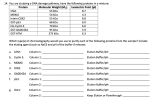 Can someone help me with this with explaination
14. You are studying a DNA damage pathway, have the following proteins in a mixture: Protein Molecular Weight (Mw) Isoelectric Point (pl) Chk1 53 kDa 8.7 MDM2 54 kDa 4.3 Intein-CDK2 55 kDa 8.8 GST-p53 68 kDa 6.0 His-Cyclin E 70 kDa 6.0 GST-GADD45A 95 kDa GST-ATM 375 kDa 6.3 5.9 Which type(s) of chromatography would you use to purify each of the following proteins from this sample? Include the eluting agent...
Can someone help me with this with explaination
14. You are studying a DNA damage pathway, have the following proteins in a mixture: Protein Molecular Weight (Mw) Isoelectric Point (pl) Chk1 53 kDa 8.7 MDM2 54 kDa 4.3 Intein-CDK2 55 kDa 8.8 GST-p53 68 kDa 6.0 His-Cyclin E 70 kDa 6.0 GST-GADD45A 95 kDa GST-ATM 375 kDa 6.3 5.9 Which type(s) of chromatography would you use to purify each of the following proteins from this sample? Include the eluting agent...
1. Draw the isoelectric glutamic acid. 2. What is the isoelectric point of the glutamic acid?...
1. Draw the isoelectric glutamic acid. 2. What is the isoelectric point of the glutamic acid? show work 3. What is the concentration of isoelectric acid in a 2.0 mM solution of glutamic acid in a pH 7.2 buffer?
please show work for both with labels and explainations this is an example of what is...
 please show work for both with labels and explainations
this is an example of what is expected
Draw the elution profile for a size exclusion column with an exclusion range of 50 kD to 500KD on which are separated. Make sure you indicate the bed and void volumes Myoglobin Hemoglobin Immunoglobulin Glutamine synthetase 17 kD -68 kD 150-200 kD 400 kD Draw the elution profile for an S sepahrose, cation exchange column pl 10.3 on which MW Cytochrome C Ribonuclease...
please show work for both with labels and explainations
this is an example of what is expected
Draw the elution profile for a size exclusion column with an exclusion range of 50 kD to 500KD on which are separated. Make sure you indicate the bed and void volumes Myoglobin Hemoglobin Immunoglobulin Glutamine synthetase 17 kD -68 kD 150-200 kD 400 kD Draw the elution profile for an S sepahrose, cation exchange column pl 10.3 on which MW Cytochrome C Ribonuclease...
please amswer as many as you can 1. Why do electrolytes conduct electricity? 2. What is...
 please amswer as many as you can
1. Why do electrolytes conduct electricity? 2. What is the name of the apparatus used to test for electrolytes? 3. How does an anion differ from a cation? 4. Name at least two physiologically important anions and state their functions in humans. 5. What is an Eq? How many mEq are in 1Liter of 0.2M Back? 6. Which pH values are acidic? Which pH values are basic? 7. Name an acidic body fluid?...
please amswer as many as you can
1. Why do electrolytes conduct electricity? 2. What is the name of the apparatus used to test for electrolytes? 3. How does an anion differ from a cation? 4. Name at least two physiologically important anions and state their functions in humans. 5. What is an Eq? How many mEq are in 1Liter of 0.2M Back? 6. Which pH values are acidic? Which pH values are basic? 7. Name an acidic body fluid?...
Interpretation of Buffer Preparation and pH measurement Hello! We did an experiment in lab creating buffers...
Interpretation of Buffer Preparation and pH measurement Hello! We did an experiment in lab creating buffers using 3 different methods, 1)weak acid + strong base, 2) wake base + strong acid, and 3)weak acid + weak base. The desired pH (and the number used to calculate concentration of components) was 7.5....Solution 1 had pH of 5.9, solution 2 had pH of 7.3 and solution 3 had pH of 7.1 I'm having trouble interpreting these results. Were these pH levels expected?...
Confused on how to answer questions E, F, and G. The answer for E is Cysteine,...
 Confused on how to answer
questions E, F, and G.
The answer for E is Cysteine,
F (i) is 2
F (ii) is 2
F (iii) is 180
Question 5. Protein X, a protein that binds tyrosine tightly, can be purified in three chromatography steps: 1) affinity chromatography using a tyrosine resin, 2) gel filtration chromatography using a resin with a separation range of 30-200 kDa, and 3) anion exchange chromatography run at pH 7.6. The elution profiles for Steps...
Confused on how to answer
questions E, F, and G.
The answer for E is Cysteine,
F (i) is 2
F (ii) is 2
F (iii) is 180
Question 5. Protein X, a protein that binds tyrosine tightly, can be purified in three chromatography steps: 1) affinity chromatography using a tyrosine resin, 2) gel filtration chromatography using a resin with a separation range of 30-200 kDa, and 3) anion exchange chromatography run at pH 7.6. The elution profiles for Steps...
Question 6 -- / 1 You wish to prepare a buffer containing CH3COOH with a pH...
 Question 6 -- / 1 You wish to prepare a buffer containing CH3COOH with a pH of 5.44. If the pka of acetic acid is 4.74, what ratio of [CH3C00-1/[CH3COOH] must you use? 0 5.0 2 1.4 3 0.70 4 1.1 © 0.20 4 of 6 completed
 21. A mixture of urease (pl = 5.1; MW 482,000), catalase (pl = 5.6; MW 247,500), lactoglobulin (pl = 5.2; MW 37,100) and hemoglobin (pl = 6.9; MW 64,500) were applied in a pH 6.5 buffer to a DEAE-cellulose (anion exchanger resin) chromatography column and eluted with the same buffer. What is their order of elution? How would you elute bound proteins from this type of resin? Explain your answer. (6 pts)
 (3 points) A Student uses cation exchange chromatography to separate Protein 1 pi9.5) and Protein 2 pl 45). The column is equilibrated using a 20m phosphate buffer, pH 6.0 and then the sample containing Protein 1 and Protein 2 is applied to the column. After the sample is applied to the column, the column is first washed with a low salt buffer. Subsequently, the column is washed with a high salt buffer. The elution profile is shown below. Clearly indicate...
 Can someone help me with this with explaination
14. You are studying a DNA damage pathway, have the following proteins in a mixture: Protein Molecular Weight (Mw) Isoelectric Point (pl) Chk1 53 kDa 8.7 MDM2 54 kDa 4.3 Intein-CDK2 55 kDa 8.8 GST-p53 68 kDa 6.0 His-Cyclin E 70 kDa 6.0 GST-GADD45A 95 kDa GST-ATM 375 kDa 6.3 5.9 Which type(s) of chromatography would you use to purify each of the following proteins from this sample? Include the eluting agent...
Can someone help me with this with explaination
14. You are studying a DNA damage pathway, have the following proteins in a mixture: Protein Molecular Weight (Mw) Isoelectric Point (pl) Chk1 53 kDa 8.7 MDM2 54 kDa 4.3 Intein-CDK2 55 kDa 8.8 GST-p53 68 kDa 6.0 His-Cyclin E 70 kDa 6.0 GST-GADD45A 95 kDa GST-ATM 375 kDa 6.3 5.9 Which type(s) of chromatography would you use to purify each of the following proteins from this sample? Include the eluting agent...
 please show work for both with labels and explainations
this is an example of what is expected
Draw the elution profile for a size exclusion column with an exclusion range of 50 kD to 500KD on which are separated. Make sure you indicate the bed and void volumes Myoglobin Hemoglobin Immunoglobulin Glutamine synthetase 17 kD -68 kD 150-200 kD 400 kD Draw the elution profile for an S sepahrose, cation exchange column pl 10.3 on which MW Cytochrome C Ribonuclease...
please show work for both with labels and explainations
this is an example of what is expected
Draw the elution profile for a size exclusion column with an exclusion range of 50 kD to 500KD on which are separated. Make sure you indicate the bed and void volumes Myoglobin Hemoglobin Immunoglobulin Glutamine synthetase 17 kD -68 kD 150-200 kD 400 kD Draw the elution profile for an S sepahrose, cation exchange column pl 10.3 on which MW Cytochrome C Ribonuclease...
 please amswer as many as you can
1. Why do electrolytes conduct electricity? 2. What is the name of the apparatus used to test for electrolytes? 3. How does an anion differ from a cation? 4. Name at least two physiologically important anions and state their functions in humans. 5. What is an Eq? How many mEq are in 1Liter of 0.2M Back? 6. Which pH values are acidic? Which pH values are basic? 7. Name an acidic body fluid?...
please amswer as many as you can
1. Why do electrolytes conduct electricity? 2. What is the name of the apparatus used to test for electrolytes? 3. How does an anion differ from a cation? 4. Name at least two physiologically important anions and state their functions in humans. 5. What is an Eq? How many mEq are in 1Liter of 0.2M Back? 6. Which pH values are acidic? Which pH values are basic? 7. Name an acidic body fluid?...
 Confused on how to answer
questions E, F, and G.
The answer for E is Cysteine,
F (i) is 2
F (ii) is 2
F (iii) is 180
Question 5. Protein X, a protein that binds tyrosine tightly, can be purified in three chromatography steps: 1) affinity chromatography using a tyrosine resin, 2) gel filtration chromatography using a resin with a separation range of 30-200 kDa, and 3) anion exchange chromatography run at pH 7.6. The elution profiles for Steps...
Confused on how to answer
questions E, F, and G.
The answer for E is Cysteine,
F (i) is 2
F (ii) is 2
F (iii) is 180
Question 5. Protein X, a protein that binds tyrosine tightly, can be purified in three chromatography steps: 1) affinity chromatography using a tyrosine resin, 2) gel filtration chromatography using a resin with a separation range of 30-200 kDa, and 3) anion exchange chromatography run at pH 7.6. The elution profiles for Steps...
 Question 6 -- / 1 You wish to prepare a buffer containing CH3COOH with a pH of 5.44. If the pka of acetic acid is 4.74, what ratio of [CH3C00-1/[CH3COOH] must you use? 0 5.0 2 1.4 3 0.70 4 1.1 © 0.20 4 of 6 completed
Most questions answered within 3 hours.
-
Where is the error in this code sequence?
String s1 = "Hello";
String s2 = "ello";...
asked 11 months ago -
Financial data for Joel de Paris, Inc., for last year
follow:
Joel de Paris, Inc.
Balance...
asked 11 months ago -
Consider this reaction:
Al2(SO4)3 (aq)+ BaCl3
(aq) Al2Cl6 (aq)- +
3BaSO4(s) . What is the...
asked 11 months ago -
Suppose that Savneet is considering increasing her
recent random sample from 20 car rentals to 40...
asked 11 months ago -
Trucks arrive at an unloading terminal at an average rate of 120
per hour.
Trucks arrive...
asked 11 months ago -
Why are methanol and ethanol completely soluble in water while
octanol is not very little soluble....
asked 11 months ago -
A facilities manager at a university reads in a research report
that the mean amount of...
asked 11 months ago -
When the CuSO4 is rehydrated by adding water to the anhydrous
compound, is this an endothermic...
asked 11 months ago -
A ray of sunlight is passing from diamond into crown glass; the
angle of incidence is...
asked 11 months ago -
A block of mass 0.249 kg is placed on top of a light, vertical
spring of...
asked 11 months ago -
how do the kidneys compensate in the presences of acidosis
a) trigger hyperventilate
b) reserve acid...
asked 11 months ago -
Question 501 pts
The rental rate of capital to the firm increases. Which of the
following...
asked 11 months ago