question from Digital Image processing
![9. Given a 8x16, 3-bit image with the following histogram [32, 32, 32, 32,0, 0,0, 0] Apply histogram equalization and obtain](http://img.homeworklib.com/images/0684cdc7-75e7-4bd6-8e51-3390b485fdbc.png?x-oss-process=image/resize,w_560)
Homework Answers
The first image represents the histogram equalization
The columns represent possible intensity level(rk),
Number of pixels of particular intensity level(rk),
rk/MN, 
Since it is a 3-bit image k=8(0 to 7)
 The rounded off values
represent the equalized intensity values.
The rounded off values
represent the equalized intensity values.
For histogram specification
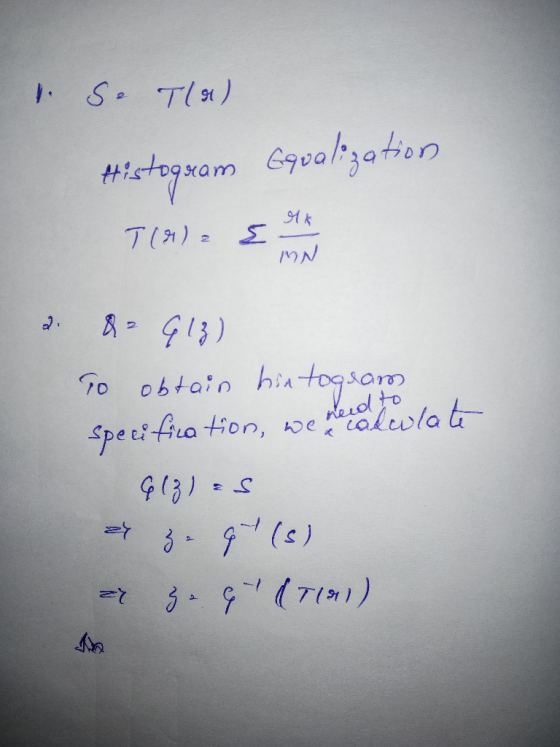
we calculate all possible intensity transformations for the expected output values for z.
The histogram specification is as follows:
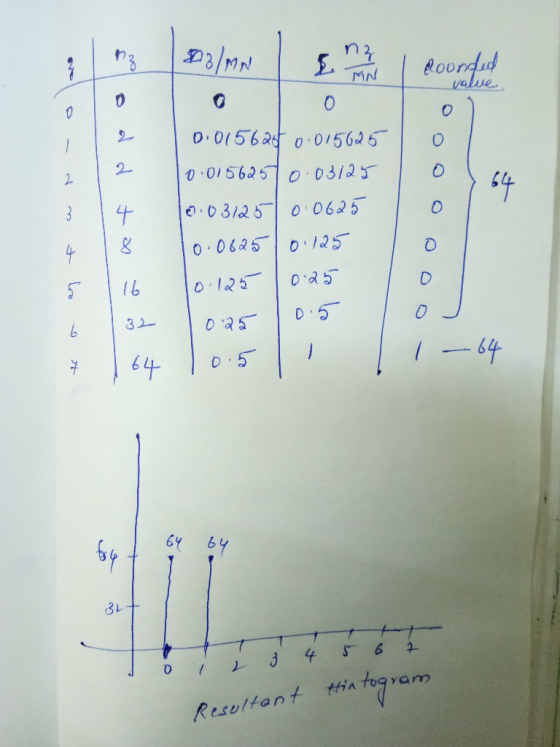
We observe that the obtained histograms are same for both the techniques.
Add Answer to:
9. Given a 8x16, 3-bit image with the following histogram [32, 32, 32, 32,0, 0,0, 0] Apply histog...
question from Digital Image processing 9. Given a 8x16, 3-bit image with the following histogram [32,...
 question from Digital Image processing
9. Given a 8x16, 3-bit image with the following histogram [32, 32, 32, 32,0, 0,0, 0] Apply histogram equalization and obtain the equalized histogram. ii) Apply histogram specification to obtain the following histogram [0, 2, 2, 4, 8, 16, 32, 64]. What is the resulting histogram? (10)
question from Digital Image processing
9. Given a 8x16, 3-bit image with the following histogram [32, 32, 32, 32,0, 0,0, 0] Apply histogram equalization and obtain the equalized histogram. ii) Apply histogram specification to obtain the following histogram [0, 2, 2, 4, 8, 16, 32, 64]. What is the resulting histogram? (10)
Question No. 2: (10) [CLO-2] a) Compute the histogram and the pdf of given 3 bit...
 Question No. 2: (10) [CLO-2] a) Compute the histogram and the pdf of given 3 bit image (shown in figure 2) b) Generate equalized image by using global histogram equalization processing. c) Draw the histogram of original image and processed image. d) What is the difference between histogram equalization and histogram matching. 2 3 3 5 7 5 4 3 1 6 1 5 2 4 7 2 3 6 4 1 6 5 3 2 4
Download image ‘city.tif’ from the Google drive. We are going to use histogram processing to improve...
 Download image ‘city.tif’ from the Google drive. We are going to
use histogram processing to improve this image. Write a program to
do the following:
Read and show this image.
Use histogram equalization on this image and show the resulting
image in a figure (use function -
exposure.equalize_hist())
Compute the histogram of each image and plot the results
Now use adaptive histogram equalization on the original image by
using the function – exposure.equalize_adapthist()) using only the
“image” parameter. Show equalized...
Download image ‘city.tif’ from the Google drive. We are going to
use histogram processing to improve this image. Write a program to
do the following:
Read and show this image.
Use histogram equalization on this image and show the resulting
image in a figure (use function -
exposure.equalize_hist())
Compute the histogram of each image and plot the results
Now use adaptive histogram equalization on the original image by
using the function – exposure.equalize_adapthist()) using only the
“image” parameter. Show equalized...
[2096] Suppose that a 3-bit image (L-8) of size 64 x 64 pixels (MN 4096) has...
 [2096] Suppose that a 3-bit image (L-8) of size 64 x 64 pixels (MN 4096) has the intensity distribution as follows where the intensity levels are integers in the range [O, L-1]- [0, 7]: (a) Find and sketch the normalized histogram of this image pr (rR) n/MN. (b) Find the values of the histogram equalization transformation function sk (c) Find and sketch the equalized histogram ps (sk). 5. r0790 r11 1023 r2 2 1179 33901 44 203 0 0 0
Histogram matching [16pt]: Given the following two input and target images, what is the resultant image...
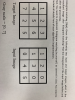 Histogram matching [16pt]: Given the following two input and target images, what is the resultant image after histogram matching? Plot the histograms of the input image before and after the processing. N.B. You need to implement histogram matching by yourself, as covered in class. You need to include all details here of your algorithm implementation Target Image Input Image Gray scale [0, 7]
Suppose that the 64-bit string A B C D E F 9 8 7 6 5...
Suppose that the 64-bit string A B C D E F 9 8 7 6 5 4 3 2 1 0 is obtained after the initial permutation in DES. Compute the 32-bit strings L1 and R1 knowing that the round key K1 is 0 1 2 3 4 5 6 7 8 9 A B.
3- for a direct mapped cache design with a 32 bit address, the following bits of address are used...
 Please answer all parts correctly and show your work
3- for a direct mapped cache design with a 32 bit address, the following bits of address are used to access the cache Tag Index Offset 31-10 9-5 4-0 Starting from power on, the following byte addressed cache reference are recorded. Address 0 16 132 232 160 1024 30 140 3100180 2180 d. How many blocks are replaced e. What is the hit ratio f. List final state of the cache,...
Please answer all parts correctly and show your work
3- for a direct mapped cache design with a 32 bit address, the following bits of address are used to access the cache Tag Index Offset 31-10 9-5 4-0 Starting from power on, the following byte addressed cache reference are recorded. Address 0 16 132 232 160 1024 30 140 3100180 2180 d. How many blocks are replaced e. What is the hit ratio f. List final state of the cache,...
9) (2 points) You are given two, 3-bit, two's complement integers A[2:0, B(2 : 0). You...
 9) (2 points) You are given two, 3-bit, two's complement integers A[2:0, B(2 : 0). You are asked to design a two's complement (signed) comparator circuit that produces f = 1 when A > B; otherwise f = 0. Design the above circuit (block diagram) assuming that you are given: i) pre-designed 3-bit unsigned comparators (f = A > B), ii) MUXes, and iii) any AND/OR/XOR/NOT Boolean logic gates.
Using the sequences of 32-bit memory read references, given as word addresses in the following table:...
Using the sequences of 32-bit memory read references, given as word addresses in the following table: 6 214 175 214 6 84 65 174 64 105 85 215 For each of these read accesses, identify the binary address, the tag, the index, and whether it experiences a hit or a miss, for each of the following cache configurations. Assume the cache is initially empty. A direct-mapped cache with 16 one-word blocks. A direct-mapped cache with two-word blocks and a total...
Consider the following two 16-bit floating-point representations 1. Format A. There is one sign b...
 Please show work, thanks.
Consider the following two 16-bit floating-point representations 1. Format A. There is one sign bit There are k 6 exponent bits. The exponent bias is 31 (011111) There are n 9 fraction/mantissa bits 2. Format B There is one sign bit There are k 5 exponent bits. The exponent bias is 15 (01111) There are n 10 fraction/mantissa bits Problem 1 (81 points total /3 points per blank) Below, you are given some bit patterns in...
Please show work, thanks.
Consider the following two 16-bit floating-point representations 1. Format A. There is one sign bit There are k 6 exponent bits. The exponent bias is 31 (011111) There are n 9 fraction/mantissa bits 2. Format B There is one sign bit There are k 5 exponent bits. The exponent bias is 15 (01111) There are n 10 fraction/mantissa bits Problem 1 (81 points total /3 points per blank) Below, you are given some bit patterns in...
 question from Digital Image processing
9. Given a 8x16, 3-bit image with the following histogram [32, 32, 32, 32,0, 0,0, 0] Apply histogram equalization and obtain the equalized histogram. ii) Apply histogram specification to obtain the following histogram [0, 2, 2, 4, 8, 16, 32, 64]. What is the resulting histogram? (10)
question from Digital Image processing
9. Given a 8x16, 3-bit image with the following histogram [32, 32, 32, 32,0, 0,0, 0] Apply histogram equalization and obtain the equalized histogram. ii) Apply histogram specification to obtain the following histogram [0, 2, 2, 4, 8, 16, 32, 64]. What is the resulting histogram? (10)
 Question No. 2: (10) [CLO-2] a) Compute the histogram and the pdf of given 3 bit image (shown in figure 2) b) Generate equalized image by using global histogram equalization processing. c) Draw the histogram of original image and processed image. d) What is the difference between histogram equalization and histogram matching. 2 3 3 5 7 5 4 3 1 6 1 5 2 4 7 2 3 6 4 1 6 5 3 2 4
 Download image ‘city.tif’ from the Google drive. We are going to
use histogram processing to improve this image. Write a program to
do the following:
Read and show this image.
Use histogram equalization on this image and show the resulting
image in a figure (use function -
exposure.equalize_hist())
Compute the histogram of each image and plot the results
Now use adaptive histogram equalization on the original image by
using the function – exposure.equalize_adapthist()) using only the
“image” parameter. Show equalized...
Download image ‘city.tif’ from the Google drive. We are going to
use histogram processing to improve this image. Write a program to
do the following:
Read and show this image.
Use histogram equalization on this image and show the resulting
image in a figure (use function -
exposure.equalize_hist())
Compute the histogram of each image and plot the results
Now use adaptive histogram equalization on the original image by
using the function – exposure.equalize_adapthist()) using only the
“image” parameter. Show equalized...
 [2096] Suppose that a 3-bit image (L-8) of size 64 x 64 pixels (MN 4096) has the intensity distribution as follows where the intensity levels are integers in the range [O, L-1]- [0, 7]: (a) Find and sketch the normalized histogram of this image pr (rR) n/MN. (b) Find the values of the histogram equalization transformation function sk (c) Find and sketch the equalized histogram ps (sk). 5. r0790 r11 1023 r2 2 1179 33901 44 203 0 0 0
 Histogram matching [16pt]: Given the following two input and target images, what is the resultant image after histogram matching? Plot the histograms of the input image before and after the processing. N.B. You need to implement histogram matching by yourself, as covered in class. You need to include all details here of your algorithm implementation Target Image Input Image Gray scale [0, 7]
 Please answer all parts correctly and show your work
3- for a direct mapped cache design with a 32 bit address, the following bits of address are used to access the cache Tag Index Offset 31-10 9-5 4-0 Starting from power on, the following byte addressed cache reference are recorded. Address 0 16 132 232 160 1024 30 140 3100180 2180 d. How many blocks are replaced e. What is the hit ratio f. List final state of the cache,...
Please answer all parts correctly and show your work
3- for a direct mapped cache design with a 32 bit address, the following bits of address are used to access the cache Tag Index Offset 31-10 9-5 4-0 Starting from power on, the following byte addressed cache reference are recorded. Address 0 16 132 232 160 1024 30 140 3100180 2180 d. How many blocks are replaced e. What is the hit ratio f. List final state of the cache,...
 9) (2 points) You are given two, 3-bit, two's complement integers A[2:0, B(2 : 0). You are asked to design a two's complement (signed) comparator circuit that produces f = 1 when A > B; otherwise f = 0. Design the above circuit (block diagram) assuming that you are given: i) pre-designed 3-bit unsigned comparators (f = A > B), ii) MUXes, and iii) any AND/OR/XOR/NOT Boolean logic gates.
 Please show work, thanks.
Consider the following two 16-bit floating-point representations 1. Format A. There is one sign bit There are k 6 exponent bits. The exponent bias is 31 (011111) There are n 9 fraction/mantissa bits 2. Format B There is one sign bit There are k 5 exponent bits. The exponent bias is 15 (01111) There are n 10 fraction/mantissa bits Problem 1 (81 points total /3 points per blank) Below, you are given some bit patterns in...
Please show work, thanks.
Consider the following two 16-bit floating-point representations 1. Format A. There is one sign bit There are k 6 exponent bits. The exponent bias is 31 (011111) There are n 9 fraction/mantissa bits 2. Format B There is one sign bit There are k 5 exponent bits. The exponent bias is 15 (01111) There are n 10 fraction/mantissa bits Problem 1 (81 points total /3 points per blank) Below, you are given some bit patterns in...
Most questions answered within 3 hours.
-
Where is the error in this code sequence?
String s1 = "Hello";
String s2 = "ello";...
asked 10 months ago -
Financial data for Joel de Paris, Inc., for last year
follow:
Joel de Paris, Inc.
Balance...
asked 10 months ago -
Consider this reaction:
Al2(SO4)3 (aq)+ BaCl3
(aq) Al2Cl6 (aq)- +
3BaSO4(s) . What is the...
asked 10 months ago -
Suppose that Savneet is considering increasing her
recent random sample from 20 car rentals to 40...
asked 10 months ago -
Trucks arrive at an unloading terminal at an average rate of 120
per hour.
Trucks arrive...
asked 10 months ago -
Why are methanol and ethanol completely soluble in water while
octanol is not very little soluble....
asked 10 months ago -
A facilities manager at a university reads in a research report
that the mean amount of...
asked 10 months ago -
When the CuSO4 is rehydrated by adding water to the anhydrous
compound, is this an endothermic...
asked 10 months ago -
A ray of sunlight is passing from diamond into crown glass; the
angle of incidence is...
asked 10 months ago -
A block of mass 0.249 kg is placed on top of a light, vertical
spring of...
asked 10 months ago -
how do the kidneys compensate in the presences of acidosis
a) trigger hyperventilate
b) reserve acid...
asked 10 months ago -
Question 501 pts
The rental rate of capital to the firm increases. Which of the
following...
asked 10 months ago