what will the initial rate be if [a] is halved and [b] is tripled?
The reaction
A+ B yields C+D
rate = k[A][B]^2
has an intial rate of 0.0220 M/s
what will the initial rate be if [A] is halved and [B] is tripled? answer must be in M/s
What will the intial rate be if [A] is tripled and [B] is
halved? answer must be in M/s
Homework Answers
General guidance
The concept used to solve this problem is based on rate law of a chemical reaction.
Rate law is an equation that establishes a link between the concentration of the reactants and the rate of the reaction.
For a chemical reaction,
The rate law is written as follow.
Here, is the concentration of reactant , is the concentration of reactant , is the rate constant of the reaction, and are the reaction orders which is an experimentally determined quantity.
Step-by-step
Step 1 of 3
Part 1
The reaction is:
The rate law for this reaction is written as:
Substitute initial rate of the reaction in rate law.
An expression for initial rate is obtained using the rate law by substituting the value of initial rate.
Step 2 of 3
Part 1
When is halved and is tripled, the new concentrations are:
and
The new rate law is written as:
Substitute, for and for in new rate law as follows:
\u2026\u2026 (1)
Since,
Substitute, for in equation (1), thus
Rate of the reaction become .
The rate of the reaction when is halved and is tripled is .
Explanation | Common mistakes | Hint for next step
When the initial concentrations of the reactants are changed by any factor, then the first step is to write the new concentrations in terms of the initial concentrations. Then, write the new rate law in terms of the initial concentrations. And then calculate the new rate law by substituting the values accordingly.
Step 3 of 3
Part 2
When is tripled and is halved, so the new concentrations are:
and
The new rate law is written as:
Substitute, for and for in new rate law as follows:
\u2026\u2026 (2)
Since,
Substitute, for in equation (2), thus
Rate of the reaction become .
The rate of the reaction when is tripled and is halved is .
When the initial concentrations of the reactants are changed by any factor, then the first step is to write the new concentrations in terms of the initial concentrations. Then, write the new rate law in terms of the initial concentrations. And then calculate the new rate law by substituting the values accordingly.
Answer
The rate of the reaction when is halved and is tripled is .
The rate of the reaction when is tripled and is halved is .
Answer only
The rate of the reaction when is halved and is tripled is .
The rate of the reaction when is tripled and is halved is .
What will the initial rate be if [A] is tripled and [B] is halved? The reaction...
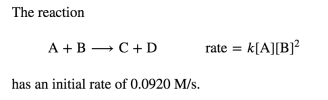 What will the initial rate be if [A] is tripled and [B] is
halved?
The reaction A + B + C +D rate k[A][B]2 has an initial rate of 0.0920 M/s.
What will the initial rate be if [A] is tripled and [B] is
halved?
The reaction A + B + C +D rate k[A][B]2 has an initial rate of 0.0920 M/s.
The reaction A+B rightarrow C+D rate=k[A][B]^2 has an initial rate of 0.0300 M/s. What will the...
 The reaction A+B rightarrow C+D rate=k[A][B]^2 has an initial rate of 0.0300 M/s. What will the initial rate be if [A] is halved and [B] is tripled? What will the initial rate be if [A] is tripled and [B] is halved?
answer all The reaction A+B +C+D rate = k[A] [B]? has an initial rate of 0.0730...
 answer all
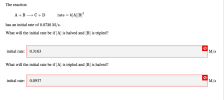
The reaction A+B +C+D rate = k[A] [B]? has an initial rate of 0.0730 M/s. What will the initial rate be if [A] is halved and (B) is tripled? initial rate: 0.3163 M What will the initial rate be if (A] is tripled and (B) is halved? initial rate: 0.0937 For the reaction 2 H2O(g) = 2H2(g) + O2(g) the equilibrium concentrations were found to be [H,O] = 0.250 M, [H] = 0.330 M, and (0,] = 0.800...
answer all
The reaction A+B +C+D rate = k[A] [B]? has an initial rate of 0.0730 M/s. What will the initial rate be if [A] is halved and (B) is tripled? initial rate: 0.3163 M What will the initial rate be if (A] is tripled and (B) is halved? initial rate: 0.0937 For the reaction 2 H2O(g) = 2H2(g) + O2(g) the equilibrium concentrations were found to be [H,O] = 0.250 M, [H] = 0.330 M, and (0,] = 0.800...
The reaction A + B -> C + D has been found to obey the following...
The reaction A + B -> C + D has been found to obey the following rate law: rate=k[A][B]2 and has an initial rate of 0.0130 M/s. What will be the rate of the reaction if [A] is tripled and [B] is halved?
2.c and 2.d 2. The rate law for the reaction A+B a. Write the rate law...
 2.c
and 2.d
2. The rate law for the reaction A+B a. Write the rate law expression. C + D is first order in [A] and second order in [B]. Rate low- k[A] [B]² b. What is the overall order of reaction? 1 +2= 3 c. How does the rate change if [A] is halved and [B] is tripled?! d. Given the data below, propose initial concentrations for A and B that would enable you to empirically determine the given...
2.c
and 2.d
2. The rate law for the reaction A+B a. Write the rate law expression. C + D is first order in [A] and second order in [B]. Rate low- k[A] [B]² b. What is the overall order of reaction? 1 +2= 3 c. How does the rate change if [A] is halved and [B] is tripled?! d. Given the data below, propose initial concentrations for A and B that would enable you to empirically determine the given...
The generic reaction A + B + C --> D has the rate law rate =...
The generic reaction A + B + C --> D has the rate law rate = k[A][B]1/2[C]. The initial rate at certain concentrations of A, B, and C is 0.0115 M/s. What is the rate if the concentration of A is halved, B is increased by 9x, and C is doubled?
Consider the following reaction: A + B + C +D The rate law for this reaction...
 Consider the following reaction: A + B + C +D The rate law for this reaction is as follows: Rate = k Alla B11/2 Suppose the rate of the reaction at certain initial concentrations of A, B, and C is 1.14x10⁻² M/s. Part A What is the rate of the reaction if the concentrations of A and C are doubled and the concentration of B is tripled? VO AED A O O ? Rate 2 = M/s Submit Request Answer
Review Constants Periodic Table Consider the following reaction: A + B + C D The rate...
 Review Constants Periodic Table Consider the following reaction: A + B + C D The rate law for this reaction is as follows: Part A Rate = k., A][C] B1/2 What is the rate of the reaction if the concentrations of A and C are doubled and the concentration of B is tripled? Suppose the rate of the reaction at certain initial concentrations of A, B, and C is 1.19x10⁻² M/s. 18 AU A O O ? Rate 2 =...
What is the rate of the reaction if the concentrations of A and C are doubled...
 What is the rate of the reaction if the
concentrations of A and C are doubled and the concentration of B is
tripled?
Exercise 14.85 13 of 32 > I Review | Constants 1 Periodic Table Consider the following reaction: A + B + C + D The rate law for this reaction is as follows: Part A Rate = k[A][C] B11/2 What is the rate of the reaction if the concentrations of A and C are doubled and the...
What is the rate of the reaction if the
concentrations of A and C are doubled and the concentration of B is
tripled?
Exercise 14.85 13 of 32 > I Review | Constants 1 Periodic Table Consider the following reaction: A + B + C + D The rate law for this reaction is as follows: Part A Rate = k[A][C] B11/2 What is the rate of the reaction if the concentrations of A and C are doubled and the...
Consider the following reaction: A+B+C→D The rate law for this reaction is as follows: Rate=k[A][C]2[B]1/2 Suppose...
Consider the following reaction: A+B+C→D The rate law for this reaction is as follows: Rate=k[A][C]2[B]1/2 Suppose the rate of the reaction at certain initial concentrations of A, B, and C is 1.19×10⁻² mol⋅L−1⋅s−1 . What is the rate of the reaction if the concentrations of A and C are doubled and the concentration of B is tripled?
 What will the initial rate be if [A] is tripled and [B] is
halved?
The reaction A + B + C +D rate k[A][B]2 has an initial rate of 0.0920 M/s.
What will the initial rate be if [A] is tripled and [B] is
halved?
The reaction A + B + C +D rate k[A][B]2 has an initial rate of 0.0920 M/s.
 The reaction A+B rightarrow C+D rate=k[A][B]^2 has an initial rate of 0.0300 M/s. What will the initial rate be if [A] is halved and [B] is tripled? What will the initial rate be if [A] is tripled and [B] is halved?
 answer all
The reaction A+B +C+D rate = k[A] [B]? has an initial rate of 0.0730 M/s. What will the initial rate be if [A] is halved and (B) is tripled? initial rate: 0.3163 M What will the initial rate be if (A] is tripled and (B) is halved? initial rate: 0.0937 For the reaction 2 H2O(g) = 2H2(g) + O2(g) the equilibrium concentrations were found to be [H,O] = 0.250 M, [H] = 0.330 M, and (0,] = 0.800...
answer all
The reaction A+B +C+D rate = k[A] [B]? has an initial rate of 0.0730 M/s. What will the initial rate be if [A] is halved and (B) is tripled? initial rate: 0.3163 M What will the initial rate be if (A] is tripled and (B) is halved? initial rate: 0.0937 For the reaction 2 H2O(g) = 2H2(g) + O2(g) the equilibrium concentrations were found to be [H,O] = 0.250 M, [H] = 0.330 M, and (0,] = 0.800...
 2.c
and 2.d
2. The rate law for the reaction A+B a. Write the rate law expression. C + D is first order in [A] and second order in [B]. Rate low- k[A] [B]² b. What is the overall order of reaction? 1 +2= 3 c. How does the rate change if [A] is halved and [B] is tripled?! d. Given the data below, propose initial concentrations for A and B that would enable you to empirically determine the given...
2.c
and 2.d
2. The rate law for the reaction A+B a. Write the rate law expression. C + D is first order in [A] and second order in [B]. Rate low- k[A] [B]² b. What is the overall order of reaction? 1 +2= 3 c. How does the rate change if [A] is halved and [B] is tripled?! d. Given the data below, propose initial concentrations for A and B that would enable you to empirically determine the given...
 Consider the following reaction: A + B + C +D The rate law for this reaction is as follows: Rate = k Alla B11/2 Suppose the rate of the reaction at certain initial concentrations of A, B, and C is 1.14x10⁻² M/s. Part A What is the rate of the reaction if the concentrations of A and C are doubled and the concentration of B is tripled? VO AED A O O ? Rate 2 = M/s Submit Request Answer
 Review Constants Periodic Table Consider the following reaction: A + B + C D The rate law for this reaction is as follows: Part A Rate = k., A][C] B1/2 What is the rate of the reaction if the concentrations of A and C are doubled and the concentration of B is tripled? Suppose the rate of the reaction at certain initial concentrations of A, B, and C is 1.19x10⁻² M/s. 18 AU A O O ? Rate 2 =...
 What is the rate of the reaction if the
concentrations of A and C are doubled and the concentration of B is
tripled?
Exercise 14.85 13 of 32 > I Review | Constants 1 Periodic Table Consider the following reaction: A + B + C + D The rate law for this reaction is as follows: Part A Rate = k[A][C] B11/2 What is the rate of the reaction if the concentrations of A and C are doubled and the...
What is the rate of the reaction if the
concentrations of A and C are doubled and the concentration of B is
tripled?
Exercise 14.85 13 of 32 > I Review | Constants 1 Periodic Table Consider the following reaction: A + B + C + D The rate law for this reaction is as follows: Part A Rate = k[A][C] B11/2 What is the rate of the reaction if the concentrations of A and C are doubled and the...
Most questions answered within 3 hours.
-
Where is the error in this code sequence?
String s1 = "Hello";
String s2 = "ello";...
asked 10 months ago -
Financial data for Joel de Paris, Inc., for last year
follow:
Joel de Paris, Inc.
Balance...
asked 10 months ago -
Consider this reaction:
Al2(SO4)3 (aq)+ BaCl3
(aq) Al2Cl6 (aq)- +
3BaSO4(s) . What is the...
asked 10 months ago -
Suppose that Savneet is considering increasing her
recent random sample from 20 car rentals to 40...
asked 10 months ago -
Trucks arrive at an unloading terminal at an average rate of 120
per hour.
Trucks arrive...
asked 10 months ago -
Why are methanol and ethanol completely soluble in water while
octanol is not very little soluble....
asked 10 months ago -
A facilities manager at a university reads in a research report
that the mean amount of...
asked 10 months ago -
When the CuSO4 is rehydrated by adding water to the anhydrous
compound, is this an endothermic...
asked 10 months ago -
A ray of sunlight is passing from diamond into crown glass; the
angle of incidence is...
asked 10 months ago -
A block of mass 0.249 kg is placed on top of a light, vertical
spring of...
asked 10 months ago -
how do the kidneys compensate in the presences of acidosis
a) trigger hyperventilate
b) reserve acid...
asked 10 months ago -
Question 501 pts
The rental rate of capital to the firm increases. Which of the
following...
asked 10 months ago